 This article was created within the "Advancing Democratic Integrity and Governance in Ukraine” project, which is implemented by Civil Network OPORA with the support of the EU. Its contents are the sole responsibility of Civil Network OPORA and do not necessarily reflect the views of the European Union.
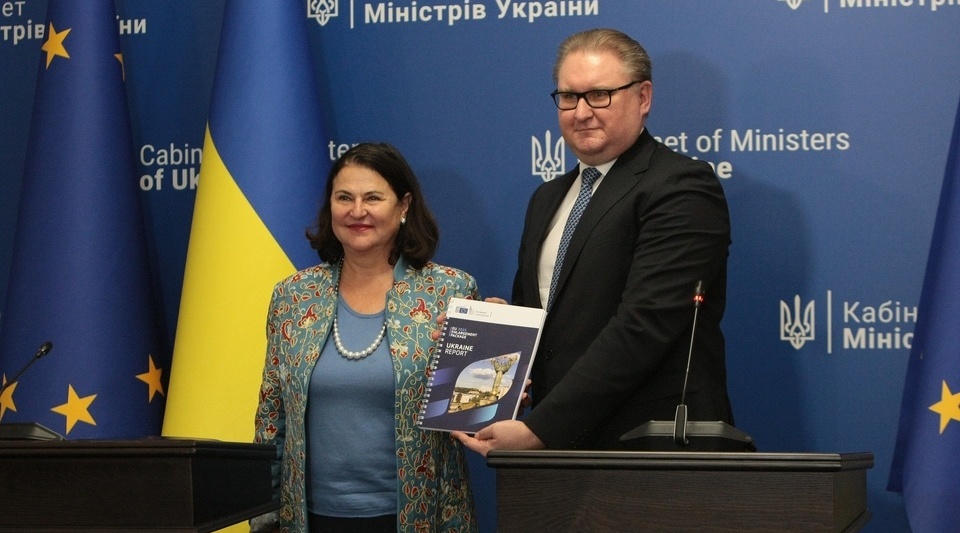
The European Commission (EC) report provides information on reforms implemented and on problems that require further resolution. Among them are issues related to electoral reform.
As the EC emphasized, the institutions responsible for European integration have already been established and are actively coordinating stakeholder participation in the screening process and the development of strategic documents related to the accession process. A team has been formed to prepare the National Program for the Adoption of the Acquis (NPAA), and the development process for this program officially began in May 2025.
The EC emphasized that no elections were held during the reporting period, as they are prohibited under martial law. On February 25, 2025, the Verkhovna Rada adopted a resolution to hold elections after a comprehensive, just, and lasting peace is achieved.
The general institutional framework in Ukraine remains largely favorable for holding democratic elections once martial law is lifted and circumstances permit. A number of key recommendations from the latest OSCE/ODIHR election observation mission reports have been implemented. Nevertheless, electoral reform must continue to address unresolved remarks and prepare the country for the eventual holding of post-war elections.
Elections
In its report, the EC noted the absence of an active parliamentary working group dedicated to electoral reform, but recognized that the Roadmap on the Functioning of Democratic Institutions, coordinated by the Office of the Deputy Prime Minister for European and Euro-Atlantic Integration, has become the primary tool for setting electoral reform priorities.
Furthermore, the EC emphasized that the most pressing issues for post-war elections will be:
-
Ensuring the political rights of Ukrainian citizens displaced within Ukraine and abroad, as well as the rights of military personnel;
-
Conducting an audit and update of the State Voter Register;
-
Countering cybersecurity threats and disinformation, particularly by further strengthening transparency and guarantees for media freedom, pluralism, and editorial independence;
-
Reforming the regulations for political advertising.
Thus, the EC underscored the necessity of electoral reform, primarily focusing on: resolving challenges in ensuring the voting rights of various voter categories (including IDPs, those abroad, women, military personnel, and people with disabilities); updating State Voter Register data; establishing security criteria for holding elections; adapting electoral legislation to EU acquis requirements; and reforming rules for election campaigning, political advertising, and countering disinformation.
As a reminder, the steps necessary for a comprehensive reform, in the view of the Civil Network OPORA, are covered in the Roadmap for Ensuring the Organization of Post-War Elections in Ukraine.
Parliament
In the context of parliamentary activity, the report states that it continues to exercise its powers under the conditions of war and martial law, actively participates in the overall reform process, and fulfills its legislative tasks. Ukraine has implemented measures to enhance legislative process transparency, including the live broadcasting of committee meetings and the participation of journalists and civil society representatives in these sessions. Among the issues requiring resolution are the following:
-
Political party legislation requires a comprehensive update, including the procedures for holding political parties accountable for violations of financing rules.
-
Women remain underrepresented in politics and decision-making; as of April 2025, the share of female MPs remains stable at 21%.
-
For democratic resilience, it is crucial to continuously ensure respect for the rights of the opposition; therefore, legislative initiatives regulating the rights of the parliamentary opposition are necessary.
The clear recommendations in the EU report open opportunities for the registration and adoption in Parliament of the new version of the Law "On Political Parties in Ukraine" developed by experts. They also provide momentum for reforming legal liability for violations of political financing rules, including countering foreign financial interference—work on which is ongoing within a working group functioning with the organizational support of OPORA.
To fulfill tasks related to political financing, it is necessary to adopt Draft Law No. 11462 (dated 05.08.2024), which aims to improve the rules governing the financing of election campaigns and the control of election funds. Separately, legislation should be developed and adopted to counter foreign interference in the financing of parties and elections.
In fulfilling the report's requirements, special attention should be paid to women's political participation through gender quota instruments and to overcoming barriers that, in OPORA's view, arise specifically from forced migration and the existence of a residency requirement for national elections.
Fundamental Rights
The general framework and protection of fundamental rights remain satisfactory, and the government has maintained overall respect for fundamental rights while demonstrating its commitment to their protection. Ukraine has adopted and implemented several key reforms, including legislation on the protection of crime victims (including victims of war crimes), the strengthening of the National Preventive Mechanism, the beginning of the implementation of the Istanbul Convention, and the adoption of a strategy to ensure the right of every child in Ukraine to grow up in a family environment.
At the same time, the lack of progress in implementing a number of policies is a cause for concern—specifically the criminalization of hate crimes, the creation of civil partnerships, and the reform of personal data protection. Therefore, in the coming year, Ukraine must:
-
Continue implementing the amended legislation on the protection of the rights of persons belonging to national minorities and the Action Plan on National Minorities in close cooperation with their representatives, while providing resources and assistance for capacity-building to the relevant authorities.
-
Review the legislation on the functioning of the Ombudsman in accordance with the UN Paris Principles and the Venice Principles of the Council of Europe regarding the protection and promotion of the Institution of the Ombudsman, and adopt legislation on data protection in full compliance with the EU acquis.
-
Continue to develop an inclusive environment for people with disabilities, including by promoting deinstitutionalization and adopting legislation on the rehabilitation of persons with disabilities.
Despite the formal distance of these topics from electoral reform, progress in the areas identified by the EC will also have long-term consequences for the conduct of elections. In particular, the absence of legislative safeguards against hate crimes creates preconditions for polarization and even political violence. Conversely, the regulation of personal data protection, specifically data managed by political parties, is crucial during the electoral process. The protection of such data is addressed in the new version of the Law "On Political Parties in Ukraine"—the bill developed by the working group with the participation of OPORA.
Furthermore, the reform must focus on ensuring the voting rights of people with disabilities and developing measures aimed at the inclusivity of elections.
Freedom of Expression
Despite the restrictions caused by the Russian war of aggression, Ukraine has achieved some progress in this area, particularly regarding the financial independence of the public broadcaster, transparency of media ownership, and access to information for journalists.
The Commission's recommendations from last year were partially implemented and remain relevant. In the coming year, Ukraine must, in particular:
-
Ensure the safety and independence of journalists and respect their role in the sphere of public information; promptly, independently, and effectively investigate cases of direct intimidation and harassment, as well as indirect forms of pressure on journalists and media;
-
Ensure adequate funding for the public broadcaster to allow independent public media to fulfill their role as enshrined in Ukrainian law, and ensure that content created by state media is representative in the context of Ukraine's political and social pluralism;
-
Continue efforts to preserve and gradually strengthen a transparent, pluralistic, and independent media landscape, ensuring that restrictions temporarily introduced under martial law correspond to key public rights and interests, such as access to information and media freedom.
Since media freedom and freedom of expression are fundamental to holding free and democratic elections, OPORA conducts research on Ukrainians' media consumption. In this context, the need to reform the rules governing election campaigning and political advertising should not be overlooked—specifically, to improve the provisions of Draft Law No. 8310 (dated 27.12.2022, regarding the improvement of regulations on information support for elections and the conduct of election campaigning) and related documents.
Joint Foreign, Security, and Defense Policy
In this section, the report specifically highlights the continuation of Ukraine's cooperation with the EU in countering cyber threats, particularly through regular cyber dialogue. In the context of international security, Ukraine actively participated in negotiations on the final report of the UN Open-Ended Working Group on Security and the Use of Information and Communication Technologies (2021–2025), notably by aligning with EU statements and submitting its national position.
Ukraine also continued its cooperation with the EU in countering hybrid threats—specifically, Foreign Information Manipulation and Interference (FIMI)—under the bilateral security agreement signed in June 2024. Ukraine joined the statement of the EU High Representative in July 2025, which condemns Russia's ongoing hybrid campaigns against the EU, its member states, and partners. It was emphasized that the fight against FIMI is particularly vital in rural and less developed regions, which exhibit lower resilience to such hybrid attacks.
The threats of Russian interference in social and political processes are existential for Ukraine; therefore, the Civil Network OPORA studies polarization in Ukrainian society and cultural policy in the temporarily occupied territories. It also organizes events aimed at countering Russian disinformation narratives, manipulations, and the discredit of Ukraine's European course.