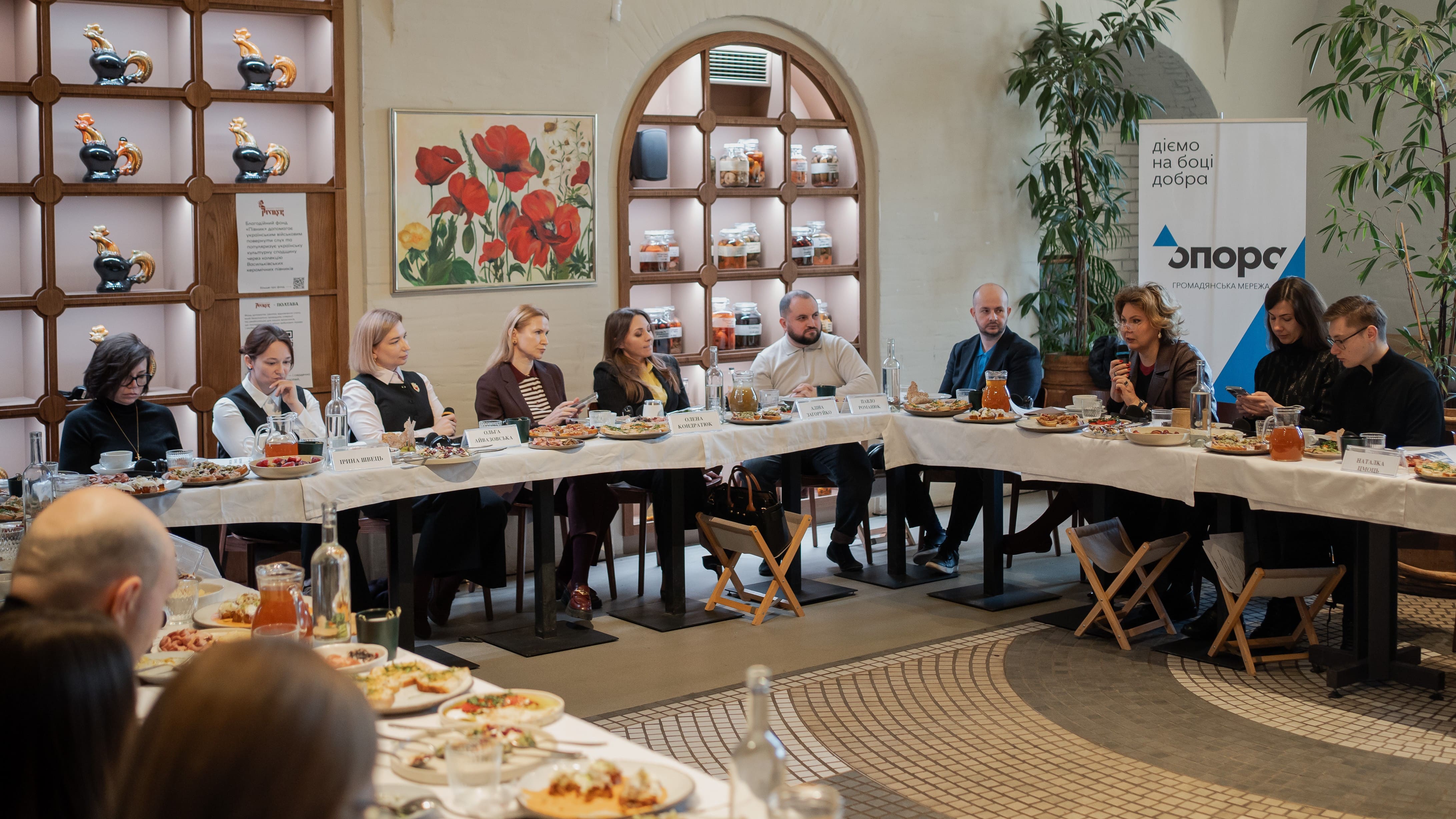
Those who were forced to leave Ukraine in 2022, even for just three and a half years, and have since returned, will not be eligible to stand as candidates in the next parliamentary elections until 2028 inclusive. This issue will also affect those who have ambitions or prospects of participating in political life as candidates in the presidential elections. This was outlined by Olha Aivazovska, Chair of the Board of the Civil Network OPORA, during the business breakfast “Guarantees of Women’s Political Participation and Voting Rights for Ukrainians Abroad” on 16 March.
Aivazovska believes that it is unlikely to achieve a productive outcome without unity and a shared understanding of the state of affairs, statistics, facts and assessments: “Today we have attempted to bring together the issues of migration, Ukrainians moving abroad and the consequences of this emigration for the electoral base and demographics, as well as women’s political rights and the right to participate in the electoral process. These issues are directly linked. And those who fail to see the connection between them, unfortunately, do not offer any relevant solutions.
I would like to feel that my own state loves and respects everyone who invests in it. Personally, I have no political ambitions, but there are many active people who do have political ambitions and the capacity to participate in the governance of their country, including in elected bodies. This criticism that everyone who left should have also been thinking, at the moment of departure, about the consequences for their election campaign seems to me to be an unconventional point of view. Because at a time when you don’t even know whether your country will survive, you don’t think about political prospects and ambitions. It shows absolutely no sensitivity to people’s grief.
Leaving the country is a huge trauma. Anyone who hasn’t been through it won’t understand this either. After all, there’s a difference when it’s a life strategy: you’ve decided to start your own business, begin your studies, or find a job, and for that you’ve left the country because you’ve decided for yourself that you want to live in a different context. But it’s entirely different when Vladimir Putin has made the choice for you, because you will either be killed along with your loved ones, or you will leave. And this is a departure without any prospects or foundations for the future. When, even after returning home, you may be deliberately restricted in your political participation. And this, unfortunately, applies to hundreds of thousands of Ukrainian women, because parliamentary prospects are also involved.
Elections will take place eventually. And if we communicate this issue incorrectly, if we deepen the divide, if we create real preconditions for social conflict on this background, then we will certainly not survive as a society and as a state.”
.jpg)
Deputy Speaker of the Verkhovna Rada of Ukraine Olena Kondratiuk noted that women’s right to participate actively in society is a matter of justice and the development of the state as a whole: “As far as I’m concerned, it’s absurd even to suggest that women abroad should be denied the right to vote, or the right to stand for election. Since 2022, I’ve had a great many trips abroad as part of my parliamentary duties. Wherever I go, I always meet with our community in every country. 95% of the people at these meetings are women — of all ages, from different regions, with varying levels of education — and many of them are active, helping Ukraine, volunteering, working multiple jobs, and ensuring the safety of their children there. But they haven’t lost their interest in Ukraine; they are active citizens of Ukraine. And, in my opinion, involving these women in the active life of Ukraine is precisely the future of Ukraine.”
As the chair of one of the sub-groups of the official parliamentary group preparing for post-war elections, Olena Kondratiuk noted that the working group’s representatives understand that it will take at least six months after the end of martial law to announce the electoral process. “Over these six months, the Ministry of Foreign Affairs, together with the Central Election Commission and our partners, must take all necessary steps to organise elections abroad. We also hope that during this time, some Ukrainians will return home and will be able to vote there. As for the voting format, we have settled on the standard method currently in use and are not considering postal or online voting,” she said.
Kondratiuk also believes that, given the number of people living abroad, a great deal of effort will be required over the next six months to engage them in the electoral process. “According to various sources, between 5 and 8 million of our citizens are currently living abroad. These are Ukrainians who are eligible and have the right to vote in the elections. There are currently only 384,000 Ukrainians registered with the consular services. We therefore understand what a huge challenge it will be to encourage Ukrainian citizens to make an active and responsible decision to take part in the elections. In order to hold the elections, we will need to make additional efforts and engage our partners and allies in countries where Ukrainians reside to open additional polling stations. It is a huge undertaking, which will be carried out by the Ministry of Foreign Affairs in conjunction with the Central Election Commission.”
.jpg)
Oleksandr Karasevych, State Secretary of the Ministry of Foreign Affairs of Ukraine, emphasised that the war has changed the landscape of the electoral process, particularly abroad: “104 polling stations are currently operating abroad at diplomatic missions, as stipulated by the current legislative framework. Even if we expand this infrastructure as much as possible and set up polling stations in all functioning institutions and their branches, we will reach a maximum of 150 polling stations.”
According to him, during the next elections, non-standard solutions should be adopted: “We understand that without additional polling stations, which will be set up on an ad-hoc basis outside diplomatic missions abroad, it will simply be impossible to grant citizens abroad the right to participate in the elections. That is a fact. And we have accepted it as a working hypothesis, but it also raises many issues: financial resources, human resources, technical resources.”
.jpg)
The event was attended by Members of Parliament, representatives of state institutions, and the leadership of international and human rights organisations.
This event is funded under the international development programme of the Government of the United Kingdom of Great Britain and Northern Ireland. The views expressed do not necessarily reflect the official policy of the Government of the United Kingdom of Great Britain and Northern Ireland.