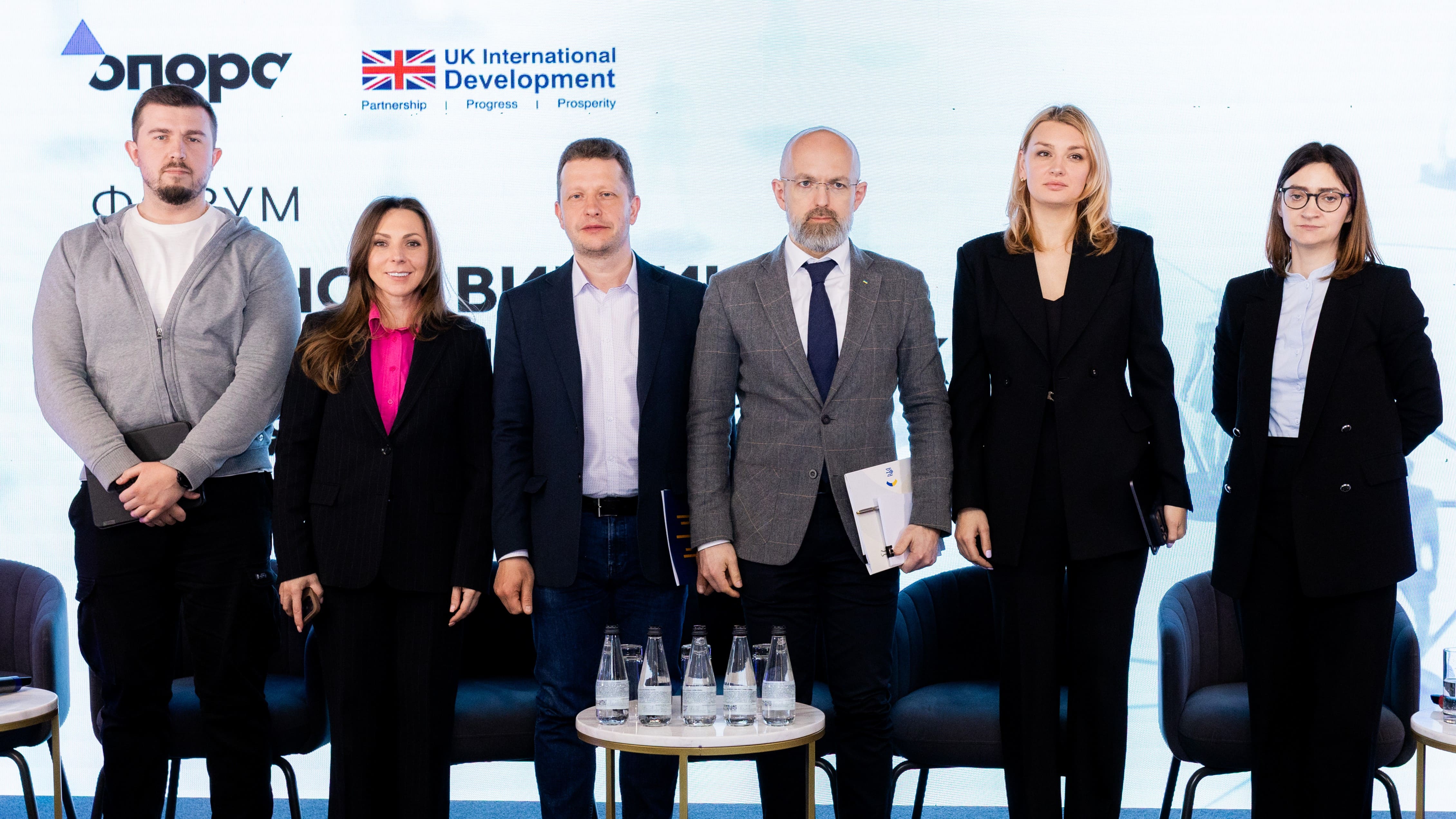
There will be enough votes in Parliament for the law on the first post-war elections in Ukraine once all seven working subgroups reach a consensus on a range of issues: residency requirement, the article defining the right to run for office, voting for Ukrainians abroad, and others. This opinion was expressed by Olena Shuliak, MP and Chair of the Verkhovna Rada Committee on State Power, Local Self-Government, Regional Development, and Urban Planning, during the panel discussion “System Resilience and the Resilience System for Organizing Protected and Fair Elections” at the OPORA’s forum “Challenges of Electoral Democracy Caused by the Great War” on March 23.
As one of the leaders of the parliamentary subgroup on election administration and electoral infrastructure, she noted that five of 23 proposals were supported. These include restricting the passive electoral right (the right to run for office) for individuals who have committed certain crimes, such as those against the foundations of national security; amendments to the Code of Administrative Legal Proceedings; proposals regarding the operation of the Inter-agency Group to counter foreign interference; and the election preparation period.
“We understand that various situations may arise. Even if there is peace and all security conditions are met, our mad neighbor could do anything. We need to clearly regulate how polling stations and commissions will operate, what to do with electoral documentation, and who is responsible for its preservation. These are technical matters, but without them, ensuring fair elections is practically impossible,” Shuliak explained.
.jpg)
Many discussions are focused on changes to the electoral system: “We have decided that this is a political issue, so it must be brought before the large group. As of now, no one—neither at the subgroup level nor in Parliament—can say for certain whether there will be a change to the electoral system,” the MP added. Other issues still discussed include the information a candidate must provide about themselves on the ballot, exactly who has the right to run for office, and the potential easing of residency requirements. “The more opportunities we have to involve citizens in the electoral process, the better the election results will be,” Shuliak believes.
It is impossible to guarantee millions of Ukrainians who were forced to leave the country the right to participate in elections under the current legislation. This is why one of the parliamentary working subgroups supported the CEC's proposal to establish temporary polling stations outside the premises of foreign diplomatic missions. This will create the necessary conditions for voting, explained Oleksandr Karasevych, State Secretary of the Ministry of Foreign Affairs of Ukraine.
“Setting up this voting network is a lengthy process, and its duration will be determined by several factors. First, we must understand the locations of the citizens who wish to participate in the elections. Second, we will need to find potential premises that can be leased,” the diplomat explained.
The state, represented by the MFA, must approach the official structures of foreign nations to request permission to organize elections outside of Ukrainian diplomatic missions. According to Karasevych, signals have already been received from several states indicating that this approval process could take up to three months. In another group of countries, national legislation strictly prohibits the establishment of such polling stations, and this is a fact that Ukraine must address.
“In some cases, our partners are meeting us halfway and suggesting interesting innovations, such as in Czechia. Initially, they were very cautious and said, ‘No, this is not possible at all.’ This was their standard response, not just to Ukraine, but to any foreign partner. However, we are asking them to find creative solutions,” the MFA representative concluded.
.jpg)
The Ministry has never faced the challenge of organizing a vote on such a massive scale. According to Oleksandr Karasevych, the Ministry estimates that hundreds of new polling stations will need to be opened; therefore, they are already developing regulations to ensure the MFA receives additional funding as quickly as possible.
Regarding the extension of voting hours abroad, Karasevych outlined several options: “We could allow voting on the same day but with an extended time window for polling stations established outside the premises of diplomatic missions. At stations located on the premises of diplomatic missions, voting could take place throughout the weekend. This would, at the very least, double the capacity of these stations.”
CEC Member Viktoriia Hlushchenko explained that the creation of additional polling stations abroad is directly linked to the number of citizens who declare their intent to vote in advance. According to her, it is crucial to convey the necessity of active registration to every voter. The quality of the voter list depends entirely on this.
Although the electronic services of the State Voter Register are already accessible and citizens can change their voting address online, very few people have used this service: “Unfortunately, the number of individuals who have already done so is insignificant; it’s not even in the thousands. Therefore, I invite all voters to change their voting addresses, update their data, and thus help not only the Central Election Commission but the state of Ukraine as a whole to organize elections in accordance with international standards,” Hlushchenko said.
.jpg)
The CEC representative also emphasized that well-organized elections are expensive, especially when it comes to inclusivity. For Ukraine, building a system of resilience means both repairing destroyed polling stations and protecting the information space.“The most costly and, at the same time, critical cluster is the functioning of the CEC's information-analytical system, which must withstand the conditions of hybrid threats and foreign interference,” Hlushchenko added.
Protection against foreign interference at the level of political parties lies in transparency, the digitalization of reporting, and the engagement of small contributions from a large number of voters. This was emphasized by Ihor Khokhych, Chief of Staff of the National Agency on Corruption Prevention (NACP). According to him, the modernized POLITDATA 2.0 system was launched last year, ensuring maximum transparency in political party reports.
“When we deal with stacks of paper, they are very difficult to sort through and analyze. In contrast, digitized data allows for the detection of anomalies. For example, when 40 people, who are students or retirees without the corresponding income, transfer 10,000 UAH to a party’s account within half an hour on the same day. This is what lies on the surface,” the NACP Chief of Staff explained. He added that the Ukrainian experience of fundraising for the needs of the Armed Forces of Ukraine could serve as a model for financing political parties.
.jpg)
“This is precisely the key that ensures the maximum independence of a political party. When hundreds of thousands of voters support a party with small contributions, they are effectively ‘voting with their money.’ This guarantees the party's independence, in contrast to situations where millions are funnelled in by a single oligarch or a foreign donor,” Khokhych noted.
Bohdan Mokhonchuk, Legal Advisor at OPORA, focused on the problem of straw donors and accountability. He cited the example of Romania and Călin Georgescu, where cryptocurrency, influencers, and internal social media currencies were used. That is why OPORA has created a platform comprising representatives from various agencies (the CEC, NACP, and law enforcement) to answer questions such as what constitutes a foreign asset or foreign interference, who should investigate it, and how to handle virtual assets, among others. “I want to believe that in the next elections, we will not face a situation like the one in Romania, and that the Russian Federation will not break us. This is a challenge to which Europe and the world have no answer. Perhaps we must be the first on this frontier,” Mokhonchuk added.
.jpg)
The scale of destruction to electoral infrastructure, the lack of roads, human resources and communication make holding elections in certain territories impossible. The criteria for determining where voting can be held are explained in the corresponding draft bill, said Alina Zahoruiko, MP and head of the parliamentary working subgroup on developing security criteria.
“There will be territories where it will be difficult to hold elections, but as a state, we will do everything possible to ensure voting still takes place there. The draft bill provides for the possibility of not just making a blanket decision on the impossibility of organizing elections, but rather identifying specific polling stations where voting is unfeasible. This is necessary to ensure that as many Ukrainians as possible can exercise their right to vote,” she said.
.jpg)
Separately, Zahoruiko explained that holding elections and a referendum simultaneously is prohibited. “It is difficult for me to speak about a referendum until I understand its subject matter. What question will be put forward? Everything depends on that: from who initiates the referendum to how it should be conducted.”
In the MP’s opinion, the consequences of a referendum could be quite negative, as it has the potential to polarize society. Before holding a referendum, it is necessary to carefully analyze all risks and determine whether it is truly essential, Alina Zahoruiko added.
This event has been funded by UK International Development from the UK government; however, the views expressed do not necessarily reflect the UK government’s official policies.