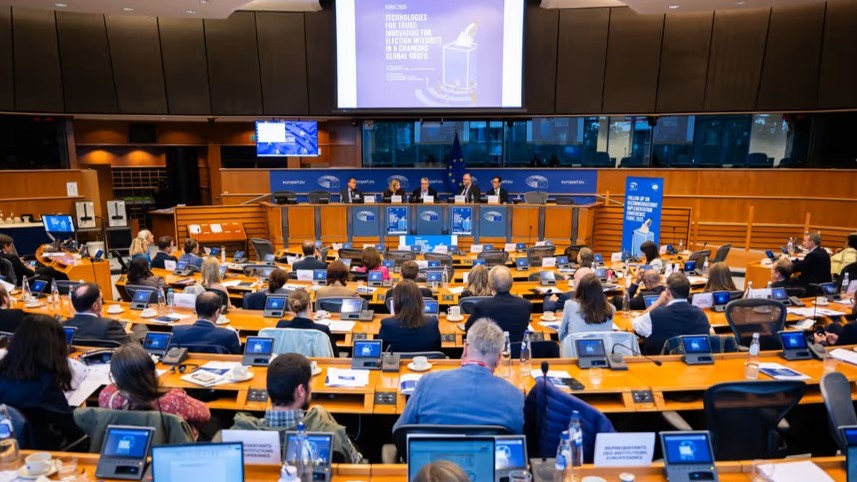
On September 23–24, the European Parliament is hosting the conference “FURIC 2025. Technologies for Trust: Innovating for Election Integrity in a Changing Global Order”, where civil society leaders, international organizations, and policymakers discussed how to safeguard election integrity and public trust in times of digital threats and authoritarian influence. The event is organized by the European Platform for Democratic Elections. Olga Aivazovska, Chair of the Board of the Civil Network OPORA, delivered a speech on the first day of the conference. Below, we share the full text of her address.
As technology advances globally, elections are becoming increasingly vulnerable. But here in Ukraine, we are not holding elections today. We are at war. A war driven by Russia’s aggressive attempts to destroy our statehood, seize our territory, and erase the identity of our people. Some might say, “Why talk about elections when no elections are happening?” After all, with no elections taking place, there is no immediate technological influence on them, and observer recommendations remain far from implementation. But the truth is exactly the opposite. Clear parallels exist between the methods used to influence elections abroad and those being used to manipulate Ukrainian society today, even in the absence of an electoral process.
.jpg)
The goal is consistent: to polarize society, to divide, to weaken resilience to populism and propaganda, erode trust in state institutions, and manipulate emotional responses. Malicious actors, Russian funding, and influence use the same mechanisms everywhere. Platforms such as Telegram and TikTok have become channels for influence operations, recruitment, money laundering, and buying the loyalty of online opinion leaders. Where soft power and FIMI are not enough, drones and direct aggression are used to push society into irrational responses and forcing compromises on international norms. For instance, a drone attack on Poland, a NATO member, could simultaneously provoke rational measures — such as strengthening defense capabilities and social cohesion — and emotional reactions, including panic or a willingness to support populists promising security and peace within 48 hours.
We must also understand that only through free and fair elections can citizens exercise their sovereign right to choose their leaders peacefully. This is about our political and civil rights. This is about a people's independent choice of the path of development, reforms and integration into Europe. But if a neighboring authoritarian state first funds and promotes satellite candidates, and then governs through them, - what kind of sovereignty can we talk about?
History provides a clear lesson: in 2013, Ukraine’s fourth president, Viktor Yanukovych, refused to sign the Association Agreement with the EU after a conversation with Vladimir Putin. It's cheaper to take over a state through effective interference and election manipulation than to start a full-scale war against it. But if you're ready to give up sovereignty in hopes of sleeping without drone attacks, you will get both - war and shame. Russian influence and funding must be countered through effective practices, a strong legal framework, adherence to updated international standards, and safeguards against manipulation.
Even in times of crisis and war, reforms are no less important than defending democracy at home. Ukraine has actively participated in shaping the framework for democratic institutions and EU accession. In the 25-page document on democratic institutions, the section titled “Electoral Process” sets a clear objective: “to ensure that key international and European Union standards, as well as previous recommendations of the OSCE/ODIHR and the Venice Commission, are taken into account.” Before the next electoral process begins, Ukraine must amend its legislation to implement the recommendations of OSCE/ODIHR election observation missions, as well as European Union standards. Of course, this is only one of many obligations. Yet, given that EU accession is now discussed as a security guarantee for Ukraine at the highest levels of government and within the “coalition of the willing”. This is not only a question of integrity — it is a question of security. My only appeal to the international organizations that worked on their recommendations is to cooperate with Ukrainian civil society and to take a more active role in the preparation for the planned reforms.
.jpg)
Election observation mission recommendations should be implemented in a timely manner, within a political window of opportunity that offers optimal conditions for meaningful changes to election law. High-quality election legislation is about citizens, election bureaucrats and organizers, and, of course, politicians who try to create the most favorable conditions for new victories. This is a delicate balance twisted with tactical and strategic conflicts of interest. What appears as reform can, in practice, serve as a tool for gerrymandering.
As a result, the political window of opportunity is very short. After an election, parliamentarians may re-evaluate recommendations based on perceived political gain or loss. If we, as non-governmental organizations or human rights advocates, passively hope for a result, it won't happen. This topic must become socially relevant, which is particularly challenging during election periods, as it is not a priority for citizens in their daily lives. Election-oriented politicians are more responsible when they feel the attention of society, not just expert organizations. And here, education, mobilization, and public control play a huge role. It is necessary to explain to citizens in simple terms why this change is important for them.
Let me remind you of another Ukrainian example. A significant breakthrough in Ukraine occurred in 2019 and 2020. After the 2019 presidential election, the parliament, for the first time in history, voted to adopt the Electoral Code, introducing progressive changes to voting rights and a new electoral system. However, this vote took place on the eve of the parliament’s dissolution, driven by an understanding of the topic’s popularity and a desire to fulfill promises and appeal to voters. Next changes and innovations to the Electoral Code were adopted by the newly elected parliament during its first year in 2020. That window of political opportunity then closed.
However, since Ukraine was granted EU candidate status in 2022, and with the adoption of the 2025 Roadmap for the Functioning of Democratic Institutions with clear deadlines and directions for reform — we not only anticipate progress but are actively working to achieve it. Our efforts range from advocating for platforms that facilitate dialogue among stakeholders to developing concrete solutions and legislative amendments.
.jpg)
Therefore, four key take aways, ladies and gentleman:
- The first one is that reform recommendations gain momentum when they are thoroughly developed and presented by experts for a vote within a narrow window of opportunity. If an idea is drafted as a draft law or amendment, and supported by qualitative and quantitative researches, it has a much higher chance of being noticed and successfully implemented.
- Secondly, observation missions should adapt and update their recommendations, as progress also requires modernizing their approach to addressing challenges in the electoral processes of each country. While democratic election standards remain constant, the ways in which they are violated and the methods used to influence free and fair elections change — and often quite rapidly. Therefore, if an international mission issued recommendations to a country five years ago, it is important not only to evaluate their implementation but also to reassess the current relevance of those recommendations.
- The third point is about the importance of public opinion on priority reforms. Among the main amendments adopted by the Ukrainian parliament in 2019 and 2020, issues related to electoral rights predominated, rather than merely the mechanics of organizing the process. The leadership role of the Central Election Commission is also vital, as it must provide key expertise. Of course, this is only possible in democratic countries.
- And the last one. The most significant tool for us today is the Roadmap for Ukraine’s integration into the EU, as recommendations and their implementation are not just guidelines for legislative or institutional reforms. It raises the importance of specific requirements, giving them greater political weight within the broader process of European integration.