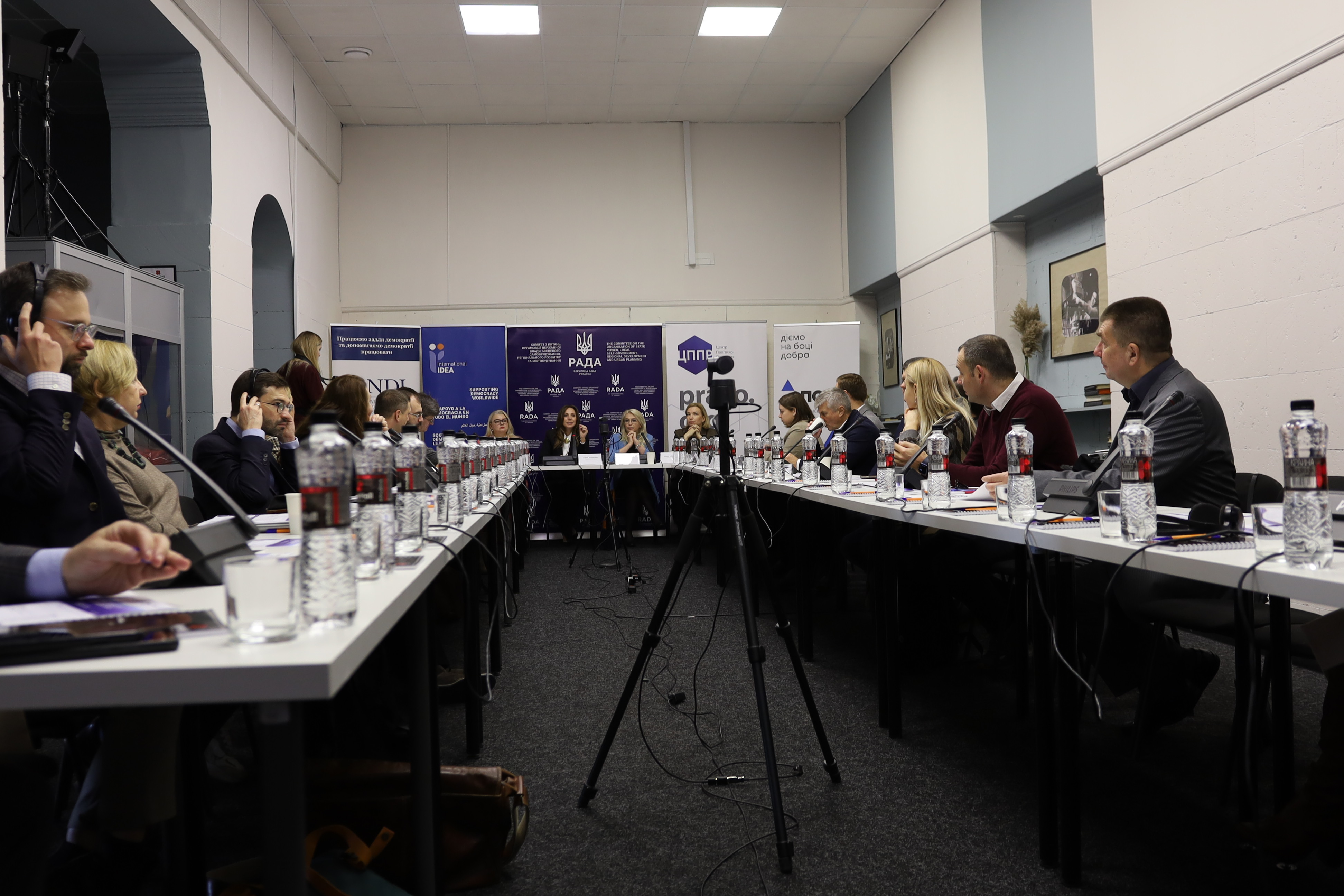
On October 31, 2025, a round table titled "Electoral Campaigns Abroad: International Practice and Recommendations for Ukraine" was held in Kyiv in a hybrid format. Participants discussed challenges and sought solutions for political campaigning in post-war elections abroad. They also explored how other countries organize out-of-country campaigns and analyzed how these international experiences correlate with Ukrainian national legislation.
The event was organized by the International Institute for Democracy and Electoral Assistance (International IDEA) in cooperation with the relevant Committee of the Verkhovna Rada, National Democratic Institute (NDI), National Agency on Corruption Prevention (NACP), Centre for Policy and Legal Reforms (CPLR), Civil Network OPORA, and CHESNO Movement.
Against the backdrop of the full-scale war, millions of Ukrainians have found themselves abroad—estimates suggest approximately 8 million people are currently in forced emigration. Despite the distance, they remain an integral part of Ukrainian society and maintain a high level of interest in events back home; more than 82% of Ukrainians abroad regularly follow politics in Ukraine.
The upcoming elections will be historic for Ukraine, and the state must ensure that citizens can exercise their voting rights abroad, even in a post-war context. At the same time, organizing elections and campaigning abroad is a highly complex undertaking, presenting numerous challenges. Decisions must be made on where and how voters scattered across the globe will cast their ballots, as well as how to create conditions for election campaigning among Ukrainians in dozens of different countries.
.jpg)
At the beginning of the event, Yuliia Shypilova, Program Coordinator at International IDEA, presented the findings of the study "Campaigning Outside the Country: Legal Norms and Practice in the 27 Member States of the European Union." According to her, while there is established practice in various countries regarding information dissemination about electoral processes abroad, the process of actual campaigning remains unclear to many.
"This study is structured to highlight general trends, challenges, and an understanding of what is possible and what is not. This is followed by an analysis of each of the 27 EU member states. We examined campaigning activities of various scales, as well as the placement of campaign materials both online and in traditional media."
She noted that the study analyzed primary and secondary legislation, as well as practices verified directly through inquiries in EU member states. Shypilova noted that they encountered difficulties with interpretation because, in many countries, it is unclear how these issues are regulated.
Member of Parliament Viktoriia Siumar ("European Solidarity") spoke about alarming trends identified by her political party in a sociological survey conducted by KIIS (Kyiv International Institute of Sociology) in Germany, Poland, and the Czech Republic in the spring of 2024:
"At that time, only 20% of respondents were pursuing citizenship in their current country of residence, while 34% had not applied and did not plan to seek such citizenship. However, I believe this situation could change significantly due to recent EU policy updates regarding protection. According to the survey, the most significant barriers to returning are problems with critical infrastructure (34%) and security (34%)."
Olha Snopok, an analyst at OPORA, shared the results of a sociological survey regarding the media consumption of Ukrainians living abroad. She emphasized that the election campaign among our citizens outside Ukraine will largely take place online.
.jpg)
"Online campaigning will predominate among Ukrainians abroad. Only 8% use Ukrainian television, and 1% use radio. The primary sources of information are messengers and social networks (60–70%). Parties will move online once the campaign begins," the expert noted, citing survey data.
Olha also warned that TikTok and Telegram are platforms with minimal moderation—those with the least control and that could become a channel for Russian information interference. Anonymous Telegram channels, which are particularly popular among the diaspora, could be used for disinformation. This creates new risks during the election campaign.
Olga Aivazovska, Chair of the Board of Civil Network OPORA, noted that the Ukrainian state must now fight for the social mobility of Ukrainians, "If this movement of Ukrainians out of and into Ukraine is halted, we will face the same situation we have had since 2022 with the occupied territories. Not from the perspective of ideology, propaganda, or life prospects, but from the perspective of a lack of interaction with the state as such."
She also emphasized, "We do not know what we will be like: in terms of numbers, social status, or the country's economic condition. But if experts and political actors gather, they can determine who we want to be and what forces and means we need to achieve that."
.jpg)
Olga Aivazovska also raised the issue not only of the right to vote (suffrage) but also of the right to be elected, and how it remains restricted for Ukrainians abroad as of now,
"Women who left in 2022 for six months and have already returned will be unable to participate as candidates in parliamentary elections until 2028 and in presidential elections until 2034. Does it satisfy an EU candidate country to understand and acknowledge the problem of restricting rights based on events that were beyond the citizens' control? To me, EU candidate status creates numerous opportunities. Many forms of exercising the rights of citizens under the special status of a candidate can be found—the main thing is the will to do so."
Olga Kotsiuruba, Senior Legal Advisor to Civil Network OPORA, emphasized during the panel that the issue of accountability for violations during election campaigning abroad must become a central item on the agenda for election preparations.
"We are working very closely with the National Agency on Corruption Prevention (NACP). We already have certain developments and solutions, but they need to be coordinated with politicians to reach concrete agreements—at least regarding issues where clear roadmap deadlines are set. This issue is ceasing to be purely political or politicized; it is becoming a matter of fulfilling our obligations as a candidate country to the EU. We, at OPORA, propose starting the discussion not from the position of 'preparing for elections,' but from the position of 'preparing for European integration.' After all, we have specific obligations to the European Union, including those with defined deadlines."
Olga Kotsiuruba also drew attention to the necessity of establishing a system of accountability for violations of campaign rules, encompassing both administrative and criminal liability. She emphasized that Moldova's experience demonstrates the real threat posed by foreign influence to voters abroad and the need for a preemptive response.
"If we are talking about election campaigning, we must understand: where there is campaigning, there are always violations. The question isn't whether they will occur, but which type of campaigning will prevail—legal or illegal. This involves criminal liability, and we must prioritize this issue now.
.jpg)
The example of Moldova illustrates this clearly: initially, attempts to influence voters were made through disinformation, and later through bribery. Similar risks could arise in the Ukrainian context, as labor migrants often work in centralized environments—such as factories or enterprises—where owners can communicate directly with Ukrainians."
Special attention during the event was given to the control of election campaign financing abroad. Hanna Chornutska, Head of the Department for the Prevention of Political Corruption at the NAPC, presented the capabilities of the Politdata platform. This state transparency tool enables tracking the flow of funds to and from political parties and election campaigns. She emphasized that, in the context of campaigning abroad, digital solutions will be key to effective financial control, as they enable the detection of potential abuses even beyond the country's borders.
The discussion also featured experts from France, Moldova, and the European Centre of Excellence for Countering Hybrid Threats (Hybrid CoE), who shared their experiences in regulating political advertising and ensuring a level playing field for parties in overseas electoral districts. They stressed that the primary challenge in most states remains financial transparency, defining the boundaries of political communication on the internet, and preventing foreign interference via online platforms.
The final session of the event, "Maintaining Political Connections with the Ukrainian Electorate Abroad", was dedicated to the outcomes of political dialogues with communities in Germany, the United Kingdom, and Lithuania. Moderated by Olga Aivazovska, the discussion featured Natalia Panchenko, a leader of the Ukrainian diaspora in Poland, and Nataliia Pryhornytska, co-founder of the "Alliance of Ukrainian Organizations" (NGO). They emphasized the vital need to integrate Ukrainians abroad into the political process and to maintain continuous, two-way communication between the state and its citizens.
The roundtable discussions demonstrated that future elections must be more than just a process of political expression; they must serve as a demonstration of the resilience of Ukrainian institutions and the state's accountability to its citizens—regardless of where they currently reside.