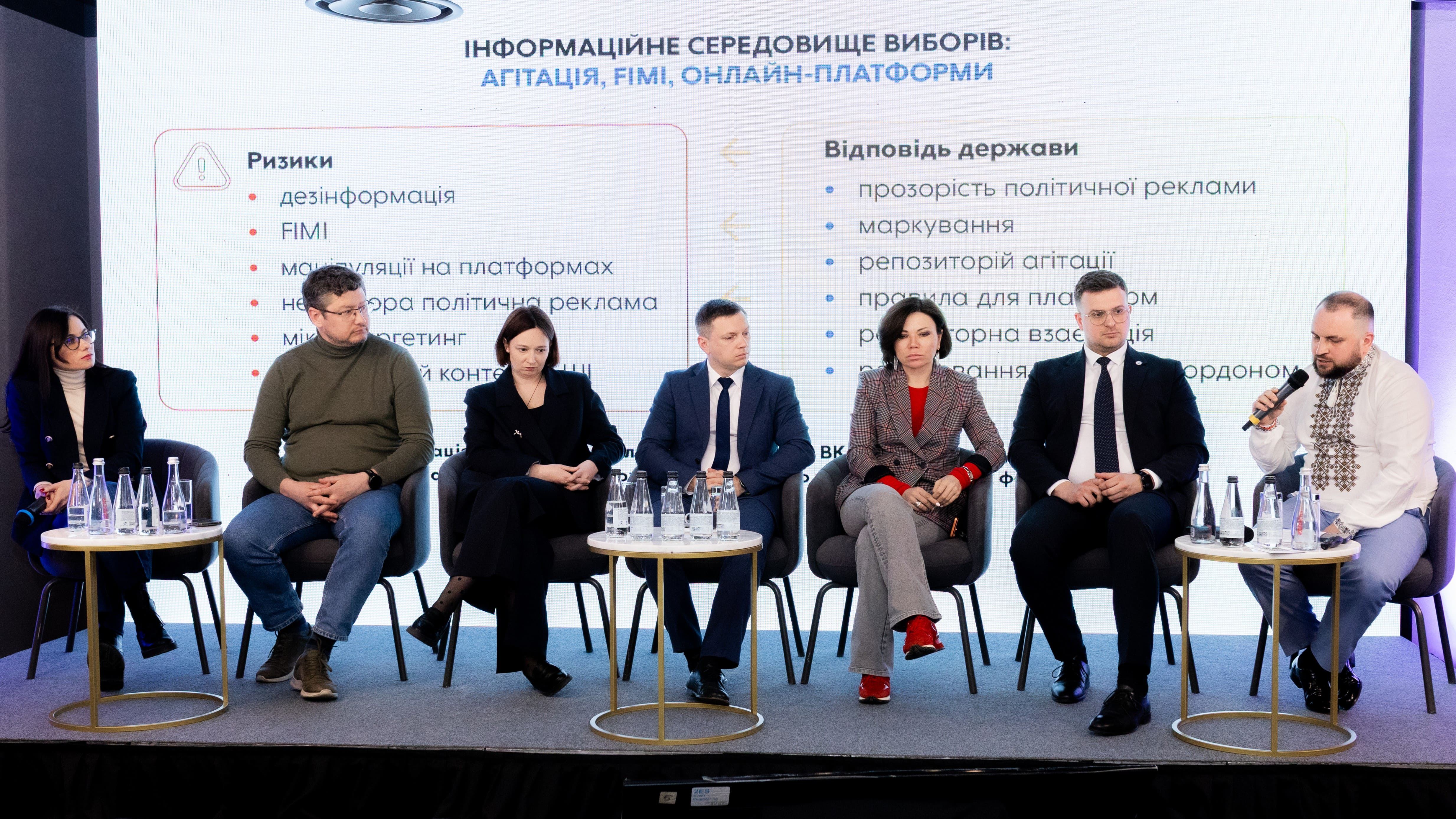
Representatives of the government and the civic sector state that the response to these risks must begin now. During the OPORA forum on March 23, they outlined the necessary steps, ranging from ensuring voting accessibility to regulating the information space and countering foreign interference. Experts discussed these issues during the public panel: “Political rights must be protected, and all categories of citizens must receive equal mechanisms for realizing the principles and standards of free elections. How to avoid politicizing the human rights agenda in the first post-war elections.”
As Serhii Postivyi, a member of the Central Election Commission, noted, much has already been done regarding the accessibility of the electoral process compared to previous legislation: 'We are aware that due to the war, the number of citizens with health impairments has increased. Therefore, as of today, the Central Election Commission has adopted a Resolution on providing voters with reasonable accommodations. We have studied international and Ukrainian experience, formulated requirements, and identified the types of reasonable accommodations that can assist citizens at polling stations.”
.jpg)
Furthermore, according to him, the CEC has submitted a document to the Verkhovna Rada containing proposed legislative amendments regarding the participation of blind and visually impaired voters. Given Ukrainian realities, not many people can utilize the Braille ballots that are common internationally: “We have proposed a certain ‘know-how’ of our own, a ballot overlay that allows a person, even without knowledge of Braille, to use a QR code to access an audio version of the ballot, a sign language translation, or an accessible text format online. With this overlay, a person will be able to vote independently, without the assistance of others.”
Oleksandr Osipov, Representative of the Verkhovna Rada Commissioner for Equal Rights and Freedoms, Rights of National Minorities, Religious and Political Views, emphasized that the priorities for the first post-war elections will be security and the opportunity to vote for all categories of voters: Ukrainian citizens abroad, military personnel, internally displaced persons, people currently in temporarily occupied territories, and others.
.jpg)
“Our primary focus now is the analysis of proposed amendments and the regulatory acts already being registered for the first post-war elections, as well as providing recommendations for preventing violations of human and civil rights in the electoral process. Immediately after the end of martial law, the issue of monitoring will become urgent, ranging from the physical accessibility of polling stations to the realization of the right to be elected,” he explained.
Viktoriia Siumar, MP from the “European Solidarity” faction, noted that since peace negotiations have not yet yielded success and there is no point in discussing elections this spring, the existence of the parliamentary Working Group has raised the question of what kind of elections we want to have after the war. In the MP's view, the publicity of this process has made it possible to clearly state the position that elections under wartime conditions can be neither democratic, nor free, nor fair: “The attention on these elections will be immense, but the key factor is that a wounded and suffering Ukrainian society will demand fair elections and seek justice through them. Any injustice or any falsification will be perceived as absolutely negative. For Ukrainians, this will be an extremely sensitive issue.”
.jpg)
Viktoriia Siumar also raised the topic of regulation for information distribution platforms. “78% of Ukrainians consume news on Telegram. We killed television with the ‘United News’ telethon—perhaps that’s its only silver lining—but in its place, we got a different monster that is not regulated in any way or by any body. Moreover, it’s a platform that itself does not recognize the principles of accountability,” she said. According to Siumar, if the state wants to ensure conditions for equal access during elections, it is necessary to bring these platforms into the legal Ukrainian framework in the state's interests, without political bias.
Oleksandr Burmahin, a member of the National Council of Television and Radio Broadcasting, noted that coordinated foreign interference is a major threat: “In Europe, everyone has already built the infrastructure and ecosystem; they are moving on to testing various instruments and thinking about how to improve them. In contrast, Ukraine has nothing at the legislative level in terms of countering Foreign Information Manipulation and Interference (FIMI). We have individual elements: the National Council can catch what constitutes hate speech within its mandate, and the Security Service of Ukraine catches something within the current Criminal Code, but it is impossible to counter this systematically when you don’t even have the corresponding definitions at the legislative level”..jpg)
According to Marharyta Sytnyk, co-founder of the “Holka” initiative, Ukrainians abroad may not know how to counter disinformation about Ukraine or respond to provocative political or historical questions posed by locals in host countries. Furthermore, Ukrainians abroad frequently consume news via Telegram and are targets of disinformation. They are also influenced through churches, as Ukrainians abroad often attend parishes of the Ukrainian Orthodox Church (formerly the Moscow Patriarchate), the number of which has significantly increased since the start of the full-scale invasion.
.jpg)
“We already have a certain inequality in the potential access of some candidates to elections. We recently conducted a study of the usernames of heads of military administrations. It turned out that 12 heads of administrations use their own names for official Telegram channels, which are currently being developed probably by taxpayer-funded press services. Once a person leaves that office, they will likely retain that Telegram channel and its large following,” she explained.
Iryna Shvets, head of the Lviv office of Civil Network OPORA and coordinator of the facilitated dialogues with Ukrainians that OPORA organized in various countries, spoke on the issue of interaction and communication between the state and Ukrainians abroad: “During our discussions, we do not directly address the issue of elections. Instead, we ask participants about their expectations and their involvement in socio-political activities. We intentionally frame the question broadly so that it is not reduced solely to elections. However, during these discussions, issues regarding active and passive electoral rights inevitably arise. For Ukrainians abroad, aside from receiving consular services, the right to vote is one of their key concerns. They are cognizant of the challenges regarding the current small network of polling stations. These active Ukrainians who attend our meetings would be willing to travel several hours to a polling station if necessary, but they all expect a step forward from the state. They expect the state of Ukraine to ensure their right to vote in a format that is more convenient for them as well, rather than having only five polling stations for 1.5 million voters in Poland”.
.jpg)
This event has been funded by UK International Development from the UK government, however, the views expressed do not necessarily reflect the UK government’s official policies.