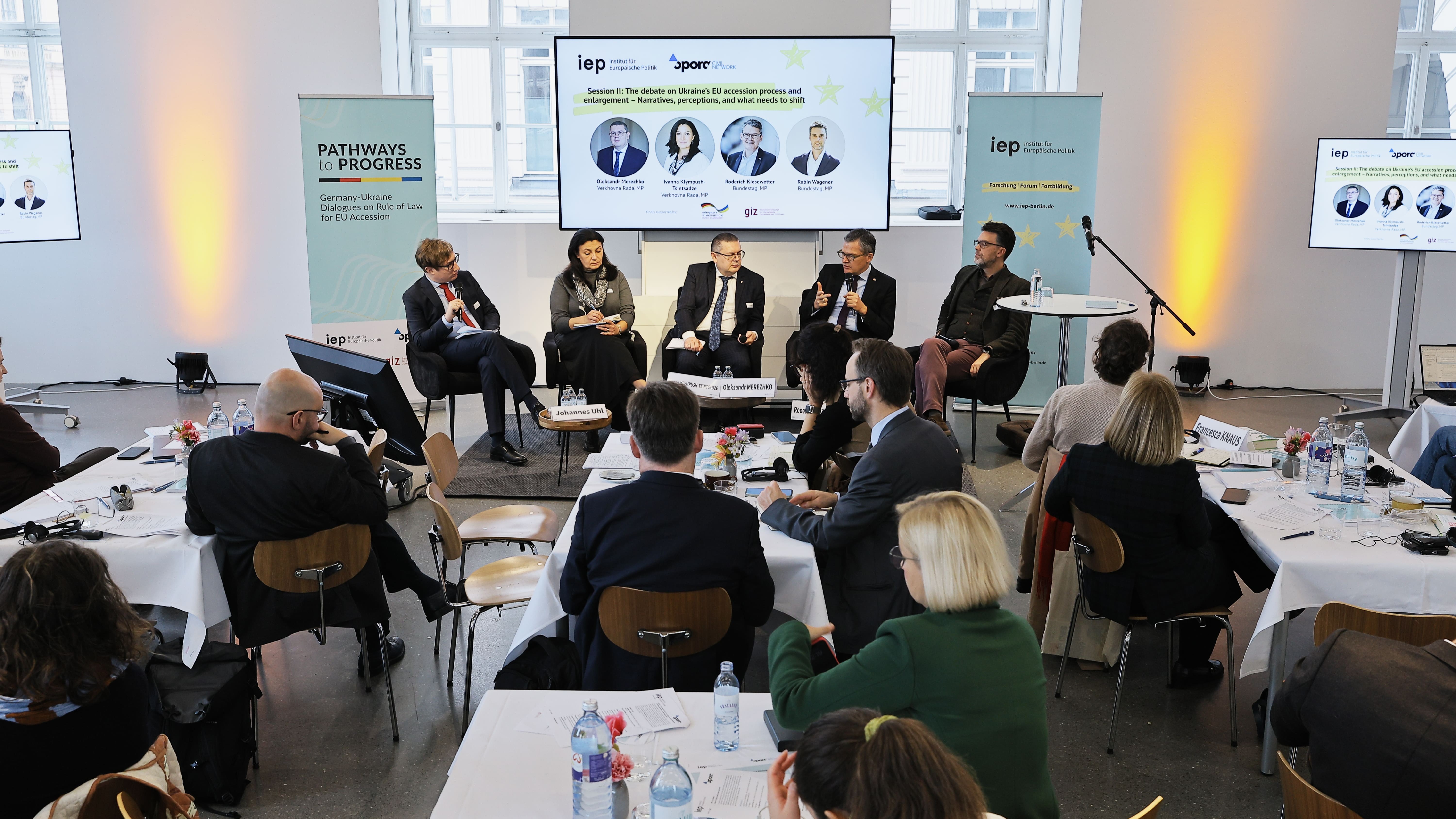
On October 16–17, a Multistakeholder Dialogue between Ukrainian and German parliamentarians, government officials, and experts took place in Berlin. The event was organized by the Institut für Europäische Politik (IEP, Berlin) and Civil Network OPORA.
The goal of the event was to deepen bilateral dialogue between Kyiv and Berlin on rule-of-law reforms, to discuss expectations and challenges of Ukraine's EU accession process, and to develop joint recommendations to strengthen reform progress.
Day One: High-Level Dialogue
The first day was dedicated to visits by the Ukrainian delegation to key German institutions. The delegation included Oleksandr Korniienko, First Deputy Chairman of the Verkhovna Rada of Ukraine; Ivanna Klympush-Tsintsadze, Chair of the Committee on Ukraine's Integration into the EU; Oleksandr Merezhko, Chair of the Committee on Foreign Policy and Interparliamentary Cooperation; and Inna Sovsun, Chair of the Subcommittee on Adaptation of Ukrainian Legislation to EU Law.
The Ukrainian parliamentarians held meetings at the Embassy of Ukraine in Germany, the German Federal Foreign Office, the Bundestag Committee on EU Affairs, the Federal Ministry for Economic Cooperation and Development, and the Federal Chancellery. Discussions focused on supporting Ukraine's accession to the EU, rule-of-law reforms, parliamentary diplomacy, and strategic approaches to Ukraine's integration into European institutions.
-min.jpg)
Representatives of German agencies emphasized the importance of political stability, transparency in reforms, and a systemic dialogue with civil society. Special attention was paid to the role of the German parliament in shaping EU enlargement policy and developing interparliamentary cooperation with Ukraine.
"Despite all the complexities and conditions, we continue to move forward with the European integration agenda and fulfill the obligations specified in the Ukraine Facility. This is a testament to the shared commitment of Ukraine and Germany to the same goals and their swiftest possible achievement," emphasized delegation representative and First Deputy Chairman of the Verkhovna Rada of Ukraine, Oleksandr Korniienko.
As noted by delegation representative and Chair of the Committee on Ukraine's Integration into the EU, Ivanna Klympush-Tsintsadze, during the meetings they discussed the formation of next year's budget with their German colleagues and emphasized the need to overcome Hungary's veto to unblock the opening of negotiations on the first clusters with the EU before the end of this year: "Our German partners were interested in the current state of reforms in Ukraine and the challenges that must be overcome to fulfill the conditions for advancing toward European Union membership."
-min.jpg)
-min.jpg)
-min.jpg)
Day Two: Joint Work of Experts and Parliamentarians
On October 17, the main day of the Multistakeholder Dialogue—an interactive workshop at the Palais Populaire —was held. The event was opened by the Director of the IEP, Professor Funda Tekin; GIZ Project Manager Johannes Uhl; the Representative of the European Commission in Germany, Dr. Jane Oispuu; and the Deputy Prime Minister for European and Euro-Atlantic Integration of Ukraine, Taras Kachka (online).
In his speech, Deputy Prime Minister for European and Euro-Atlantic Integration Taras Kachka noted: "All EU member states have supported Ukrainian refugees, thousands of volunteers, and—most importantly—governments through their decisions. This includes military, financial, and legal support—all forms of assistance. We are sincerely grateful for all that has been done and for what remains to be planned. Because Russian aggression is clearly prolonged, and our common task is to protect Ukraine, Europe, and the European Union from the Russian threat, as it is now clear that Russia seeks to spread the war as far as possible, destroying Europe's security. Europe's security is a serious and practical issue that, unfortunately, requires substantial financial and human resources. But can defense replace values? No. The most important thing in Ukraine is that the war has not become an excuse for rolling back democracy or abandoning values. On the contrary. We are defending real values through the real work of democratic institutions."
-min.jpeg)
During the first session, participants were briefed on the state of rule-of-law reforms in Ukraine. The speakers included Oleksandr Ilkov (Government Office for Coordination of European and Euro-Atlantic Integration), Valerio Paul Trabandt (German Federal Foreign Office), and Andrii Borovyk (Transparency International Ukraine). The discussion was moderated by Dr. Oksana Huss (University of Duisburg-Essen).
The second session focused on political and social narratives concerning EU enlargement and Ukraine's accession. The introductory remarks and co-moderation were provided by Ljudmyla Melnyk, Head of the Ukraine Program at the Institut für Europäische Politik, and Olga Aivazovska, Chair of the Board of Civil Network OPORA.
Olga Aivazovska presented preliminary findings from a survey of Ukrainian experts, government officials, and politicians, which was conducted as part of an ongoing joint German-Ukrainian study:
"Ukraine's path to EU membership cannot rely solely on adrenaline or emotions. It requires long-term, effective, and meaningful efforts, as well as a shared interest in progress from all parties. Expecting rapid positive changes without cooperation between all branches of government and civil society is simply naive."
-min.jpeg)
She noted that for more effective European integration, we must shift to a paradigm of shared interests: engaging sometimes "uncomfortable" audiences—political groups disloyal to Ukraine—and working directly with the societies of EU member states through business, civil society, and parliamentary and cultural diplomacy. At the same time, Ukraine's main task remains the implementation of reforms. This will become easier once the first negotiation cluster is established and Hungary's purely political blockade is lifted.
According to her, during the surveys, Ukrainian experts identified both internal (Ukrainian) and external (European) barriers slowing down integration: "Externally, membership could be complicated by populism, polarization, and electoral cycles within member states. According to experts, internal challenges include resource depletion, a lack of bureaucratic expertise, inconsistency in reforms, and rising Euroscepticism if the first cluster remains closed."
As part of the interparliamentary dialogue, positions were expressed by Ukrainian MPs Oleksandr Merezhko (Servant of the People) and Ivanna Klympush-Tsintsadze (European Solidarity), and by Roderich Kiesewetter (CDU) and Robin Wagener (Greens) from the German parliament. Svitlana Matviienko (Agency for Legislative Initiatives) and Francesca Knaus, an advisor on human rights and foreign policy, also participated in the discussion.
Joint Recommendations and Next Steps
In the afternoon, participants worked in two groups. The first, moderated by Iryna Shyba (EU Anti-Corruption Initiative), focused on supporting rule-of-law reforms. The second, facilitated by Iryna Shvets (Civil Network OPORA), focused on developing effective communication strategies to increase support for EU enlargement in Germany and to overcome misconceptions about Ukraine.
-min.jpeg)
The key findings from both groups were presented during the final session, which was summarized by Oksana Huss (University of Duisburg-Essen) and Laura Christoph (Institut für Europäische Politik). These recommendations will form the basis of a joint analytical document by the IEP and OPORA on the prospects of German-Ukrainian cooperation in reforms and EU enlargement.
The Multistakeholder Dialogue is organised as part of the project ‘Germany-Ukraine Dialogues on Rule of Law for EU Accession’. It is being implemented in close cooperation with the Civil Network OPORA (Kyiv). It is funded through the project ‘Strengthening Ukraine's EU Alignment in the Rule of Law’ (3*E4U) of the Deutsche Gesellschaft für Internationale Zusammenarbeit (GIZ) GmbH on behalf of the Federal Foreign Office.