.jpg) This material was produced as part of the project “Promoting Democratic Integrity and Governance in Ukraine”, implemented by the Civil Network OPORA with the support of the EU. Its content is the sole responsibility of the Civil Network OPORA and does not necessarily reflect the position of the European Union.
This material was produced as part of the project “Promoting Democratic Integrity and Governance in Ukraine”, implemented by the Civil Network OPORA with the support of the EU. Its content is the sole responsibility of the Civil Network OPORA and does not necessarily reflect the position of the European Union.
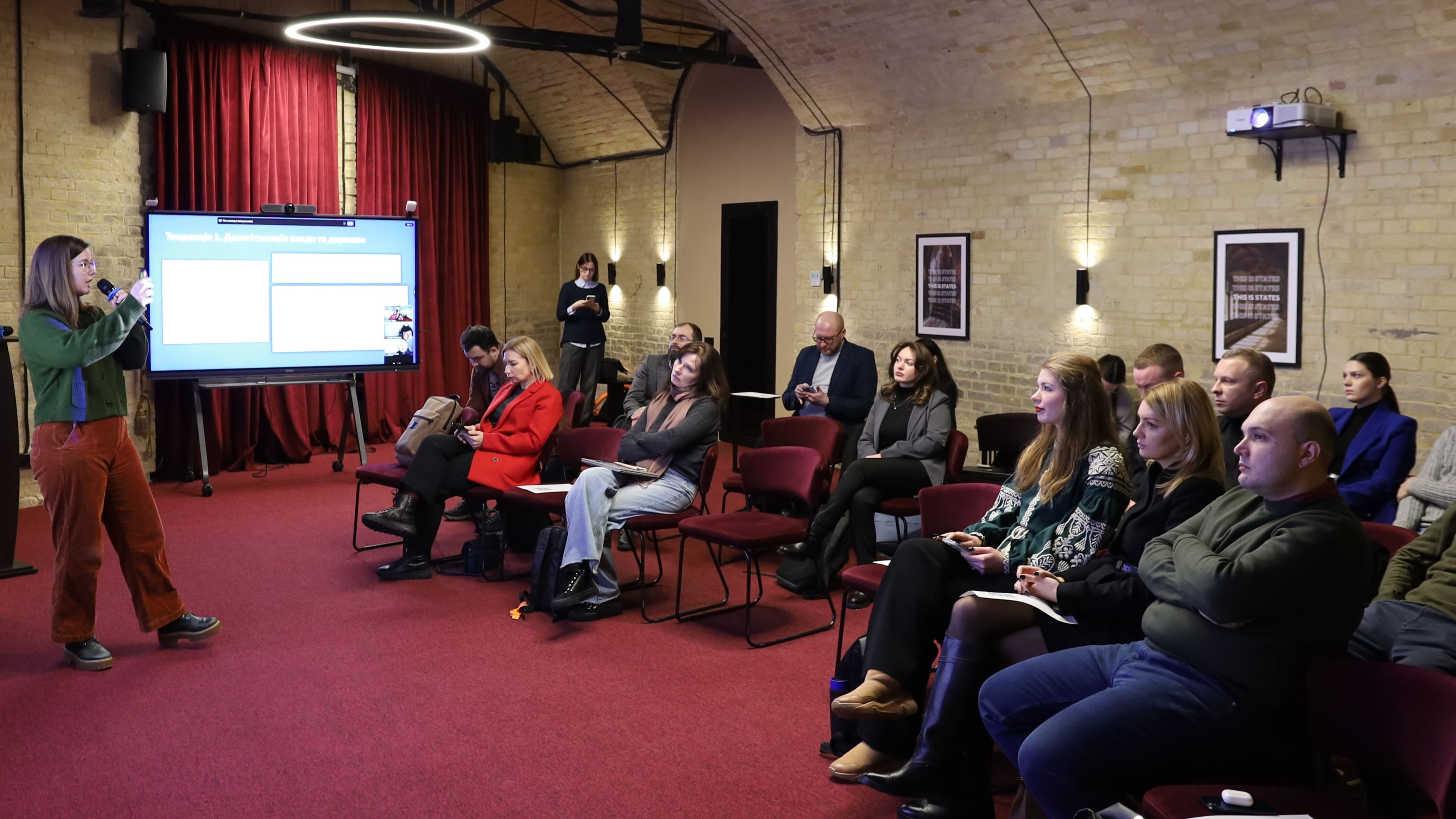
The most popular Telegram channels in Ukraine systematically disseminate violent narratives. And although such messages are few in number, they appear virtually every day or every week. This was reported by Anastasiia Romaniuk, a digital platforms analyst at the Civil Network OPORA, during the presentation of the study “Aggression in the Digital World: Research on Violent Narratives in Popular Ukrainian Telegram Channels”, which took place on 18 February.
“After three months of monitoring selected Telegram channels, we can state that the level of violent rhetoric stands at 3.6%. And here it is important to bear in mind the sheer volume of content published by these channels. In absolute terms, we are talking about several thousand pieces of content every month. However, it is not the quantity that is most alarming, but the systematic presence of such content in subscribers’ feeds. In other words, we did not record a single day or week when this rhetoric did not appear in the content of the Telegram channels we studied”, — she said.
“In the context of preparations for the upcoming election cycle, whenever it may begin, one of the key concerns is the potential polarisation of different groups of the population. That is why we have turned our attention to the issue of political violence, that is, hostile and aggressive acts of violence driven by political motives or the desire to influence political processes,” the researcher explained.
Olha Aivazovska, Chair of the Board of the Civil Network OPORA, noted during the presentation that the issue of political violence will become particularly acute during the post-war reconstruction period: “Every participant in the electoral process, every candidate, every election organiser, member of an electoral commission, and leader of political parties or civil society organisations who will be observing or carrying out specific work during this period is a potential victim of political violence”.
 (1).jpg)
According to researcher Anastasiia Romaniuk, people are not born radicals, so in order to commit violent acts of any kind (terrorist attacks, physical violence at protests, etc.), each individual must undergo a certain process of normalising violence. This happens, for example, when society considers it acceptable for such actions to have no serious consequences, and also when there is a sense that it is impossible to satisfy one’s interests by any means other than violence.
She explained: “We were interested in two aspects. Firstly, whether a favourable environment is being created in the information space that normalises and escalates various manifestations of political violence or fosters a climate of violence, making violent actions possible in the future. Secondly, which groups in Ukrainian society are systematically marginalised in the information environment, as they have fewer tools to defend their rights and are thus placed in a high-risk category”.
 (15).jpg)
For the study, OPORA experts compiled a sample comprising the 15 most popular anonymous Telegram channels in Ukraine (“Trukha”, “Insider ua”, “Ukraine Now”), the most popular Telegram bloggers (Ihor Lachenkov, Serhii Sternenko, Anatoly Shariy, Yurii Butusov, Andrii Smolii, Myroslav Oleshko) and 46 local Telegram channels (two for each region, excluding the temporarily occupied territories).
The main findings of the study can be summarised as follows:
- Violent rhetoric on the most popular Telegram channels is currently limited in percentage terms, but systematic.
- Online discourse delineates new cleavages (lines of friction) shaped by the experience of full-scale war, yet simultaneously maintains those more “traditional” to Ukrainian society.
- Graphic violence and hate speech are not only actively disseminated but also capitalised upon.
- Insults, hate speech and calls for violence are circulating on Ukrainian Telegram channels without moderation and are accessible to children.
- Political discourse on Ukrainian Telegram is saturated with discriminatory language, mockery and humiliation.
This material has been funded as part of the international development programme of the Government of the United Kingdom of Great Britain and Northern Ireland, but the views expressed herein do not necessarily reflect the official policy of the Government of the United Kingdom of Great Britain and Northern Ireland.