 This article was created within the "Advancing Democratic Integrity and Governance in Ukraine” project, which is implemented by Civil Network OPORA with the support of the EU. Its contents are the sole responsibility of Civil Network OPORA and do not necessarily reflect the views of the European Union.
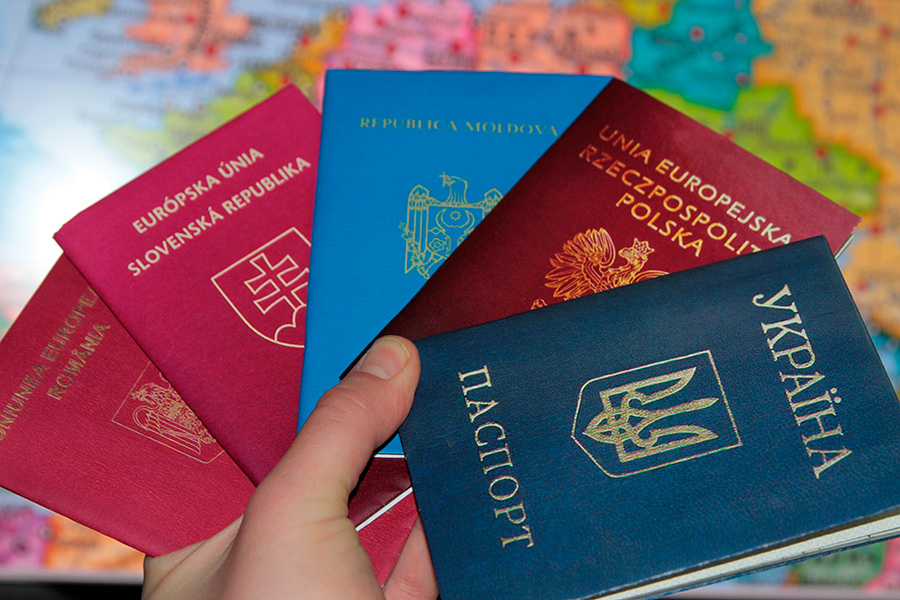
The Verkhovna Rada of Ukraine has passed a law that changes the approach to citizenship by introducing the institution of multiple citizenship. This new development has raised a multitude of questions: who will be able to hold several IDs, how will the new law affect Ukrainians abroad and in the occupied territories, and what risks and benefits does it entail? Lawyers of the Civil Network OPORA have analysed the text of the law and prepared answers to the most common questions. Below, we will explain exactly what will change for both Ukrainian citizens and foreigners who seek to obtain a Ukrainian passport.
- When will this law take effect?
Although the law has been adopted and published, it will come into force on January 16, 2026 (6 months from the date of publication). Until then, the old regulations will apply.
- How many citizenships can a person now hold?
The new law introduces the institution of multiple citizenship in Ukraine, which allows Ukrainian citizens to obtain passports from other countries without losing their Ukrainian citizenship. The number of foreign citizenships is not limited, but it is important to emphasize that this does not apply to all states. A list of countries whose citizenship can be held without the risk of losing Ukrainian citizenship will be approved by the Cabinet of Ministers of Ukraine. In addition, there is a categorical ban on obtaining citizenship of the aggressor state (the Russian Federation). It is important to note that, regardless of other passports, a person will always be recognized exclusively as a citizen of Ukraine in legal relations with this country.
- Where will I vote when having several citizenships?
According to Ukrainian law, if you are 18 years old on election day, are a citizen of Ukraine (even with other citizenships), and have not been declared legally incapacitated by a court, you can exercise your right to vote—as a rule, at your place of residence (your voting address). However, the laws of other countries of which you are a citizen may provide for a different procedure for exercising your active right to vote. It is also worth noting that after gaining full membership in the European Union, Ukraine will have to fulfill the requirements of the EU Charter of Fundamental Rights. In particular, Article 40 requires granting voting rights in local elections to EU citizens (i.e., not even citizens of Ukraine).
- What does the law mean to those who left Ukraine in 2022?
For millions of Ukrainians forced to flee abroad after the full-scale invasion, this law is an opportunity to maintain their connection with Ukraine. It allows them to obtain citizenship in the country that gave them refuge (though the list of these countries is not yet known and will be determined by the government). This helps them stabilize their lives, gain full social rights, and secure official employment, all without losing their Ukrainian citizenship. Previously, obtaining another citizenship was a formal reason for the loss of Ukrainian citizenship, although this rule was rarely applied.
- What does this law mean to people in the temporarily occupied territories?
According to Part 6 of Article 5 of the Law "On Ensuring the Rights and Freedoms of Citizens and the Legal Regime on the Temporarily Occupied Territory of Ukraine," which has been in force since 2014, the forced, automatic acquisition of Russian citizenship by Ukrainian citizens residing in the temporarily occupied territory is not recognized by Ukraine and was not a ground for losing Ukrainian citizenship.
The new law specifies what is not considered to be voluntarily acquired (and therefore not a ground for losing Ukrainian citizenship): citizenship of the aggressor state or occupying state in the temporarily occupied territory of Ukraine or in the event of illegal deportation from such territory. This also applies to cases where obtaining such citizenship required filing an application or a petition. However, these exceptions do not apply when the person's actions are aimed at promoting war and publicly supporting armed aggression against Ukraine or pose a threat to the national security and/or national interests of Ukraine.
- Can civil servants hold a dual citizenship?
No, they cannot. The new law does not change existing restrictions for civil servants. As before, they are obliged to hold only one citizenship—Ukrainian. Multiple citizenship is forbidden for them.
According to Part 1, Article 84 of the Law "On Civil Service," the establishment of a civil servant having foreign citizenship or a civil servant acquiring foreign citizenship while in service is grounds for the termination of civil service due to the loss or limitation of the right to civil service. In such a case, the appointing authority is obliged to dismiss the civil servant within three days from the day such a fact occurs or is established. For judges, the acquisition of another state's citizenship is defined as a ground for the termination of their powers at the level of the Constitution of Ukraine (Part 7, Article 126; Part 1, Article 149-1). At the same time, having foreign citizenship is not a ground for terminating the powers of the President, people's deputies of Ukraine, local deputies, or rural, settlement, or city mayors, nor does it limit their passive voting rights (running for these elected positions).
- Under what conditions can I be deprived of Ukrainian citizenship?
Depriving a person of Ukrainian citizenship is prohibited by Part 1 of Article 25 of the Constitution. However, citizenship can be terminated (OPORA has already explained the difference between deprivation and termination in the article "It is impossible to deprive, but allowed to terminate: peculiarities of citizenship termination"). The Law (Article 17 of the Law "On Citizenship of Ukraine") provides that the citizenship of Ukraine is terminated:
- As a result of renouncing citizenship (upon the application of a person permanently residing abroad, or their parents/adoptive parents);
- As a result of losing citizenship (if grounds incompatible with the status of a citizen of Ukraine are present, which is established by a Presidential Decree);
- On grounds stipulated by international treaties of Ukraine.
Losing Ukrainian citizenship occurs on the following grounds (Article 19 of the Law "On Citizenship of Ukraine"):
The voluntary acquisition (including all cases where a person has filed an application or a petition) by an adult person of citizenship of the aggressor state (or the occupying state) or of citizenship (subjecthood) of any state where the acquisition of citizenship in a simplified manner is not allowed. The list of such states (with which multiple citizenship is effectively permitted) will be determined by the Cabinet of Ministers of Ukraine. Previously, the voluntary acquisition of citizenship of any country was a ground for loss of the Ukrainian citizenship. Being granted Ukrainian citizenship on the basis of providing false information, forged documents, or concealing any material fact that would have prevented this. Compared to previous regulations, examples of providing false information are specified. The establishment of the fact that a person is performing military service under a contract for the aggressor state or the occupying state. Previously, voluntary military or alternative service in any state was a ground for the loss of Ukrainian citizenship.
A court guilty verdict coming into force against persons convicted in Ukraine for committing a number of crimes (against the foundations of national security of Ukraine, against peace, the security of humanity, and international legal order, for committing or assisting a terrorist act, creating a criminal community, etc.). Previously, this was not a ground for loss. The establishment of the fact of participation in or assistance to the commission of armed aggression against Ukraine. Previously, this was not a ground for loss. However, each of these points contains additional conditions and exceptions.
- Does this law create a risk of increasing the number of stateless people in Ukraine?
In our opinion, no. Although some grounds for the termination of citizenship were added or changed in Article 19 of the Law "On Citizenship of Ukraine," the provisions of all clauses, except for Clause 2 (providing false information upon being granted citizenship), do not apply if a citizen of Ukraine would become a stateless person as a result. This is due to the principle of statelessness reduction and Ukraine's participation in the Convention of the same name.
- How can a foreigner obtain Ukrainian citizenship?
As before, foreigners who are not entitled to acquire Ukrainian citizenship by birth (jus sanguinis), by territorial origin (jus soli), or on other grounds can be granted citizenship upon their application. However, they must meet a number of conditions, including recognizing and complying with the Constitution and laws of Ukraine (which is certified by the person in the application for citizenship submitted in the prescribed manner), knowing the fundamentals of the Constitution of Ukraine and Ukrainian history, being proficient in the state language, having continuously resided in Ukraine for the last 5 years, and having an immigration permit and legal sources of livelihood.
In addition, to formalise being granted Ukrainian citizenship, one of several declarations must be submitted (for example, a declaration of self-identification as a citizen of Ukraine, a commitment to terminate foreign citizenship, or a declaration of no foreign citizenship). However, it is important to emphasize that exceptions are provided for each of these points. Specifically, most of the points do not apply to persons who have outstanding merits, are of state interest (determined by the President of Ukraine), or who are performing military service under a contract in the manner prescribed by the laws of Ukraine.
The law does not fundamentally change the list of conditions for acquiring Ukrainian citizenship but only adds specific exceptions to them (for example, the five-year residency period does not apply to persons who have been married to a Ukrainian citizen for more than three years, whereas previously this period was two years) and modifies the procedure for submitting the aforementioned declarations.
- Does the law create the risk of an influx of migrants?
The law does not directly concern issues of migration and the status of foreigners in Ukraine—these issues are regulated by the Laws "On Immigration," "On the Legal Status of Foreigners and Stateless Persons," and "On Refugees and Persons in Need of Additional or Temporary Protection." Civil Network OPORA has researched the legal regulation of migration and has provided recommendations on the matter.
- Who cannot be granted Ukrainian citizenship?
A person will not be granted Ukrainian citizenship if they:
- Have been convicted in Ukraine for committing a serious or especially serious crime, taking into account the level of threat to the national security of the state;
- Have committed an act on the territory of another state that is recognized in Ukraine as a serious or especially serious crime;
- Are creating or have created a threat to the national security of Ukraine through their illegal actions.
The law provides an important exception that applies exclusively to crimes committed on the territory of another state. This prohibition does not apply to persons who have outstanding merits before Ukraine or have participated in its defense (in the Anti-Terrorist Operation, in repelling the armed aggression of the Russian Federation), as well as to some other categories of foreigners and their families. The main condition for applying this exception is for the Ukrainian authorities to officially establish that the person's conviction in another country was based on political motives by the aggressor-occupying state or a state that does not recognize Ukraine's territorial integrity and sovereignty. Thus, the law protects, among others, foreign volunteers and other activists from obstacles in obtaining Ukrainian citizenship due to fabricated cases in the Russian Federation or other hostile countries.
- Will Russians be able to obtain Ukrainian citizenship?
No, as a general rule, they will not. Many grounds for acquiring Ukrainian citizenship have restrictions related to the aggressor state and the occupying state, which are determined by the parliament. As of today, only Russia is recognized as such state, although according to international definitions, other countries also fall under the characteristics of an aggressor state, including Belarus (due to the use of its territory for aggression against Ukraine) and North Korea (sending armed forces for aggression against Ukraine). The legislative changes also explicitly prohibit the inclusion of such states in the government-approved list of countries with which multiple citizenship is permitted. Even if Russians fall under certain exceptions (for example, on the basis of contract service, as refugees, or as being of state interest), they will still need to submit a declaration (renunciation of Russian citizenship) and fulfill the other conditions mentioned above. Moreover, the law does not allow granting Ukrainian citizenship to persons whose illegal actions create or have created a threat to the national security of Ukraine.
- What about Russians who are persecuted in Russia?
Yes, Russians who are persecuted, particularly for pro-Ukrainian activities, can obtain Ukrainian citizenship under a somewhat simplified procedure provided for by the amendments to the Law "On Citizenship of Ukraine." The key condition is proving the fact of persecution for political reasons. According to the amendments to the law, such persecution is defined as criminal cases, illegal arrests, or other forms of deprivation of liberty committed by the Russian Federation's authorities in connection with a person's activities in defense of Ukraine's national interests. To confirm this fact, the person must obtain an official document from the Ministry of Foreign Affairs of Ukraine or a Ukrainian embassy or consulate.
The law still requires such individuals to meet the conditions for being granted Ukrainian citizenship, including passing exams on the fundamentals of the Constitution of Ukraine, Ukrainian history, and proficiency in the state language. However, instead of the complex process of renouncing Russian citizenship, they are allowed to submit a "declaration of renunciation of foreign citizenship and of recognizing oneself as a citizen of Ukraine only." This option is explicitly provided for citizens of the aggressor state who have faced confirmed persecution, and it also extends to their spouse and children. This frees them from the need to interact with Russian state bodies to terminate their citizenship, which is critically important for people fleeing political repression.
In addition, under current law (according to the Law "On Refugees and Persons in Need of Additional or Temporary Protection"), persecution for political beliefs also allows a person to obtain refugee status. Refugees are subject to additional exceptions from the conditions for being granted Ukrainian citizenship. For example, the five-year residency period in Ukraine is reduced to three years. They are also not required to have an immigration permit and legal sources of livelihood.
- Does this law have any shortcomings?
The law introduces quite a few changes, and an assessment of each of them deserves a separate article. Furthermore, the law is not yet in force, so it is currently impossible to evaluate its practical application. However, its core is the introduction of the institution of multiple citizenship, with all its advantages (primarily the ability for our citizens abroad to maintain a connection with Ukraine) and disadvantages.
In particular, there is a question of whether this Law complies with the principle of single citizenship provided for in Article 4 of the Basic Law, but only the Constitutional Court of Ukraine can provide an answer to this.
Challenges also arise related to a potential conflict of status for citizens of several states. In the article "Is there life after citizenship termination, or what will change for former citizens of Ukraine?" OPORA has already analysed such challenges, including issues of military service (when a person would have to serve in different countries), freedom of movement (under martial law, border crossing is restricted for those liable for military service, and if a person is also a citizen of another country, this may be perceived as a violation of their right to enter the country of their other nationality), holding certain government positions, legal liability (including extradition), etc. Of course, the law states that individuals with multiple citizenships are considered citizens of Ukraine (so there will be no legal obstacles to participating in elections and referendums), but such conflicts between the two statuses are inevitable and will require resolution at least at the level of bilateral agreements between states.
In addition, a moral dilemma may arise when running for elected office as to whether such a representative will truly defend the interests of Ukraine and not the state of their other citizenship.
This article was created within the "Advancing Democratic Integrity and Governance in Ukraine” project, which is implemented by Civil Network OPORA with the support of the EU.