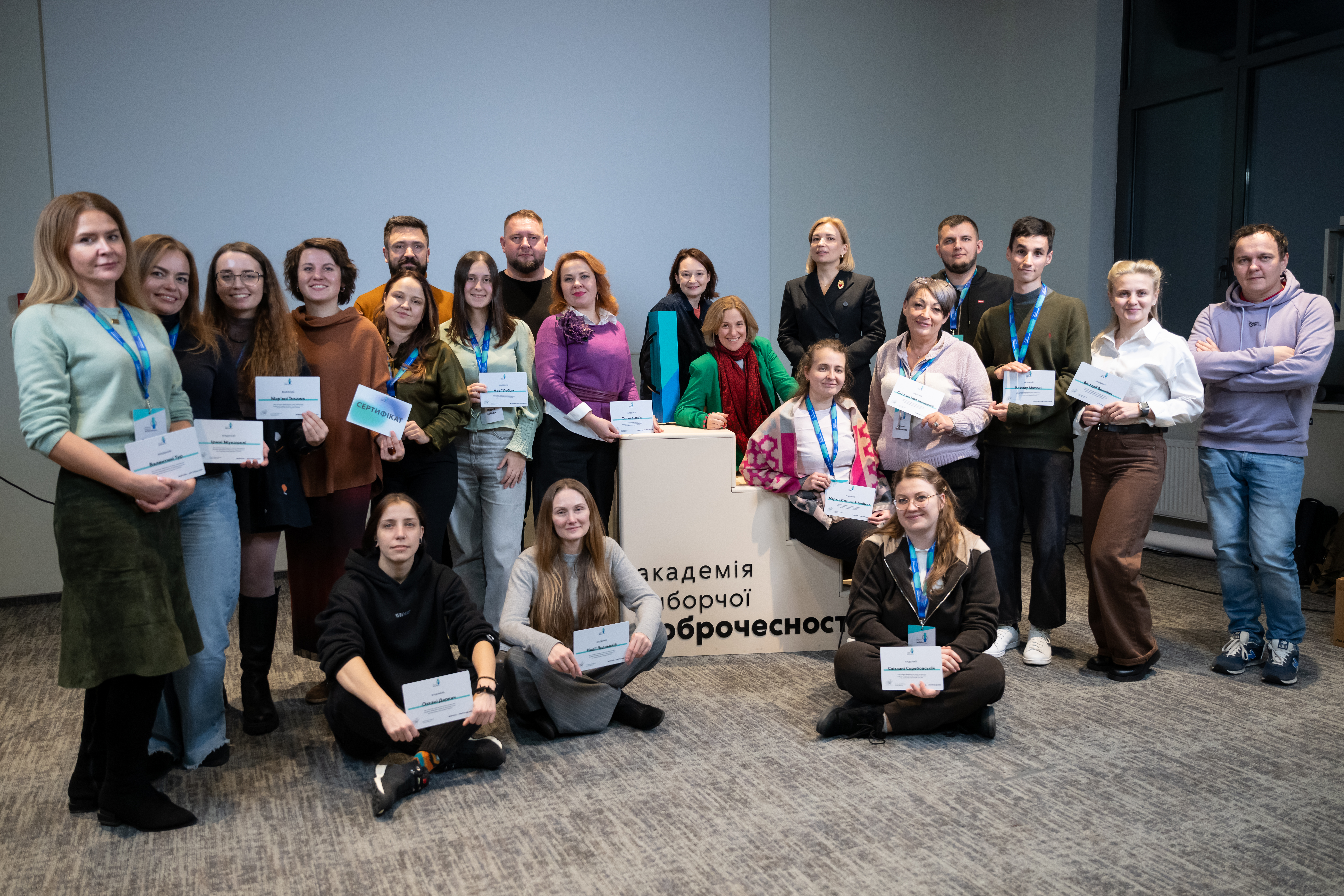
A few days ago, the first wave of the Electoral Integrity Academy concluded. This educational program brought together individuals from diverse communities, professions, and backgrounds around the idea of fair and responsible elections. Over the course of three modules, participants studied the nature of electoral processes, analyzed their architecture, explored ethical and security aspects, examined modern threats, and resolved real-world electoral dilemmas.
The Academy became a space for collaborative learning, reflection, and the formation of a community dedicated to restoring trust in democratic processes and building a culture of responsibility in Ukraine. At a time when war challenges traditional mechanisms of political participation, such initiatives serve as practical tools for supporting the resilience and maturity of communities.
.jpg)
The first module was held offline and focused on values, ethical standards, and the architecture of electoral democracy. Participants discussed the roles of various stakeholders in the electoral process, formed a shared understanding of what integrity means in practice, and contributed to the development of the Integrity Manifesto — a document that will serve as the value-based foundation for graduates.
During this module, Pavlo Klimkin, Minister for Foreign Affairs of Ukraine (2014–2019), joined the Academy. In a dialogue titled "Security as a Prerequisite for the Resumption of Electoral Processes," he spoke about the link between state security and electoral legitimacy, outlining conditions under which a return to electoral procedures would not undermine national security and would meet democratic standards.
.jpg)
Program coordinator Andriy Tokarskyi articulated the key idea that became the invisible backbone of the entire training: "Our Academy is primarily about people united by shared values and a readiness to act even in difficult times. When there is a common goal, differences do not divide us—they strengthen us. Integrity is born in joint discussions, in the ability to listen to one another, and in the search for honest solutions where it might be easier to take a simpler path."
The Academy also featured Vasyl Lutsyk, a lawyer and electoral law expert. His lectures focused on ethical leadership and typical electoral violations. He presented the electoral process as a living system in which justice and trust are shaped primarily by human behavior. The team of lecturers was also joined by Iryna Pavlenko, an expert on political parties, who focused on internal party democracy, transparency, and accountability.
.jpg)
To strengthen the security block, experts Anatolii Bondarchuk and Andrii Savchuk conducted a session on security frameworks for communities. They worked with participants on practical audit tools to assess community readiness for resuming elections. Anastasiia Romaniuk addressed information security, demonstrating how disinformation campaigns erode trust, while Iurii Lisovskyi covered the basics of risk management—from technical threats to preventive response. Final reflections, moderated by Iryna Shvets and Andriy Tokarskyi, helped integrate these topics into the Integrity Manifesto.
The second module focused on the security aspects of elections, which carry particular weight during wartime. Participants analyzed community safety criteria, worked with disinformation risks, and discussed foreign interference and institutional resilience. Olha Snopok, an analyst at OPORA, discussed the nature of influence campaigns and lessons from the "2024 election year." Kateryna Mikhalevska from OPORA explained the opportunities and threats AI brings to electoral processes. Participants mastered the nuances of party and candidate financing with expert Ihor Feshchenko, working with the POLITDATA platform.
.jpg)
In the module's legal block, participants interacted with OPORA legal experts Bohdan Mokhonchuk, Pavlo Romaniuk, Olga Kotsiuruba, and Vasyl Lutsyk. The sessions covered ECHR (European Court of Human Rights) standards in electoral matters, common violations of electoral rights, response algorithms, and liability for such violations. As a separate thematic block, participants examined the abuse of administrative resources.
The third module was dedicated to ethical leadership, complex electoral dilemmas, and transparency. Participants worked with real-life scenarios, seeking a balance between the law and core values, and examined behavioral standards that define trust in the electoral process.
.jpg)
In the final module, Kateryna Ryabiko and Maksym Yelihulashvili joined the coaching team. Kateryna Ryabiko, Strategic Advisor to OPORA and Chair of the Board of the Laboratory of Legislative Initiatives, focused on women's political participation and the inclusivity of electoral processes. Meanwhile, Maksym Yelihulashvili, a facilitator, conflictologist, and expert at the Institute for Peace and Understanding, worked with participants on conflict behavior strategies, mediation, and dialogue in electoral disputes, demonstrating how negotiation and mediation tools help restore trust in complex political situations. Anatolii Bondarchuk, an analyst at Civil Network OPORA, focused on manifestations of the abuse of administrative resources in the electoral process and explained how these practices impact trust, equality of opportunity, and election results.
During the lecture on negotiation methods and preparing for complex communications, Olga Aivazovska, Chair of the Board of Civil Network OPORA, shared her personal experience participating in the negotiation subgroup within the Minsk process. She also explained the rationale for ongoing negotiations to resolve the Russo-Ukrainian war.
.jpg)
During the certificate ceremony, Olga Aivazovska summarized, "The community forming around the Academy is an investment in the future quality of democracy. We will certainly involve graduates in OPORA’s processes, as their expertise and values strengthen our work. Concordia res parvae crescunt—in harmony and trust, even small things grow. Democracy grows in the same way when responsible people work on it."
.jpg)
The participants also shared their impressions:
"I really missed spaces like this, where one can freely talk about electoral and political processes, debate, and reflect. This is truly valuable. It is especially inspiring that young people, who haven’t even voted yet, are already actively following politics and joining the discussions," Iryna Pylypenko, Academy participant, said.
"I am sincerely grateful for this experience. I am convinced that the connection between us will remain—and will grow into new joint initiatives or work during the elections that we are all so looking forward to," Yana Sauliak, Academy participant, said.
.jpg)
"For me, this was a 'great love'—because it was a truly safe space. A space of warmth, smiles, and mutual understanding. We shared knowledge openly and applied it in practice immediately, even when a competition of opinions arose during activities," Maryna Stashyna-Neimet, Academy participant, said.
"The topic of networking became one of the most valuable to me. People empower people—and it is precisely because of this that we all become stronger and better,” Maryana Tekliuk, Academy participant, said.
.jpg)
For many, the Academy became a supportive environment, a source of new meaning, and a platform for professional growth. For us, it is a testament to Ukraine's community's capacity to strengthen democratic institutions and foster a culture of integrity, even in the most challenging times.
The Academy team is sincerely grateful to all participants for their trust, engagement, and readiness to apply their knowledge within their communities. The first wave is ending, but the community continues to grow. Together, we are working to ensure that Ukraine has fair, free, and genuine elections that society can trust.