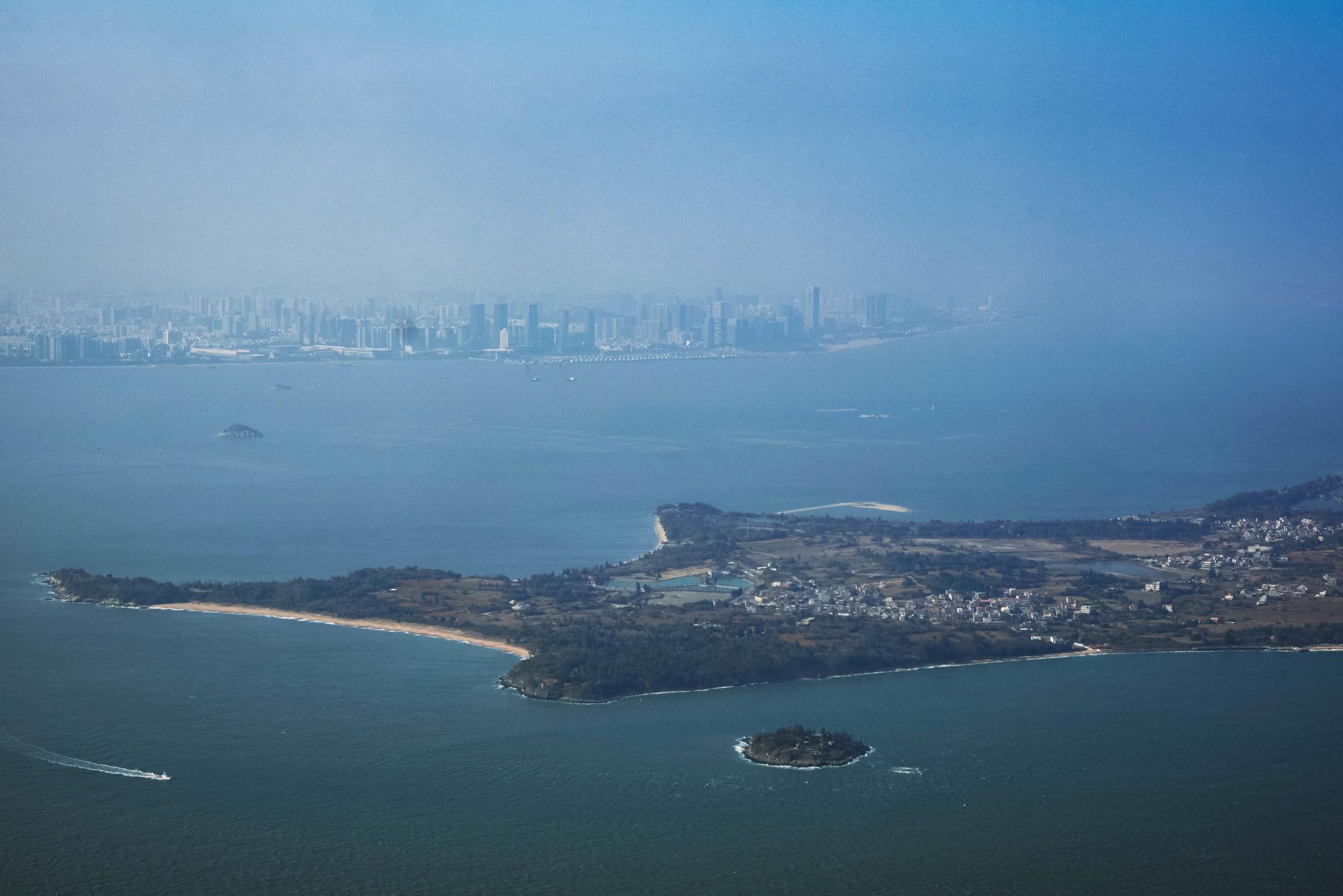
This is a report by the Taiwanese organisation Factlink. It has been published with the authors’ permission as part of the cooperation between Civil Network OPORA and Factlink on researching Russian and Chinese propaganda. The analysis and conclusions are those of the authors of the original report.
OPORA’s study on the use of AI to promote Russian propaganda on TikTok, produced as part of this cooperation, is available here.
Wei-Ping Li, Research Director, FactLink
Mary Ma, Head of Investigation, FactLink
Summer Chen, Founder and reporter, FactLink
The Chinese Communist Party’s (CCP) propaganda targeting Taiwanese audiences goes beyond harsh criticism of Taiwan’s politics and efforts to gain recognition as a country. Some pieces instead seek to evoke a sense of “yearning to come back to the motherland” among Taiwanese people while highlighting the benefits of “reunification.” Recently, powerful AI tools have enabled Chinese propaganda to turn this rhetoric into videos depicting an idealized picture of convenient, comfortable living, alongside a determined Chinese government working to help Taiwanese people “achieve a better life.” We use TikTok videos themed around “building up Xiamen- Kinmen Bridge” to showcase how recent Chinese propaganda has used AI to create a rosy yet unsettling picture for Taiwanese audiences.
To understand the role of AI in videos with the theme of “Xiamen-Kinmen Bridge” disseminated on TikTok, we searched for relevant videos from 2023, when the Chinese government started building the Chinese side of the bridge, to September 1, 2026, using the keywords “Xiamen-Kinmen Bridge” and “Kinmen-Xiamen Bridge” on Apify and TikTok. We obtained 112 videos focused on the theme. We then manually examined and labeled the videos by account location, video date, audience engagement, subthemes, video style, and whether the videos were AI-generated. To assess whether the videos were made with AI, we used several techniques, including reviewing video details, using reverse image search, comparing with images of the locations, looking for details in the TikTok accounts, and submitting queries to multiple AI image-detection tools. All suspicious images were examined by three of FactLink’s team members. We also sampled and sent videos to independent experts to verify whether the videos were made with AI. To analyze trends and possible coordination among creators, we compared posting dates of the videos, the locations and dates the accounts were established, image and script similarities, and extracted shared elements to construct common narratives.
We will detail our findings in later sections. Before discussing the AI videos, however, we need to briefly introduce the controversial “Xiamen-Kinmen Bridge” plan and what its construction symbolizes for Taiwanese and Chinese people so readers can better understand and evaluate the purpose, techniques, and influence of Chinese propaganda.
Located between Taiwan and Xiamen, a city in southeastern China’s Fujian province, Kinmen is a group of islands that served as an important stronghold for the Kuomintang (KMT, or the Nationalist Party of China) in defending Taiwan after the KMT was defeated by the Chinese Communist Party (CCP) and fled to Taiwan. Kinmen is geographically closer to Xiamen, with just 6 miles separating them at their nearest points. Since Taiwan began gradually opening direct trade, transportation, and postal links (the three direct links) between Kinmen and Xiamen in the early 2000s, the two communities have grown intertwined through tourism, daily commerce, investment flows, and shared resources. For example, since 2018, a Fujian water company has supplied some of Kinmen's water. As the tie has grown closer, the Xiamen government and several Taiwanese politicians, including former Taipei mayor Ko Wen-je, who ran for president in Taiwan’s 2024 election, have proposed building a bridge connecting Xiamen and Kinmen.
The CCP has been enthusiastically building the bridge because it sees the project as a symbol of Taiwan’s eventual integration into China. In 2019, Chinese leader Xi Jinping said that “connections for water, electricity, gas, and bridges” between Xiamen and Kinmen could serve as a harbinger and model for broader connections between China and Taiwan. For Taiwanese people, although the bridge could improve life for Kinmen residents, it also raises serious national security concerns, including the risk of compromising Taiwan’s border security. It could also signal to the international community that “Kinmen is an inseparable part of China” and undermine Taiwan’s sovereignty. For these reasons, the Taiwanese government has firmly opposed the project. Despite Taiwan’s opposition, China began construction in 2023 on the section running from Xiamen Island to the new Xiang'an International Airport. However, when this report was written in late September 2026, there was no indication that Taiwan intended to build its section of the bridge. Still, videos about the construction of the Xiamen-Kinmen bridge have circulated on TikTok since 2023, with their numbers surging in late 2025, boosted by AI.
A comparison between TikTok videos produced before and after 2025, when AI-generated videos became more common, indicates how AI has facilitated video production. The early videos, which circulated in 2023 when construction on the “Xiamen-Kinmen Bridge” began, feature authentic news clips of Taiwanese politicians, such as Ko Wen-je, expressing support for the bridge, as well as footage of major construction milestones. Later, some videos also show individuals standing in front of the construction site and shouting, “Everybody look! This is the first cross-sea Xiamen-Kinmen bridge that leads to Taiwan!” Since 2025, however, AI-generated scenes have been added and mixed with authentic images. Many depict construction work (see Image 1), including workers enduring harsh weather, and boast about the milestone achievements of the bridge. Others even specify that Americans react with shock to the remarkable construction work by the Chinese (see Image 2). Although some images are easy to identify as AI-generated, combining authentic and fabricated construction scenes has made it harder for audiences to distinguish the bridge’s actual progress from imagined scenes of its completed form.
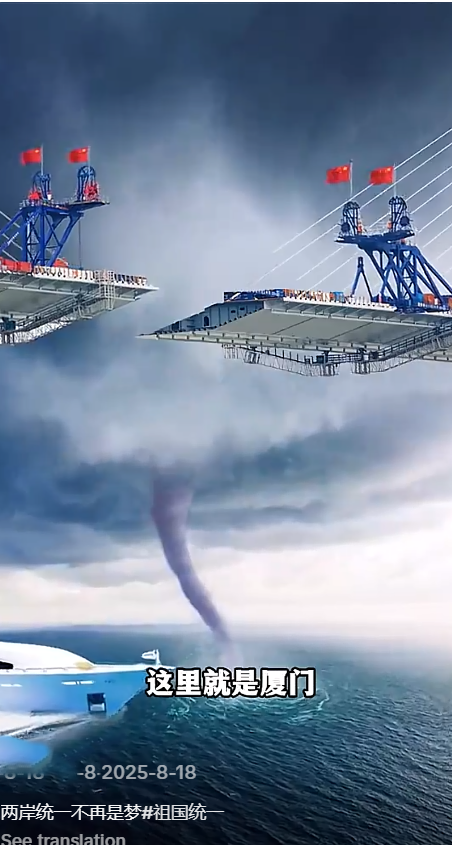
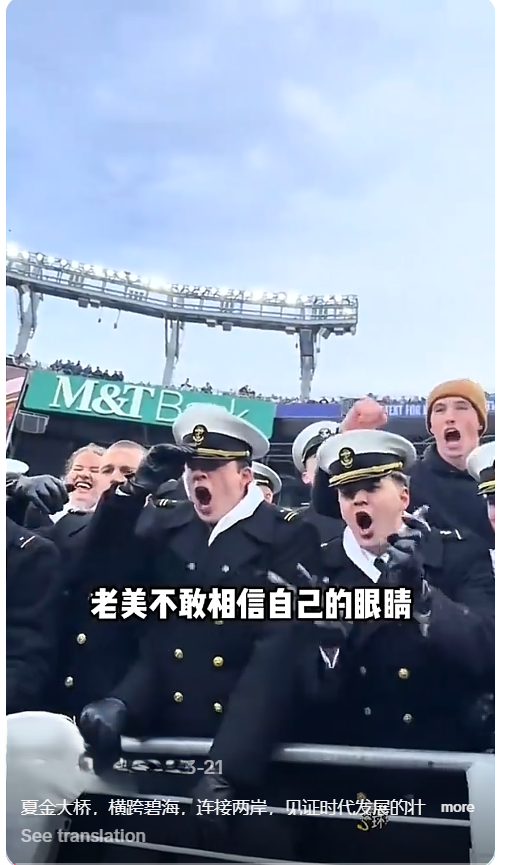
Image 1: An AI-generated scene in one of the videos. The Chinese title says, “This is Xiamen.” Image 2: An AI-generated scene depicting “Americans cannot believe their own eyes!”
The use of AI to create videos about the “Kinmen-Xiamen Bridge” taps into China's summer 2026 trend of AI short dramas. An AI drama-style video titled “Kinmen-Xiamen Bridge - a road to home” appeared on TikTok in July 2026. More than two minutes long, it features two related stories highlighting the benefits of a bridge connecting Xiamen and Kinmen, the Chinese people’s determination to improve life for Kinmen residents, and the Taiwanese government’s “heartless” objection to its construction and disregard for Kinmen people’s needs. In the first story, an old man urges a young fisherman, who is indifferent to the bridge's construction, to appreciate the Chinese government's efforts. The old man claims that “our water and electricity were all supplied by Fujian,” which is incorrect in reality: Kinmen has not used electricity from Xiamen. At the end, the old man says, “This bridge is for all the people who want to go home” and wishes for a better life once the bridge is built. In the video’s second part, a Chinese construction worker questions the purpose of building the bridge, since Taiwan has not even raised a finger to build its part. His colleague warmly reiterated the old man’s comment from the first part: “This bridge is for all the people who want to go home,” and claims they would fulfill their promise because Taiwanese people look forward to the bridge.
Unlike videos that showcase construction sites and tout the bridge's achievements, this AI short drama uses a plot and light background music to emphasize China’s care for Taiwanese people and its wish for them to “have a better life,” while appealing to the “family tie” between Kinmen (Taiwanese people) and Xiamen (Chinese people). The scenes transition smoothly, and the characters resemble real people. However, attentive viewers can still spot flaws that reveal the video was AI-generated. For example, the old man’s accent changes abruptly midway through a scene. As appealing as the drama-style AI video may be, it has not been widely disseminated: it has received only 170 shares two months after posting. (The account that posted it had 4,548 followers in September 2026, although it was probably not the video’s original creator.) Further searches found no evidence that other TikTok accounts had widely shared the video, either.
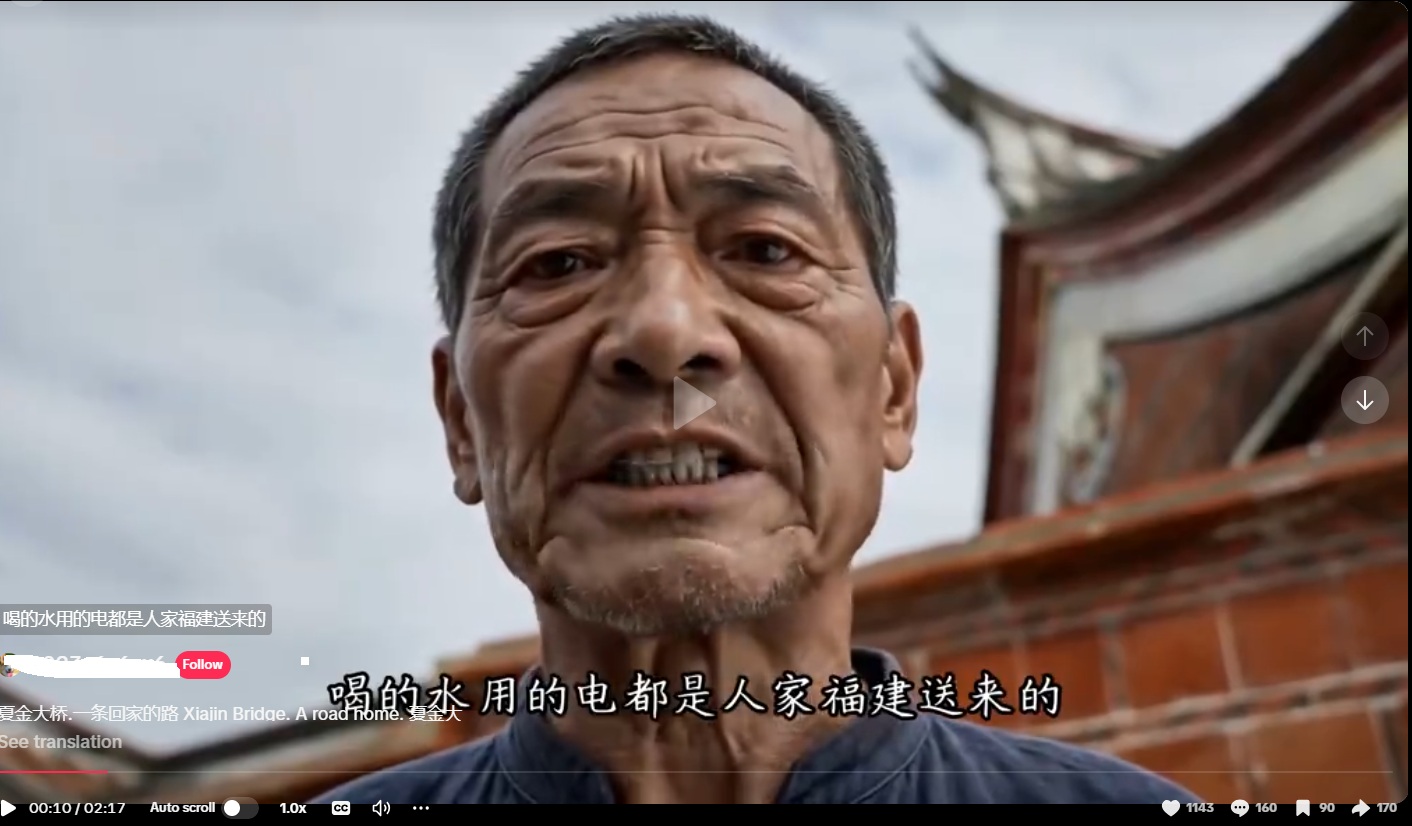
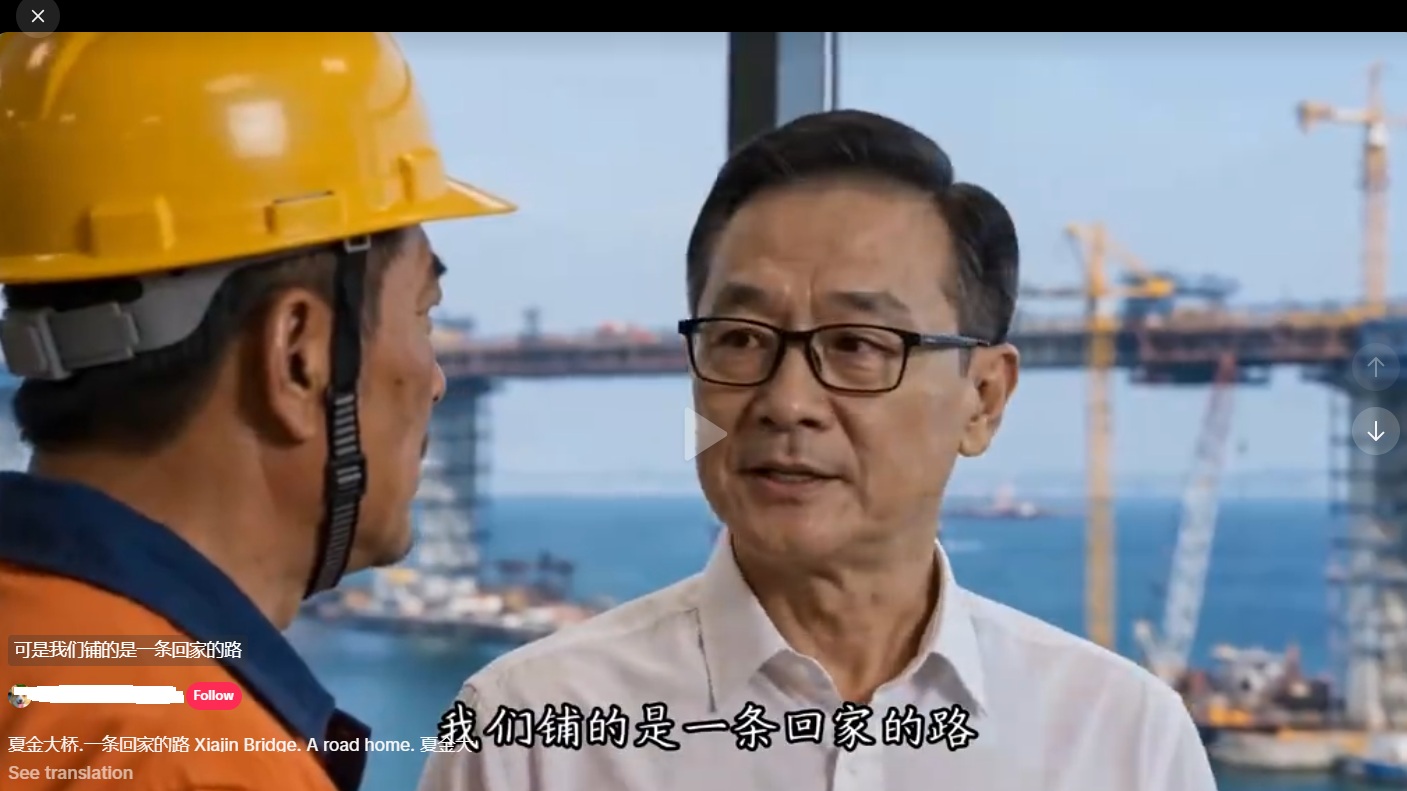
Images 3 and 4: Scenes from an AI-generated short drama promoting the idea that the “Kinmen-Xiamen Bridge” is a bridge for Kinmen residents and the Taiwanese people to return “home.”
In addition to the AI short-drama video that drew little attention, we identified a coordinated propaganda campaign in which different AI-generated female hosts read highly identical scripts. The videos open with the lines “The U.S. really can't sit still anymore; they are in a state of frantic agitation, as Taiwan is on the verge of establishing direct links with the mainland!” The hosts then describe the large sums the Chinese government has spent on construction and how Chinese engineers have overcome challenges crossing the sea to connect Xiamen and Kinmen. “It will no longer be a dream to drive directly from Xiamen to Kinmen- it will only take tens of minutes.” The videos all end by invoking Japan, despite Japan having no stake in the matter. The hosts urge viewers to “like” the video by appealing to patriotism and the negative feelings many Chinese people feel toward Japan:
“A video of cherry blossoms from Japan garnered over a million likes. Doesn't our own "super project," which connects the blood of both sides of the Strait, deserve to be seen by even more people? Let's boost this post so that more sons and daughters of China can see it!” (See images 5, 6, 7,8)

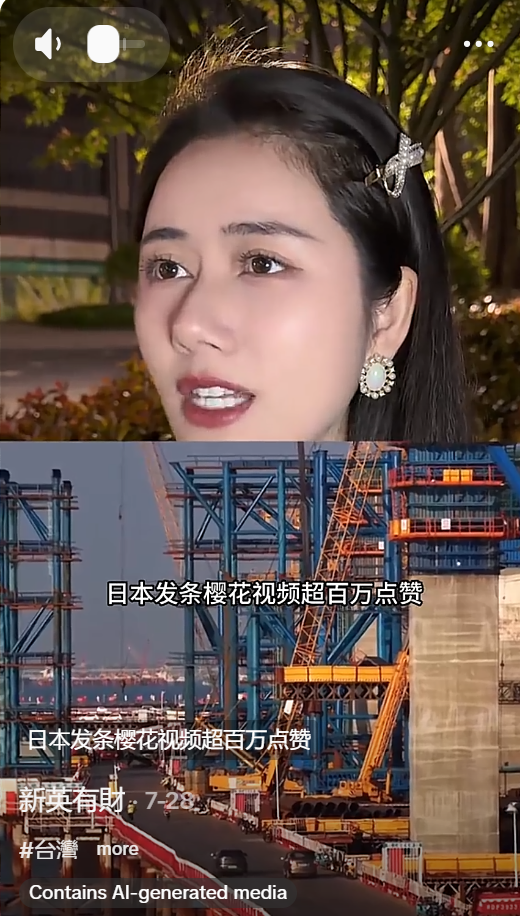


Images 5,6,7,8: Screenshots show different “female financial experts” using identical lines in their videos to urge audiences to “like” them by contrasting their videos with Japanese cherry blossom videos and appealing to patriotism.
Not only are the scripts largely the same, but the videos share an identical style, with all hosts as the main focus, standing on a street or sitting in rooms, tilting their heads, and turning their faces toward and away from the cameras. Most of the hosts (and their TikTok accounts) claim to be “financial experts” and offer investment tips, economic analysis, and commentary on international affairs. In total, we identified 12 “female expert” personas posting similar videos about the Xiamen-Kinmen bridge, across 23 videos. Of these, four personas used multiple accounts under different names. For example, we found that the account nicknamed “Fiance girl Ing-Ing[財女英英]” also posted similar content under two other accounts, “Hsing-Ing got money[新英有財]” and “Ging-Shin[靜心].”
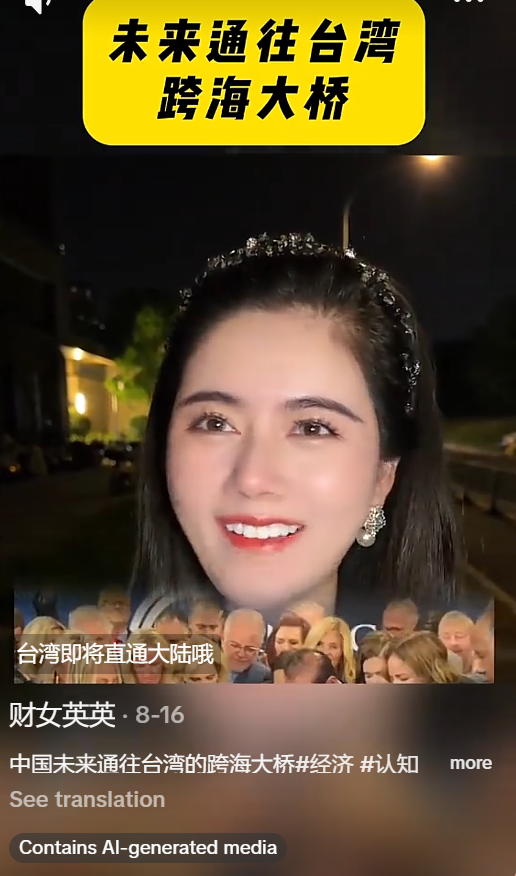
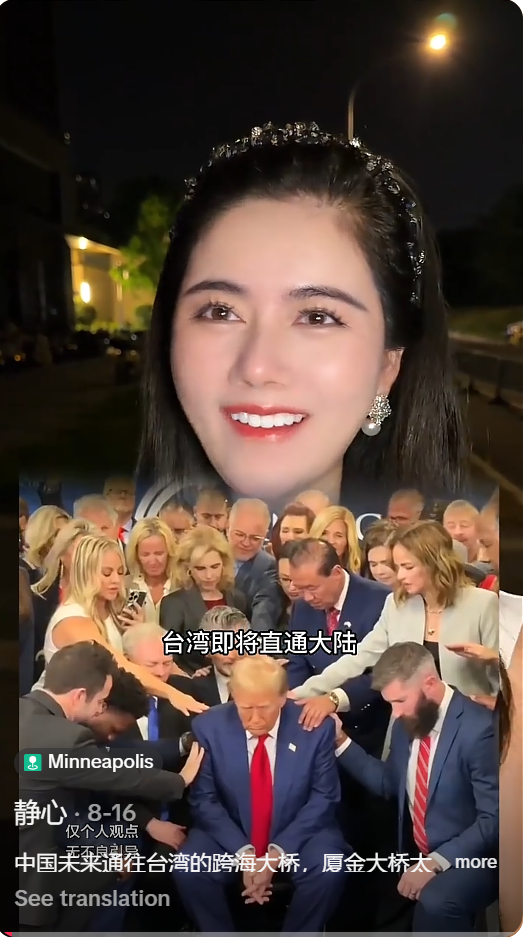
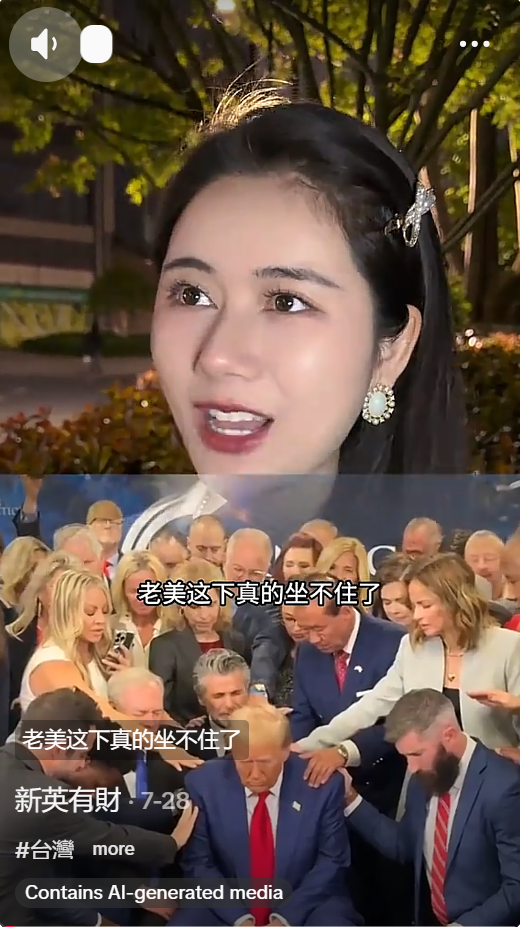
Images 9,10,11: Three TikTok accounts used identical hosts and scripts to promote propaganda about the “Xiamen-Kinmen bridge.”
Multiple videos also feature identical construction- or news-clip-like scenes in the lower part of the screen. For example, one AI-generated scene shows Trump surrounded by supporters and praying with them. Some videos openly label themselves as containing “AI-generated media.” We submitted the image to the AI-detection websites Image Whisperer and Hive Moderation, both classified it as “AI-generated.” ImageWhisperer also indicated that some of the videos were made with Google Veo-3, an advanced generative AI video model developed by DeepMind.
We also found cases in which the female host was highly likely to be AI-generated. AI-detection websites Image Whisperer and Hive Moderation, along with independent AI image verification expert Dr. Chih-Chung Hsu (許志仲) of National Yang Ming Chiao Tung University, concluded that the host herself might be an AI-generated figure. (Images 13-14 are examples of accounts that the host could be an AI-generated figure).

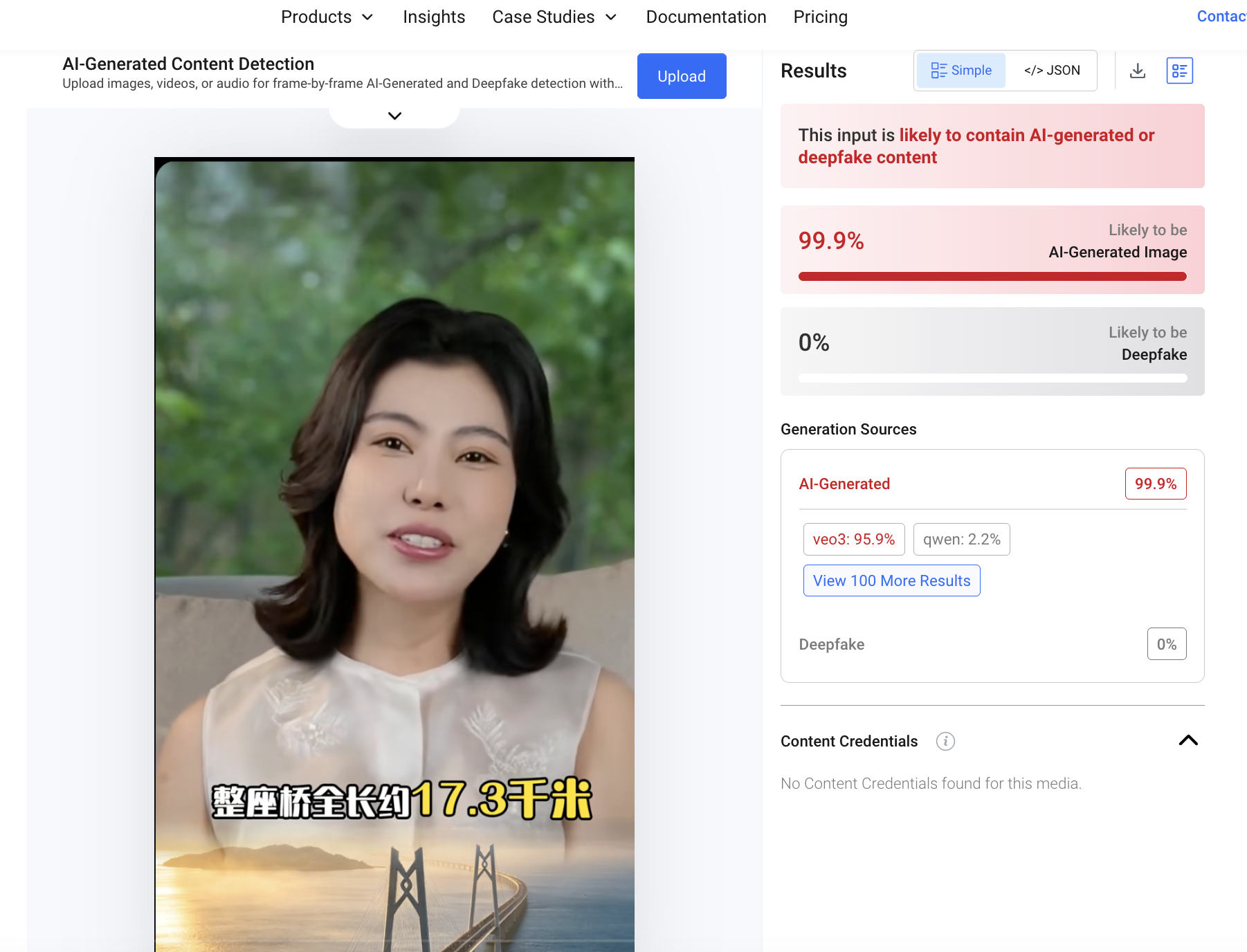
Image 13-14 AI Verification results by ImageWhisper and Hive Moderation
The posting dates of the videos and the account creation dates, alongside their identical scripts and visual arrangements, suggest that the videos may have been part of a coordinated campaign. Of the 23 videos we identified as potentially linked to the same campaign, 21 were posted in late July and August 2026, while the other two were posted in March and April 2026. Most accounts were created after late 2025, with one exception dating to 2023. As for the locations of these accounts, most appeared to be in Southeast Asian countries, including Malaysia, Singapore, and Myanmar, with 6 in Taiwan and 1 in the United States.
By presenting the hosts as “financial experts” and sharing “investment tips,” these videos appeal to viewers who may not have strong political views but are interested in investment knowledge or current events. In this way, they reach people with a wider range of interests than political leanings alone. The attractive female personas may also draw viewers who linger on videos featuring pretty faces, making them more likely to absorb the hosts’ stories. However, a closer look at the “financial tips” shows that they mostly consist of generic recommendations, such as “luck is very important when you are making investment decisions,” or praise for China's rise.
How have audiences responded to these AI-hosted videos? Even with multiple personas and videos across TikTok repeating the same propaganda lines, overall engagement across these videos seems tepid. Since the videos were posted in August 2026, most have received only hundreds of likes and dozens of comments. While some commenters expressed appreciation with thumbs-up or smiling emojis, others voiced disapproval and tried to set the record straight. Still, none of the comments flag the videos as AI-generated—even when the videos explicitly state that they “contain AI-generated media”.
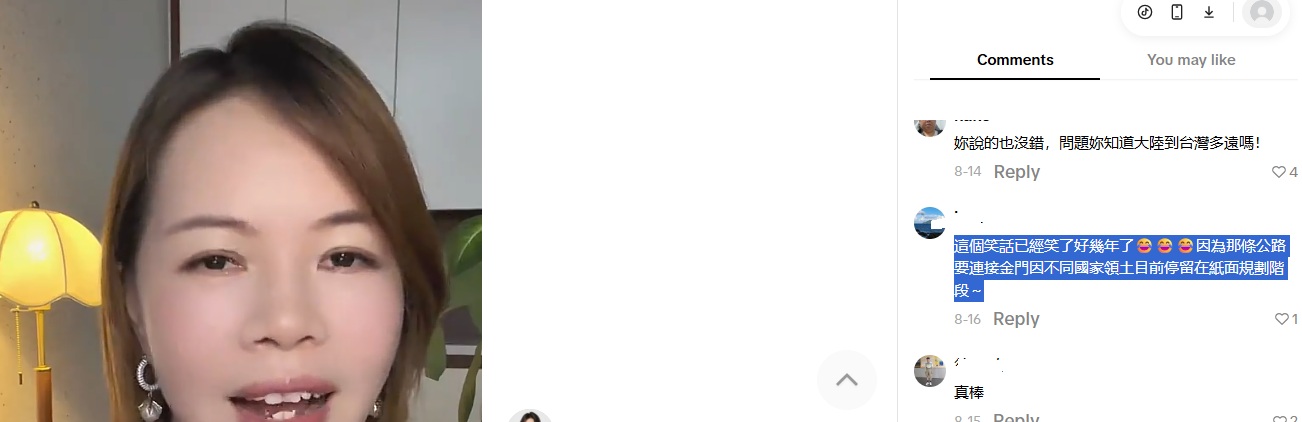
Image 9: Comments disapproving and ridiculing the video. The highlighted sentence goes: “People have been joking about this for years—specifically regarding the highway intended to connect Kinmen; because it involves territories belonging to different countries, the project currently remains stuck at the planning stage.”
Takeaways
Through the research on cases where TikTok videos use the “Xiamen-Kinmen bridge” theme to promote Chinese soft propaganda, we would like to highlight the following takeaways:
- AI tools have enabled information manipulators to produce generic videos quickly and at scale. For example, “female expert” videos that contain AI materials use highly identical scripts and similar styles. With just a few key prompts, AI-generated images can be easily created and merged into videos using a template, with each one repeating the same lines and similar scenes. The growing volume of these similar videos could help them reach more people and increase opportunities to influence audiences, although these operations do not appear very successful at present. Still, the risk remains as long as AI tools make this possible.
- AI tools can also produce drama-like content featuring plots, characters, and even music without real people playing the roles, shortening production time and lowering costs. As AI-generated short dramas grow more popular on social media, we expect more information campaigns to use these techniques to tell stories framed around “the Chinese story” and influence audiences’ perceptions in Taiwan and other countries. AI tools can also help these campaigns reach audiences who speak different languages by making it easier to overcome language barriers.
- AI tools are also used to create realistic imaginary scenes. In the cases we studied, some scenes depicting construction and events were AI-generated. As these tools advance, especially when AI-generated images are mixed with real footage, it will become even harder for audiences to distinguish fake scenes from real ones, what happened from what did not, and, of course, propaganda from truth.