
At the start of Russia's war against Ukraine, creating propaganda images required real people. In 2014, Ukrainian journalists dubbed them "gastrolers" ("touring performers"), since the same faces kept appearing in different cities and TV segments, playing entirely different roles.
One of the most famous "gastrolers" was Andrey Petkov, who was shown on air on three different Russian TV channels from the very same hospital bed but with three different biographies. On "Rossiya 1," Petkov said he was an ordinary resident of Mykolaiv who had been injured during protests against "Ukrainian militants." For NTV, Petkov presented himself as a German mercenary who had brought money from Germany for "Ukrainian neo-Nazis." And in an interview with a Crimean outlet, the man introduced himself as a pediatric surgeon who had saved the lives of more than 200 infants and returned to his native Mykolaiv to organize protests against the new Ukrainian government.
Cases like this were not rare, since Russian propaganda desperately needed actors to portray the "horrific acts of the new neo-Nazi regime in Kyiv" for both domestic and international audiences. Beyond the actors, staging such productions required a location, a cameraman, editing, a script, or at the very least a real story that could be twisted beyond recognition.
Nowadays, however, much of this work can be done using just one person, a computer, and a well-written prompt. Generative artificial intelligence (AI) makes it possible to create a character, their voice, appearance, location, and even the event itself—one that never happened—and to do all of this quickly, cheaply, and at a scale that Russian propagandists in the 2010s could not even have dreamed of. Volodymyr Zelenskyу can dance for Donald Trump, Vladimir Putin can beat up the Ukrainian President, Ukrainian military enlistment offices (territorial recruitment centers, TRCs) staff can come to take away newborns from maternity wards, and a non-existent news anchor can report on events that never took place.
TikTok is a particularly favorable environment for this kind of content. Memes, music, and other entertainment formats on the platform allow users to relax and be less critical of the videos they see. As a result, Russian propagandists can promote their narratives, reaching diverse audiences in a format that is easy to consume. In this study, Civil Network OPORA examined how actively AI is being used to promote Russian propaganda on the Ukrainian segment of TikTok and which specific narratives Russia is promoting on the platform.
Scene overview: Why and how did we study TikTok?
To find out how AI helps various actors influence the views of Ukrainian audiences regarding the Russian-Ukrainian war, we focused on two key areas: undermining the reputation of the Ukrainian military by lowering trust in servicemen and territorial recuitment centers (TRCs), and undermining the reputation of the Ukrainian authorities by lowering trust in key state institutions. TikTok was chosen for this study as a social network that is built entirely around visual content, which makes it possible to detect signs of AI use far more effectively than on other social media oriented mainly toward text formats.
Since TikTok does not offer its own analytical tools, this significantly complicates the ability to search for and track the behavior patterns of various actors. Therefore, the OPORA team first conducted exploratory research of the platform's content on the selected topics. To do this, we compiled a list of hashtags that, in our view, largely reflect the public discussion around the topics chosen for this study:
- undermining the reputation of the Ukrainian military: #бусифікація (refers to the forced via minibus round-ups), #зрадникиукраїни (traitors of Ukraine), #могилізація (refers to the forced mobilization as a quick way to the grave), #геноцидукраїнців (genocide of Ukrainians), #ганьбатцк (shame to TRCs), #зрадникиуформі (traitors in the [military] uniform), #військові (the military), #ЗСУ (AFU, Armed Forces of Ukraine);
- undermining the reputation of the Ukrainian authorities: #зелячерт (“Zelenskyy is a devil”), #зеля (derogatory form of Zelenskyy’s name), #верховнарада (Verkkhovna Rada, parliament of Ukraine), #депутати (deputies), #зеленський (Zelenskyy).
Using Apify, we scraped TikTok posts containing these hashtags, and then analyzed the downloaded content for signs of AI use. If a particular TikTok profile systematically used AI to create content on one of the topics we selected for this study, we added it to a database of profiles for further in-depth examination.
At the same time, while viewing videos in the desktop version of TikTok, we noticed the "You may like" section—the platform's recommendations for content a user might enjoy based on the videos they watch. In this section, we noticed many profiles publishing content with signs of AI use on both topics chosen for the study. In addition, it turned out that, beyond undermining the reputation of the Ukrainian authorities and military, TikTok systematically recommended profiles with AI-generated content on two further thematic areas: pro-Ukrainian content and content promoting narratives linked to the Russian Orthodox Church. This prompted us to somewhat adjust our approach and expand the study to include these two additional topics.
As a result, the final dataset covers four topics where we observed active use of AI:
- Undermining the reputation of the Ukrainian military;
- Undermining the reputation of the Ukrainian authorities;
- Pro-Ukrainian content in support of the military and the authorities;
- The use of "soft power" (particularly religion) to promote pro-Russian narratives.
For each of the four areas, we collected 60 TikTok profiles that used AI to create posts (240 profiles in total). We downloaded all publications from the moment each of these accounts was created up to July 13, 2026—a total of 152,759 posts.
From this dataset, a sample was formed consisting of 2,000 posts for each thematic group. The sample was constructed based on channel name, which made it possible to cover publications from all TikTok accounts proportionally. This approach allows capturing the key features and tactics of AI-generated content use, but does not allow tracking the dynamics of growth in AI use over the entire observation period. It should be noted that some TikTok channels were deleted during the study, which means the final figures may vary.
OPORA team manually analyzed the final dataset, with a total sample of 8,000 posts, to identify the key themes and narratives used by various actors to influence the attitudes of TikTok users in Ukraine regarding various issues related to the Russian-Ukrainian war.
Cast of characters: key characteristics of TikTok accounts
Before moving on to the analysis of specific themes and narratives, it is worth describing the accounts themselves that made it into our sample. For convenience, within this subsection we combined three of the four thematic areas (undermining the reputation of the Ukrainian military, undermining the reputation of the Ukrainian authorities, and promoting narratives linked to the Russian Orthodox Church) into a single category, which we will henceforth refer to as "destructive content." All three areas, while differing in their specific narratives, share a common goal—undermining audience trust in Ukrainian institutions and the army, or casting doubt on Ukrainian identity.
Set apart from this category is the fourth area—pro-Ukrainian content in support of the military and the authorities—which we analyze separately since it differs substantially from the other three. Combining the three areas allows us not only to see the overall scale of the spread of destructive content but also to trace the developmental dynamics of the channels that spread it and to determine whether the emergence of these accounts was an organic process or coordinated activity that intensified during a particular period.
Since TikTok does not show an account's creation date, in this study we determine the approximate starting point of a given channel's existence by the publication date of its first post. This approach is not fully reliable, since some channels may have been created earlier but did not publish posts, while others may periodically delete previous posts to "refresh" their subject. Nevertheless, this is currently the only way to approximately assess trends in the creation of such accounts.
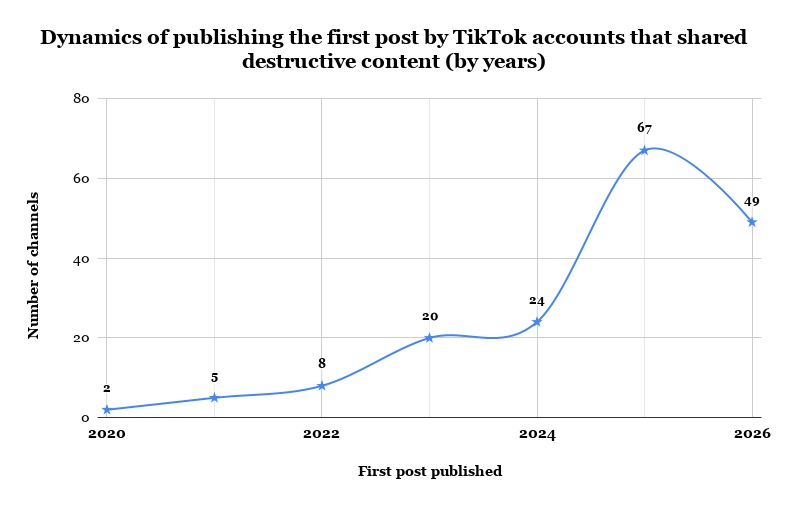
Looking at the dates of the first posts published by accounts with destructive content, it becomes noticeable that the number of new channels grew unevenly. In 2020–2022, only 15 of the accounts we studied published their first post. In 2023, however, 20 accounts already published their first post, and 24 started publishing content in 2024. The peak falls on 2025, when 67 channels published their first post, and in just the first seven months of 2026 alone, 49 new accounts appeared that use AI to promote destructive narratives.
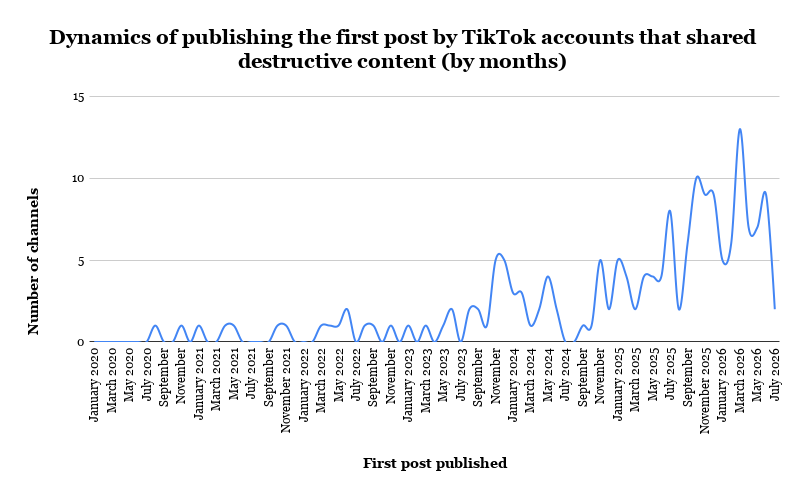
If we look at the dynamics of first posts appearing across the studied channels on a monthly basis, the picture becomes even clearer. Until the end of 2023, the number of new accounts per month rarely exceeded 1 or 2. The situation began to change in November 2023, when more than 5 new channels appeared in a single month. Throughout 2024, a growth trend is also observed, though somewhat unstable. The most noticeable spikes occur in 2025–2026: in July and September 2025, the number of new channels exceeded 8 and 10, respectively, for the first time, and in March 2026 an absolute maximum for the entire observation period was recorded—13 new accounts in a single month. This dynamic may indicate not organic growth of interest in the topic but a situation in which new channels appear in groups during certain periods.
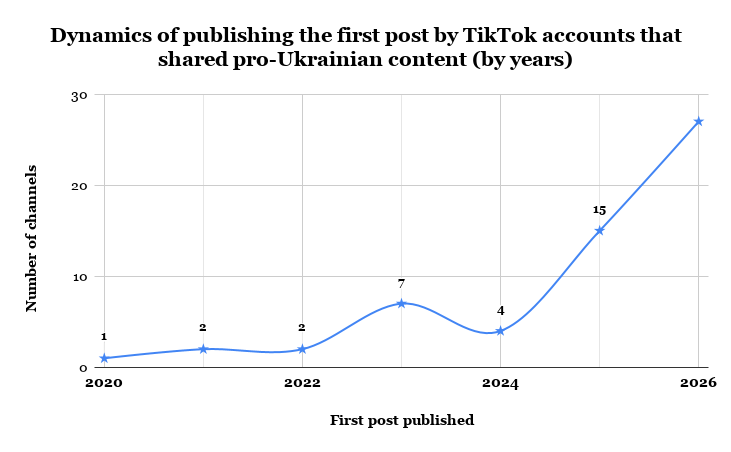
A similar situation is observed with pro-Ukrainian TikTok accounts: 16 of them published their first posts between 2020 and 2024. A noticeable increase in the number of new channels begins in 2025, when 15 accounts published their first videos on the platform, and in just the first seven months of 2026 alone, 27 new accounts had already appeared.
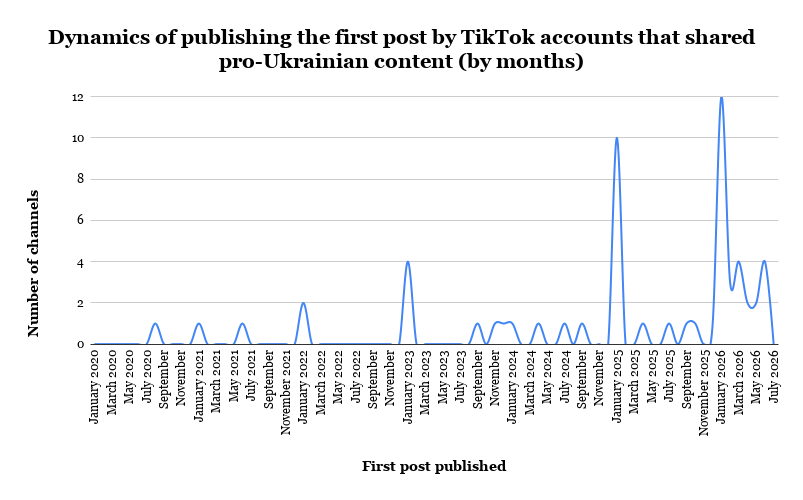
The monthly breakdown allows for a closer examination of the identified trends. Unlike destructive content, where growth occurred gradually, pro-Ukrainian accounts are characterized by sharp spikes in the number of new accounts. The most notable peaks occured in January 2025 (10 new channels) and January 2026 (12 new channels), while during the remaining months the number of new accounts rarely exceeded 1 or 2.
Among the other characteristics of the accounts selected for the study worth noting are their number of followers and user engagement. Accounts with religious rhetoric turned out to be the absolute leaders on this measure, with a combined total of nearly 9.8 million followers subscribed to them (an average of 163,663 followers per channel). A similar advantage is observed in the number of likes: publications from accounts with religious rhetoric collected a total of more than 128 million likes, roughly twice as many as the other categories (58–60 million each). In second place were accounts with pro-Ukrainian rhetoric: in total, they have around 3.5 million followers and 60 million likes. By contrast, accounts with rhetoric aimed at undermining the reputation of the Ukrainian military and the Ukrainian authorities show somewhat lower audience engagement: the former have around 2 million followers and 60 million likes, the latter—1.5 million followers and 58 million likes.
|
Account type |
Total followers |
Average followers |
Total likes |
Average likes |
|
Accounts with religious rhetoric |
9,819,765 |
163,663 |
128,410,345 |
2,140,172 |
|
Accounts with pro-Ukrainian rhetoric |
3,501,074 |
60,363 |
60,219,661 |
1,038,270 |
|
Accounts with rhetoric aimed at undermining the reputation of the Ukrainian military |
2,100,082 |
35,595 |
60,084,552 |
1,018,382 |
|
Accounts with rhetoric aimed at undermining the reputation of the Ukrainian authorities |
1,470,407 |
24,507 |
58,506,803 |
991,641 |
Another indicator is the volume of content produced by channels in each category. Accounts with religious rhetoric remain leaders in the number of videos: combined, the 60 channels in this category have published more than 55,000 clips (an average of 921 videos per channel). At the same time, the maximum number of videos from a single channel in this category is 3,493, meaning the high average figures are explained by the activity of many channels rather than just one. Pro-Ukrainian channels, by contrast, despite noticeably lower follower and like counts compared to "orthodox Christian" accounts, show the second-highest figure for total number of videos (45,744, an average of 789 per channel). Almost a quarter of this content (11,800) was published by a single account alone. Channels with rhetoric aimed at undermining the reputation of the Ukrainian military show the lowest figure for content volume (18,441 videos, an average of 313 per channel). Accounts with rhetoric aimed at undermining the reputation of the Ukrainian authorities occupy an intermediate position: noticeably less content than the religious or pro-Ukrainian accounts (33,319 videos), but with a relatively high maximum number of videos published by a single channel (5,612).
|
Account type |
Total videos |
Average videos |
Maximum number of videos from a single channel |
|
Accounts with religious rhetoric |
55,255 |
921 |
3,493 |
|
Accounts with pro-Ukrainian rhetoric |
45,744 |
789 |
11,800 |
|
Accounts with rhetoric aimed at undermining the reputation of the Ukrainian military |
33,319 |
565 |
5,612 |
|
Accounts with rhetoric aimed at undermining the reputation of the Ukrainian authorities |
18,441 |
313 |
2,006 |
The statistics above allow for several important observations. First of all, most accounts using AI to create destructive and pro-Ukrainian content have emerged only over the past 2–3 years, with the peak of activity falling on 2025–2026. This trend is quite understandable: as content-generation tools become more accessible and effective, more accounts begin using them.
Second, the number of channels with a given narrative is not the most important indicator of their actual influence. Although all categories are represented by an equal sample of 60 channels, accounts with religious narratives show the highest audience reach—in followers, in likes, and in volume of content produced—significantly outpacing the other types of rhetoric. This suggests that religious content, despite its seemingly "softer" form, can be quite an effective tool for influencing the Ukrainian audience.
Setting the scene
While studying narratives aimed at undermining the reputation of the Ukrainian authorities and the Ukrainian military, we also observed the use of certain techniques for spreading discrediting content. For example, AI-generated videos mocking or discrediting the Ukrainian authorities were used as a kind of engagement bait. We identified a number of relatively small TikTok profiles, including accounts belonging to little-known bloggers or even simply schoolchildren that published generated videos mocking or demeaning Ukrainian politicians. On these pages, such videos received incomparably more views, likes, and comments from TikTok users than all their other videos combined. The subject of such videos is most often Volodymyr Zelenskyy: he is either shown in a kitchen wearing a long red dress, or dancing in a cemetery, or riding through a forest on a sled pulled by a pig. In other words, AI-generated content that mocks or demeans the Ukrainian authorities helps even channels that don't “specialize” in political topics gain popularity. In addition, a significant amount of AI-generated content is spread by accounts that mix generated videos with real ones on their pages. This pattern is observed both in content discrediting the Ukrainian authorities and in other topics we studied as part of this research.
Another fairly popular technique is discrediting AI content mimicking news content. Some of the TikTok profiles we identified published AI-generated "news" segments. At least two key approaches were used to create them. In the first case, a voiceover narrated the message while the video consisted of AI-generated material, sometimes mixed with fragments of real footage. The second type of such messages effectively mimicked a television news segment: AI was used to create the image of an anchor delivering a particular "news" item. Such messages often contained disinformation and were emotionally charged, with generated videos or images used to demean or discredit various political actors.
We also observed a mixing of entertainment and discrediting content. A significant portion of the content did not contain direct criticism of the authorities or the Ukraine Defense Forces. Instead, these messages were mostly embedded in humorous videos that mocked, demeaned, or belittled politicians or military personnel. The most telling example is accounts specializing in AI-generated music. These songs frequently carried narratives portraying Ukrainian politicians as corrupt or irresponsible, Ukrainian servicemen as victims of circumstance, and TRC staff as pure evil. In this format, the line between political and entertainment content becomes blurred, making it much easier for users to absorb such content.
Act One. Undermining the reputation of Ukrainian authorities
Among the AI-generated content aimed at undermining the reputation of the Ukrainian authorities, no single narrative or a unified method of discrediting dominated. Instead, we see a combination of various specific techniques and numerous smaller narratives that together form an image of the Ukrainian authorities as hostile to the Ukrainian people, corrupt, weak, dependent on the West, or responsible for prolonging the war and worsening the situation of Ukrainians. A notable part of this narrative also includes messages discrediting Ukraine's international partners and, in contrast, attempts to build a positive image of Russia and Vladimir Putin.
Discrediting Ukraine's political leadership
The first major group of the messages undermining the reputation of the Ukrainian authorities concerned discrediting the Ukrainian political leadership and personally President Volodymyr Zelenskyy.
One of the most notable trends was building an image of Volodymyr Zelenskyy as a weak political leader, incapable of acting independently and fully controlled from outside. This often comes up in the context of relations with Western countries: videos claim that the President "bends to" Europe, which fights the war using Ukrainian hands, and sells the country to the US. At the same time, the claim is made that even such dependence on partners does not secure Zelenskyy their support. In particular, some videos push the narrative that the Ukrainian President has allegedly already “become tiresome” to Donald Trump and is gradually losing US support, while European partners laugh at him and refuse to supply weapons. On the other hand, in the context of confrontation with Russia, Zelenskyy is portrayed as weaker than Vladimir Putin. For instance, in one AI-generated video Zelenskyy literally falls down upon meeting Putin's gaze; in another, Putin teaches him how to use a microphone; and in yet another, Putin kicks Zelenskyy in the face.
Another narrative that reinforced the depiction of Zelenskyy as a weak leader was portraying him as incompetent, dangerous, or unfit. In some videos, the President appears as a maniac who does not allow Ukrainian men to leave the country; in others, as someone who is militarizing Ukraine and poses a danger to neighboring countries or reacts inadequately to Ukraine's rejection from NATO. In addition, in some videos Zelenskyy's behavior or words were taken to the point of absurdity, undermining his authority. A vivid example of this approach is a clip in which the audio track has the Ukrainian President saying, "We will not surrender, we will not lose, we will go to the end," while the visuals show Zelenskyy tied to a tree in Siberia. A similar approach is used in a video where Zelenskyy consults with the spirit of the deceased Stalin or enthuses over the Russian messaging app MAX. However, the most popular narrative for discrediting the President in this context was videos accusing him of drug dependency (allegedly, on trips abroad he is handed packets of white powder; if a Zelenskyy dolls were released by the Barbie company, the set would include a piano, cards, and a bag of drugs; and videos in which Zelenskyy is allegedly searching through bushes for packets with suspicious contents). In some videos, the President was simply depicted with white powder under his nose or in an unfit state.
Another common method of discrediting Volodymyr Zelenskyy was humiliating him. Unlike the narratives described above, this kind of content often contained no criticism of his policies or decisions at all. Instead, AI was used to consistently portray Zelenskyy in invented absurd, degrading, or sexualized situations. Some of these videos were relatively "innocent" and resembled absurdist memes: Zelenskyy dancing together with Donald Trump and Benjamin Netanyahu or eating ice cream together with Trump and Putin. However, the share of such "innocent" AI-generated clips was relatively small: in most videos, mockery was combined with outright degradation: for example, Zelenskyy was depicted in a dress, in a situation where he supposedly dances for Donald Trump, or kisses the feet of Emmanuel Macron.
The homophobic component of this content proved to be especially prominent. A significant share of the videos portrayed Zelenskyy as a member of the LGBT community, with the most recurring plot being his allegedly romantic or sexual relationship with Emmanuel Macron. Occasionally, these accusations were used to depict Zelenskyy in a degrading position relative to other political leaders, including Donald Trump. Notably, many different formats of content were used for this narrative: these included both ordinary AI-generated videos and cartoons, as well as allusions to well-known films and series, such as to the film "Twilight". The previously mentioned technique of creating fake news segments was also occasionally used to promote this content.
Ultimately, no less important a way to humiliate and discredit Volodymyr Zelenskyy was distorting his image. The videos we found did not build any single, coherent image of the President, appealing to emotion rather than logical consistency. For example, he was portrayed as homeless or even as a rooster or a pig; it was claimed that he was constantly begging for money from Western partners; videos were published purporting to show his face printed on toilet paper, and so on. Some videos featured AI-generated derisive songs about Zelenskyy.
Zelenskyy's coverage on TikTok was supplemented through typical Russian propaganda narratives, in particular portraying the Ukrainian President as a Nazi or a Nazi collaborator: Zelenskyy was depicted in Nazi uniform or attributed sympathy for Nazi ideology. Some videos were designed to stir up hostility between Ukraine and Poland, insisting that the Ukrainian president is a "Banderite" (supporter of the ideology of Stepan Bandera, a term Russian propaganda uses as a slur to brand Ukrainians as Nazis). In other videos, by contrast, Zelenskyy was portrayed as a Russian agent who travels to Moscow and sings the song "I am Russian," holding a USSR flag.
Another typical Russian narrative actively used as part of the campaign to discredit Zelenskyy was portraying him as an illegitimate President who is destroying rights and freedoms in Ukraine. In some videos, he was called "expired," it was claimed that the Verkhovna Rada ordered him to resign, and it was emphasized that elections need to be held in Ukraine (the elections cannot be held in Ukraine because of the legal regime of the martial law). In some other videos, claims circulated that Volodymyr Zelenskyy had stripped Ukrainian society of all rights guaranteed by the Constitution.
In addition, the Ukrainian President was consistently accused of being interested in prolonging and escalating hostilities. Some TikTok videos directly claimed that if Volodymyr Zelenskyy were not in power, the war in Ukraine would have ended long ago (notably, AI-generated images of Ukrainian soldiers were used to voice these claims).
Zelenskyy was also accused of hypocrisy: allegedly, he said he was ready for the war to end but in fact does nothing to bring that about and instead deliberately leads Ukrainians toward death. Claims also circulated that Volodymyr Zelenskyy dragged Ukraine into the war himself (and as a result, the whole country is burning, with no electricity or water) and that he constantly seeks escalation, threatening attacks on Belarus, Kazakhstan, and an invasion of Russia. Ultimately, TikTok accounts concluded that it is not bombs but those in power who are destroying Ukraine and that if Ukrainians want to survive, they must flee the country. One video, shared by several TikTok profiles at once, showed a generated image of the president supposedly saying that this year "schoolchildren won't be taking exams; they'll be taking Kharkiv." In another video, an AI-generated Vladimir Putin was shown urging: "If a fight is inevitable, fight Zelenskyy."
Moreover, discrediting content was not limited to Volodymyr Zelenskyy. A significant share of the videos we identified was directed against the Ukrainian authorities as a whole. One of the most prominent claims in this context was the portrayal of the Ukrainian authorities as systemically corrupt, with their representatives depicted as people using the war and state resources for personal enrichment. The President, too, was mentioned in this context: he was called a corrupt official, it was claimed that Ukraine is the poorest state with the richest president in its entire history, and there were references to the connection between Zelenskyy and the head of his office Andriy Yermak. Similarly, it was claimed that Zelenskyy's children don't fight on the battlefield, while he himself eats black caviar and drinks wine in the Maldives, using money stolen from Germany's military aid for this purpose. Such videos also mentioned other representatives of the Ukrainian authorities: these included general claims about the corruption of the Ukrainian authorities and the enrichment of individual politicians while ordinary Ukrainians are dying, as well as mockery of the idea that "the interests of Ukrainian MPs in the Emirates need to be protected."
Messages aimed at discrediting other representatives of the Ukrainian authorities and political institutions used the techniques mentioned above, such as mocking one’s appearance, showing them in absurd situations, and using degrading imagery. For example, Kyiv Mayor Vitali Klitschko was depicted as an "underdeveloped African," and the appearance of other political figures became the basis for mocking them. Some videos attempted to demonstrate the incompetence or lack of patriotism of Ukrainian officials: for instance, in one video, using an altered audio track, a Ukrainian MP allegedly called Vladimir Putin the president of Ukraine. In other videos, the Verkhovna Rada (parliament) and its MPs were called "flunkies compared to the Joker," a "circus," and a "theater of the absurd": on this theme, we documented numerous videos with songs generated by AI.
Notably, the discrediting content identified within the study also targeted opposition Ukrainian politicians. The most prominent form of this discrediting was mocking politicians' attempts to publicly demonstrate their involvement in the war: for example, Petro Poroshenko (former President of Ukraine, who is involved in helping the Armed Forces of Ukraine) and Yurii Lutsenko (former ormer Prosecutor General of Ukrainem who is currently in the military) were depicted at the front line in the guise of homeless people. In other videos, Oleh Liashko (leader of the Radical Party of Ukraine, who is currently in the military) allegedly carries Poroshenko out of encirclement, or the two politicians together ford a river. Other narratives include the following: in some clips, Yurii Lutsenko is shown relaxing in the Maldives instead of taking part in the war, while Petro Poroshenko travels to a tropical island for "negotiations" with an important tribe. Some videos portrayed opposition leaders as members of the LGBT community or mocked their manner of speaking, insisting that all Ukrainian politicians lie.
Ultimately, the most radical manifestation of anti-government rhetoric was material in which discrediting the Ukrainian authorities shifted into direct or indirect calls for their removal. While most of the content described above built an image of the authorities as corrupt, incompetent, or undeserving of trust, the continuation of this claim became an assertion of the need to change them. In particular, we documented both direct calls for the removal or destruction of the authorities, as well as comments claiming that "only the Chinese model of governance will save Ukraine: caught taking a bribe on Wednesday, executed by Friday."
Discreditation of Ukraine’s allies
A logical continuation of discrediting Ukraine's political leadership is the creation of a negative image of Ukraine's allied countries. However, this image in such content cannot be called uniform: depending on the specific video, Ukraine's international partners may appear weak and disunited, exploiting Ukraine for their own interests, or hypocritical and undemocratic.
One of the most prominent narratives builds an image of a weak and disunited West, incapable of providing Ukraine with the necessary support. In some videos, Europe is directly called internally divided, or specific allies of Ukraine, such as Estonia, are mocked for the weakness of their armed forces and their inability to resist. There was active promotion of the claim that Western partners are gradually turning away from Ukraine and halting weapons supplies to it, allegedly out of a realization that defeating Russia is impossible. A telling example is a video that depicts Ukraine, Europe, the US, and Taiwan simultaneously. In this clip, Ukraine is supposedly unable to withstand Russia because the US takes back the weapons it had provided and redirects aid to Taiwan instead. As a result, Ukraine is destroyed, Europe is meanwhile "freezing," and Taiwan itself, despite the weapons it received, also turns out unable to withstand the blow.
The second, no less popular narrative is the claim that Western countries are manipulating Ukraine, cynically using it for their own interests. In this context, it was claimed that the US and Europe use Ukrainians and their lives to stop Russia's advance. The key culprit in this situation, according to TikTok accounts, is the US, which allegedly controls the European Union. Videos claim that the West hates Russians, wants to drag Belarus into the war, and that lies, dictatorship, and degradation reign in Western countries themselves. These messages were combined with mockery of Western politicians, as well as claims that certain countries are manipulating Ukraine and using compromising material to force Ukrainians to sign an unfavorable peace agreement.
Elevating the Russian authorities
Alongside the discrediting of the Ukrainian authorities and Ukraine's international partners, part of the analyzed content built a positive image of Russia and Vladimir Putin. Most often, this involved portraying Putin as a strong world leader through comparisons with other political figures, particularly Donald Trump. In other videos, he was depicted among key world leaders, alongside Biden and Macron. At the same time, Putin is portrayed as a kind and caring leader who, for example, loves animals and stands firmly behind Russians. Some videos simply show admiring attitudes toward the Russian president.
Some of the videos contain a positive portrayal of Russia as a state. In particular, there is a recurring claim that Russia allegedly does not seek war but has historically come to Europe only as a "liberator". AI-generated music plays a notable role in this context. Some of the videos praising the Russian state were accompanied by songs with propagandistic lyrics (such as in videos about Donbas or Mariupol).
Act Two. Undermining the reputation of the Ukrainian military
A significant portion of the AI-generated content we identified during the study concerned military service, mobilization, and the activities of law enforcement and security structures. As with the discrediting of the Ukrainian authorities, the videos were not concentrated around a single dominant narrative. Different messages complemented one another: military service was portrayed as a path to inevitable death, mobilization as an action that can only happen through violence, the TRCs as a repressive structure, and other security agencies as ones that do not value human life.
One of the most prominent narratives identified within the study was the portrayal of war and military service exclusively in the context of death, physical injury, and lost futures. Some channels devoted virtually all of their videos to this theme, claiming that absolutely every serviceman pays an unbearably high price for being in the military and will almost inevitably die. One account we identified published AI-generated songs, describing the feelings and thoughts of wounded or fallen servicemen: "The war raises the stakes for us, because to it we're just a shooting range," "Our guardian angel slept through it all." Some songs were entirely devoted to describing death, while others spoke of there being "tickets only there, no tickets back." There were also videos devoted to the long-term consequences of war, in particular living with injuries or concussions. In these, the authors spoke ironically of wanting to "live life in reverse": "to lose count of legs and arms," but still make it home. In another video (also featuring an AI-generated song), the lyrical protagonist, a serviceman, recounts that after a concussion sustained at the front, he can't remember which city he's from. In some videos, the authors mused on the idea that even women now have to fight.
An additional narrative worth mentioning in this context is the discrediting of the Armed Forces of Ukraine and military command, primarily through claims that officers do not value soldiers' lives. One account we identified systematically spread content about a specific commander, insisting that he treats his subordinates like objects that can be "written off," and portraying his appointment as commander of the 36th Brigade as a "death sentence" for the personnel. A similar claim appears in a broader context as well, where commanders are described as "handsome and polished" military men who supposedly seek to "bury the ground in other people's corpses."
At the same time, servicemen were portrayed as weak and cowardly: in one generated video, a frightened soldier with a Ukrainian chevron is allegedly afraid to jump with a parachute. The negative portrayal of the Ukrainian army was often contrasted with glorified depictions of the Soviet or Russian army: soldiers of the latter were described as self-sacrificing and strong, while the Ukrainian army was called "terrorists."
Alongside the portrayal of military service through death and injury, we identified narratives about the devaluation of servicemen in society. For example, in one video a voiceover says that he doesn't demand "medals or people kneeling before him," but simply wants to be treated normally. In another video, with yet another AI-generated song, a serviceman asks whether he is "a pixel on the canvas" or merely "a surname for petitions."
Alongside messages aimed at intimidating potential servicemen, a notable narrative was the portrayal of mobilization as a threat to society. AI was used quite actively in such videos, but never to describe mobilization as a necessary step to replenish the army or as a precondition for demobilizing those who had already served for a long time. Instead, mobilization measures were covered exclusively in a negative light: it was claimed that TRC staff abduct people, can detain citizens without grounds, or issue them enormous fines. Mobilization policy in such videos was referred to as "busification" (a mocking coinage blending "bus" and "mobilization," referencing men reportedly being seized off the street and put on buses to be delivered to TRCs). AI-generated songs were devoted to it, and claims were made that similar manifestations of mobilization policy would soon appear in many European countries as well. TikTok videos also frequently mocked mobilization: in some videos, the TRC might "mobilize" Lenin; in others, they come to maternity wards to register newborn boys for military service or issue summonses to pensioners. In some videos, the content creators ironically suggested that children's stores should sell toy versions of TRC vehicles.
In the context of mobilization, discrediting the territorial recruitment centers (TRCs) became a key element. Many accounts publishing videos on this topic mixed real and AI-generated content. They might publish several real video recordings of detentions of citizens by notification groups and then publish another, AI-generated one. One channel regularly published AI-generated songs discrediting the TRCs while also posting real humorous sketches insisting that "the army raises slaves, not men."
In such content, the TRCs were portrayed primarily as a repressive body: they were called "manhunters," compared to the KGB (the Soviet Union secret service known for its repressive measures), and it was claimed that, along with handing over a summons, they instantly striped people of their freedom. In one of the most extreme examples, the TRC was called "an enemy worse than the ruscists," and it was also claimed that TRC staff allegedly killed a girl during a notification operation. One account even joked ironically that Kyiv should erect a separate monument to "TRC staff who beat people up," while another published an AI-generated song about TRC "crimes," set to the visuals from a Kalush band music video. In some cases, the TRC was described as a corrupt institution: in one video, a TRC employee was attributed the claim that mobilization should be "for the poor," while another claimed that every member of the notification groups actually profits from mobilization efforts and, accordingly, has no interest in seeing the war end.
An important role in shaping the negative image of the TRC was played by mocking and humiliating their employees. They became characters in memes and AI-generated cartoons: for example, in this video a dog urinates on a TRC representative, in this one a member of a notification group is portrayed as a "fat TRC guy," and in this one the creators imagine "what your life would look like if you woke up as a TRC employee." Other videos show a generated image with a deliberately unpleasant portrayal of TRC representatives claiming that Ukraine is carrying out "the most humane mobilization in the world." Against this backdrop, some TikTok accounts proposed various ways to "solve this problem," ranging from calls to "send the TCC to the front" to messages that normalize a violent response to mobilization attempts.
That said, the discrediting of law enforcement and security agencies was not limited to the TRC and often extended to other bodies, in particular the National Police of Ukraine and the Security Service of Ukraine. Most of this content concerned the police: content creators asked why police officers remain in the rear rather than being "at zero" (the front line), or why soldiers at the front line are forced to raise money for vehicles themselves while the police get new service cars, and so on. In addition, police officers were regularly called derogatory names, including "well-fed cop bulls," accused of corruption, and of being capable only of "crashing service vehicles," and so on. In some videos, content creators showed degrading attitudes toward the police even coming from children. The situation regarding the Security Service of Ukraine (SBU) was somewhat less critical, although there were also cases of outright mockery of the institution's staff and accusations that the SSU allegedly ignores actual criminals while instead focusing on pursuing "draft dodgers." As with the TRC, these narratives were accompanied by suggestions on how to make the situation with law enforcement bodies more fair. In particular, content creators emphasized that civilians "never swore an oath to protect police officers," proposed signing a petition to send police officers to the front, and some even praised a terrorist attack at a police station.
The narratives described above, despite their diversity, coalesce into a fairly consistent overall narrative designed to undermine Ukrainian citizens' willingness to mobilize, since military service appears not only dangerous but also unjust. Against this backdrop, a separate body of content offers TikTok users alternative behavioral scenarios, such as draft evasion. "Draft dodgers" are portrayed as positive characters, smarter and more resourceful than servicemen, capable of "outsmarting the system." A notable share of this content consists of AI-generated songs: listeners are urged to flee Ukraine across the Tysa River (located at the border between Ukraine and Hungary) and to hide if they don't want to defend the "Ukraine concentration camp." Some videos mock the very question "why aren't you at the front line."
The second way out offered by the TikTok accounts identified is the swiftest possible end to the war. In some videos, we noticed direct and fairly emotional calls to stop the fighting, built around the desire for the war to finally end. This same narrative is reinforced by AI-generated videos that simulate Russian strikes on Ukraine, as if hinting that the situation in the country will only keep getting worse going forward.
Act Three. The "soft power" of the Russian church
We must acknowledge that religious content was not originally part of this study's scope. However, as already noted above, during data collection we not only reviewed content published by accounts we had already identified but also paid attention to videos TikTok suggested to us in the "You may like" recommendations section. While analyzing content related to discrediting the Armed Forces, mobilization policy, and the TRC, we noticed an unexpected pattern: religious content linked to the Russian Orthodox tradition appeared extremely often among the recommended videos. What particularly caught our attention was that all of this content was AI-generated.
It is important to note that the Russian Orthodox Church in Ukraine (ROC) has never been a purely religious institution. Historically, it was one of the channels of Russian influence, and after the start of Russian aggression against Ukraine, and especially after the full-scale invasion, its political role and support for the war became even more evident. Beyond prayers for the Russian army and collecting humanitarian aid for the Russian armed forces, the ROC performs an important ideological function. For instance, on March 27, 2024, a council congress of the ROC was held in Moscow under the leadership of Moscow Patriarch Kirill, at which Russian religious figures declared the "special military operation" a "holy war" (and in August of that year, the ROC's activity on the territory of Ukraine was banned by parliament). These same narratives are echoed by local priests. It is also important to understand that for a long time, the Russian Orthodox Church was the largest religious institution on the territory of Ukraine—until 2019, when Ukraine obtained the right to create its own autocephalous church. Some of the Russian church's parishes that were present in Ukraine before 2019 are still operating, attempting to preserve Russian cultural and religious influence on Ukrainian society. This prompted us to look into how the ROC is being promoted on TikTok, why AI is being used for this purpose, and how content about mobilization in Ukraine turned out to be algorithmically linked to this topic.
Looking a bit deeper into the "religious" recommendations, we found that the overwhelming majority of them currently do not contain narratives aimed at exalting the Russian Orthodox Church by demeaning other religious traditions. At the same time, as already mentioned above, all pages with religious content stand out for their extraordinary popularity. At first glance, it might seem that their main goal is to grow popularity by publishing a large number of varied videos and stimulating any kind of user engagement with this content. However, on closer inspection, it becomes clear that this is only the first stage: the real goal of such pages is to lead followers outside the TikTok "bubble" and draw them into closer engagement with religious content on other platforms, particularly Telegram and WhatsApp. Let's take a look at exactly how this happens.
What draws the most attention is the exploitation of faith to gain likes, comments, or shares for the content published by channels of this kind. Most of the “Orthodox” accounts we identified generate dozens of posts per day using AI, limited to a handful of key formats:
- bringing icons "to life" so they bless the user;
- prayers for users, sometimes set to music;
- an image of a priest personally addressing the user and offering to pray for them, assuring them their life will soon improve if they watch the video to the end, or offering some kind of spiritual guidance;
- announcements of upcoming Orthodox holidays, or holidays associated with particular saints or religious objects and icons;
- images with prayers or other religious sayings;
- calls to support religious creative work (also AI-generated);
- videos with completely random plots unrelated to Orthodoxy in any way, and so on.
An important feature uniting such videos, regardless of their format, is a call for the viewer to do at least one of three things: like the video, comment on it (usually with the word "Amen"), and share it with at least one other person. Most of these calls are fairly manipulative: some promise that if the user does at least one of these things, all their problems will disappear from their life, while others assure the user that they and their family will be blessed with health, happiness, and joy. Some videos even use appeals like "if you love God, leave a like on this video and write 'Amen.'"
However, the manipulative nature of such accounts' content does not end with calls to react to a particular video. While reviewing “Orthodox” TikTok accounts, we noticed that a certain share of the videos on each of them was devoted to children and attempted to manipulate parents' desire to protect them. Some accounts published AI-generated prayers "for a daughter, that she remain under God's protection her whole life," urging mothers "to read it at least once a day" so that "a blessing may remain with them." Similar prayers were published for "establishing protection" over sons and grandchildren. In some cases, according to the voiceover, it wasn't even necessary to repeat the prayer oneself: it was enough just to listen to it, send it to one's child, and write "Amen" in the comments for the prayer to come true. Accounts also periodically held "special days of prayer for the health and protection of children and grandchildren": such videos usually began with the words that "Orthodox believers must not miss this." As with the exploitation of faith, these videos were accompanied by calls to like and leave a comment.
Beyond appealing to parental concern for children, Russian Orthodox TikTok channels also used feelings of fear to influence their community. They claimed that "death threatens our lives at all times," warned that "in 2026, disasters may become even more severe," generated images of an approaching "great catastrophe," and even convinced followers that a war between the US and Iran is a harbinger of the Second Coming of Jesus Christ. According to these TikTok accounts, in order to survive these times, people must remain under God's protection and "rid themselves of the hell dwelling in their hearts." And to obtain this divine protection requires little effort: just watching the video to the end, writing "Amen", and sharing the clip with family and friends.
While reviewing videos from Russian Orthodox TikTok accounts and examining the manipulation tactics they used on users, we noticed they are not limited to a Russian audience. First of all, it is worth noting that under most of the videos we found, we also saw comments in Ukrainian, meaning this content was reaching the feeds of TikTok users in Ukraine. In the course of our search, we also identified a number of Ukrainian accounts that effectively duplicated the ROC's approaches to creating content and engaging with audiences on TikTok.
As with the Russian version of this content, Ukrainian Orthodox accounts also devoted the most attention to exploiting faith to elicit reactions from TikTok users. There were instances of bringing to life "powerful icons that deliver results every time," as well as offers from AI-generated priests to pray for users, AI-generated prayers, spiritual guidance, notices about Orthodox holidays, assurances that "God has never abandoned you," and so on. These videos were accompanied by promises that after watching the video "God will remove hardship from your life," that the prayer the users just heard "will destroy internal burnout," and that a like, comment, or share would inevitably compel God to grant the requests voiced in the prayer spoken by the AI-generated priest.
Children were exploited in a similar manner: parents watching the videos were assured that the generated prayer would become "a shield for their children," and that a mother's prayer for her son would cause "even the devil to avoid the paths he walks." Parents were urged to leave "Amen" in the comments if they wanted the priest to pray for their child personally.
Some publications appealed to fear: this video contains an AI-generated image of a woman standing in the metro, apparently during an air raid alert, hugging a child and saying that "death can come to any family at any time," and that if the viewer wants to protect their family, they must leave the word "Amen" in the comments. Fear was also used by warning that "even greater disasters are coming in 2026," that a "sudden hantavirus attack" is expected, and that the only way to protect oneself from this is to trust the AI-generated priest and then leave a like and comment under his video.
While studying Russian and Ukrainian Orthodox channels, we noticed one more pattern common to both types of accounts, which supported the claim that popularity is, in fact, not the ultimate goal for which they call on viewers to leave likes and comments. Quite often, another type of activity appeared in these accounts' videos, which they urged their viewers to join: moving over to Telegram or WhatsApp groups, where they would gain "the opportunity to study God's word for free and receive God's blessings," and where "priests would pray for them and their families." In these groups, direct communication takes place instead between moderators and users: one can leave a request or ask a question, and in return the group administrator will respond or publish a prayer (usually in Russian and in accordance with the canons of the Russian Orthodox Church).
Moving from videos on TikTok to more private communication channels allows the administrators to establish direct contact with their audience. TikTok is an environment dependent on algorithmic distribution: even a loyal viewer may not see an account's next video if the algorithm decides not to show it. A Telegram or WhatsApp group, by contrast, removes this inconvenience, since a message in it always reaches the subscriber. Second, a closed channel allows for building regular contact with the audience, creating a sense of belonging and a personal connection. Third, platforms like TikTok have stronger moderation and can remove content or ban accounts for violating the rules. Telegram and WhatsApp are environments with far weaker content control, where the same rhetoric can be spread with less risk of removal and without public visibility for researchers or platform moderators.
Act Four. Shattering unity and fueling the war
Having undermined public trust in the Ukrainian authorities, discredited the Ukrainian military, and established direct contact with at least part of the Ukrainian public through culture and religion, it is entirely logical for hostile external actors to invest in the gradual fragmentation of Ukrainian society. This is not a new technique invented during Russia's full-scale invasion of Ukraine: in fact, Russians have long actively sought to create new rifts and deepen existing ones within the societies of countries they consider adversaries.
In this context, the most conspicuous efforts came from one account that sought to undermine Ukrainian statehood altogether. This account actively called Ukrainians derogatory names ("khokhly," "Banderites"), compared them to pigs, and insisted that the Ukrainian coat of arms derived from a Khazar brand once used to mark livestock. Some of this account's videos claimed that Ukraine does not exist at all as a separate state.
At the same time, we also documented attempts to deepen certain internal divisions already present in Ukrainian society. For instance, people who supported the Ukrainian authorities were called "pot-heads" in such videos (a derogatory nickname dating back to the Euromaidan, when some protesters used pots as improvised helmets), hinting at their supposed inability to think critically. People holding patriotic views were called "victory-believers" (mockingly suggesting that they believe in a victory that may never come), who allegedly want others to fight on their behalf while themselves avoiding mobilization. This devaluation also targeted Ukrainians abroad: they were portrayed as lazy and foolish people who don't understand the realities of life in Ukraine. There were also notable attempts to create new divisions: for example, some videos tried to build a negative image of migrants both within Ukraine and outside its borders.
The volume of such content we identified was noticeably smaller compared to other narratives. This may be explained not so much by lesser Russian propaganda activity in this direction but rather by the specifics of our sample: the search was conducted using keywords and hashtags related to discrediting the authorities and the Armed Forces, while content aimed at deepening internal social divisions may have used different vocabulary outside the search queries we employed. The examples given above should be viewed as confirmation that this line of activity exists, rather than as an exhaustive assessment of its its actual scale.
Act Five. Pro-Ukrainian rhetoric
Since all previous sections of this report have dealt with Russia's attempts to intervene in the Ukrainian information space using AI and impose certain narratives on Ukrainians, it may seem odd that the final section is devoted to pro-Ukrainian rhetoric. While researching AI-generated content related to discrediting the Ukrainian authorities and the Ukrainian military, we came across a whole series of seemingly pro-Ukrainian accounts. At first glance, these channels published mostly content aimed at supporting the Ukrainian military, covering war-related news, and spreading patriotic messages. However, on closer inspection, it becomes apparent that even pro-Ukrainian content can, in fact, serve a destructive function and work to weaken Ukrainian society.
First of all, it should be noted that most of the pro-Ukrainian content was indeed openly and straightforwardly pro-Ukrainian. A large share of the videos contained AI-generated songs in Ukrainian, portrayed Ukrainian women as warriors, featured Ukrainian symbols and generated images of happy Ukrainian families, asked viewers to like a video with a blue-and-yellow tiger if they oppose Russia, and so on. There were also posts supporting the Ukrainian authorities, such as images of the Ukrainian president and videos of him punching Vladimir Putin and holding a weapon in his hands. The Ukrainian army was portrayed as a positive figure: here, a Ukrainian soldier distributes humanitarian aid; here, servicemen are shown as extremely effective and well-equipped; accounts published songs in their support, congratulated them on professional holidays, and highlighted the extraordinary effectiveness of strikes on Russian territory. Another notable portion of the pro-Ukrainian content consisted of videos mocking or demeaning the Russian authorities. Some accounts depicted Vladimir Putin as a monkey that never evolved into a human, showed devils dragging him to the hell after death, where he is ordered to be plunged into boiling sulfur, "drowned" the Russian president together with the Russian ruble, accused Dmitry Medvedev and Maria Zakharova of alcoholism, and depicted Putin in prison or in a swamp, and so on.
From this description of the pro-Ukrainian content identified, one might get the impression that most such videos simply offer mirror the narratives to those used to discredit the Ukrainian authorities, military, and state as a whole. For the most part, that is indeed the case: such content is an expected attempt to protect the Ukrainian information space from external AI attacks.
However, while researching pro-Ukrainian content, we also identified some rather unexpected narratives promoted with the help of AI. Some of the accounts did not limit themselves to patriotic videos; instead, they exploited images of Ukrainian servicemen to gain likes, comments, or even collect money from followers. Quite often, such videos featured AI-generated Ukrainian soldiers asking viewers to watch the video and support them with a like and a follow. At various times they were shown in trenches, with animals or children, next to various weaponry, celebrating a birthday, or carrying out combat missions. In some cases, this involved generating videos of young women in Ukrainian military uniforms singing or dancing in front of the camera, standing with flowers, or posing around medical vehicles. Such female images were often sexualized and provocative, portraying servicewomen as frivolous and sexually available women.
At the same time, the overall tone of such videos was not positive. For the most part, videos featuring AI-generated Ukrainian soldiers sought to evoke strong negative emotions in viewers (sadness, fear, or pity). For instance, in this video, a young soldier says that today he turns 23 and his mother saw him off to the front and then asks, "How many people will wish him success", clearly attempting to provoke a reaction from viewers. In this video, a girl set against the backdrop of a burning train says she is a doctor on the front line, that today is her birthday, and that she thanks everyone for their wishes. In this video, the creators simply ask viewers to wish luck to a pair of AI-generated servicemen; in this one, to thank a soldier who has been on the front line for more than a thousand days; in these videos, to like videos of soldiers supposedly going into an assault or holding the front line; and in this one, to like the video so that the soldier will protect your family every day. Sometimes such videos manipulated the theme of parents at war: for example, publishing a generated image of a father seeing his child for the first time, or staging a story about how a brother-in-arms becomes a father figure to the child of his friend who died at the front. Some videos also included appeals to the authorities, in particular requests to increase servicemen's pay.
However, what caught our attention the most were videos depicting AI-generated Ukrainian soldiers lying in a hospital or having lost limbs as a result of combat. Such videos were accompanied by captions stating that these "soldiers" had done great work and sacrificed themselves for others, while Ukrainian society ignores them, enjoys itself, and doesn't thank them for their service. While some of these videos promoted a positive attitude among servicemen toward such circumstances, most were designed to evoke pity and sorrow. In addition, such videos could be seen to contain a call to action: one account was devoted almost entirely to generating images of fallen soldiers and urging TikTok users to sign certain petitions. In the same vein, posts were published claiming that servicemen ask viewers not to scroll past the video and to help them with treatment and limb prosthetics. The descriptions of accounts that spread such videos, as well as the comments under each video, have pinned bank account details to which funds can be transferred. Often, in such accounts, real footage is mixed with generated content, further confusing inattentive users.
In addition to exploiting the pain and losses experienced by servicemen, we also observed cases of exploiting the grief of families who lost loved ones at the front. Some videos depicted AI-generated grieving mothers or wives mourning their husbands or sons. Some of these videos were accompanied by calls to "write a few encouraging words" in the comments to support these women.
Therefore, despite their seemingly wholly pro-Ukrainian content, a significant portion of this material actually performs a destructive function similar to that of openly pro-Russian narratives. Instead of directly discrediting the Ukrainian military or authorities, these accounts exploit images of defenders, their pain, and their families' losses for the sake of likes, comments, or money. Such content normalizes the use of wartime tragedy as a tool for earning money or building popularity, drains the audience's emotional capacity through the constant depiction of grief, and fosters distrust toward charitable fundraising. Ultimately, even without being openly pro-Russian (indeed, unlike all the previous sections, the videos described here are difficult even to attribute to having been created in Russia), this content weakens societal resilience by depleting the audience's capacity to trust and empathize with their fellow citizens.
What is the performance really about?
Looking at all the content we studied as a whole, the most noticeable trend is the large number of different narratives that can operate in parallel. Even the discrediting of, say, Volodymyr Zelenskyy is not built around a single claim. On the contrary, he is simultaneously portrayed as a drug addict, illegitimate, incompetent, dependent on Western partners, or simply inept. These storylines don't always align with one another, but they don't need to: none of the narratives are meant to convince users that Zelenskyy genuinely possesses any one of these traits. Instead, the main goal that external actors are trying to achieve is an image of the Ukrainian President as someone who cannot be trusted, through an accumulation of different characteristics that work differently for different audiences. This same approach applies to other Ukrainian institutions, social groups, and even individual people.
Another notable trend is that the destructive content we identified is far from always trying to persuade the user. Sometimes its immediate goal is much simpler: to get a like, a comment, a follow, a move to another platform, or even a money transfer. A significant share of this content is built around simple, powerful emotions: fear for one's children, sympathy for the wounded, grief over the fallen, faith, or hope. This approach is not new in itself, but AI makes it far easier to use. A story no longer requires a real person or a real event: one can simply generate a soldier, a child, a mother, or a priest and build the desired storyline around them at essentially no cost to their creators.
A separate problem arises from mixing of AI-generated content with real videos. In the accounts we studied, real videos are often published alongside generated ones and real stories of servicemen alongside fake injuries and even deaths. This makes it generally harder for users to assess exactly what they are looking at, especially for older people who are not yet "trained" to instantly distinguish generated content. Eventually, this can affect trust in content overall, including content produced by state and local government bodies.
Returning to the question we posed at the start of this study—what exactly AI changed in Russian information influence on the Ukrainian audience—the answer turned out to be somewhat more complex than simply the emergence of new tools for creating propaganda or disinformation. Most of the narratives we saw already existed before: AI didn't replace these approaches, but significantly expanded the possibilities for using them. Now the same narrative can be quickly reproduced in many variations and formats, from memes and songs to fake news, prayers, or emotional stories about a serviceman's life.
At the same time, our study indicated that AI should be viewed as a tool within a much broader, multi-layered system of influence. Our data does not allow us to claim that the accounts identified within this study are acting in coordination. However, it can be stated with confidence that different types of content complement one another: some undermine trust in the authorities, others in the military and mobilization, others still work with social divisions, while religious content uses soft power to influence the hearts and minds of TikTok users. This means that the use of AI to generate disinformation narratives will only intensify and deepen in the coming years, especially given the prospects for the development of Russia's and China's own AI systems. In light of this, the democratic community should invest in developing its own AI and develop automated systems for detecting generated content, building a kind of shield to protect its communities from the incursions of hostile actors.