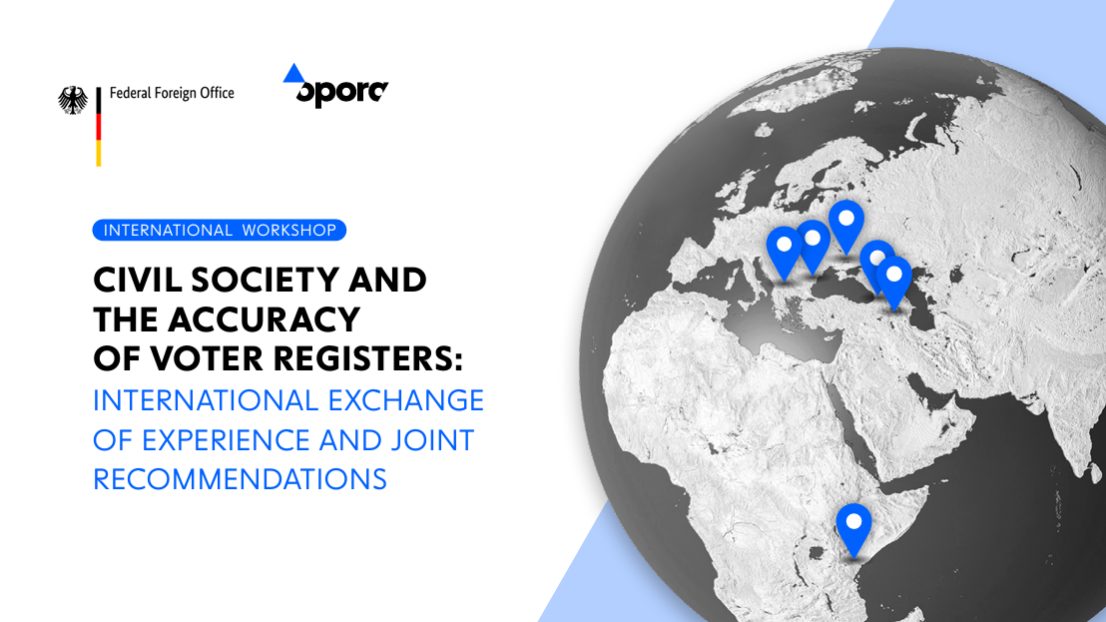
On 3 September, Civil Network OPORA held its first international online workshop, “Civil Society and the Accuracy of Voter Registers: International Exchange of Experience and Joint Recommendations.” Civil society representatives from Ukraine, Kenya, Serbia, Moldova, Armenia, and Georgia discussed the main causes of inaccuracies in voter registers, the risks they pose to voters’ rights and electoral integrity, mechanisms for verifying and updating voter data, and opportunities to strengthen cooperation between election management bodies and civil society.
“It is very important that voters can see what is happening, that the results are clear, and that the rules are simple. This helps build people’s trust in the institutions responsible for the electoral process and in elections themselves. The work we do together will be useful to everyone who wants better elections and is looking for effective solutions to the problems we face,” said Olga Aivazovska, Chair of the Board of Civil Network OPORA and moderator of the workshop, in her opening remarks.
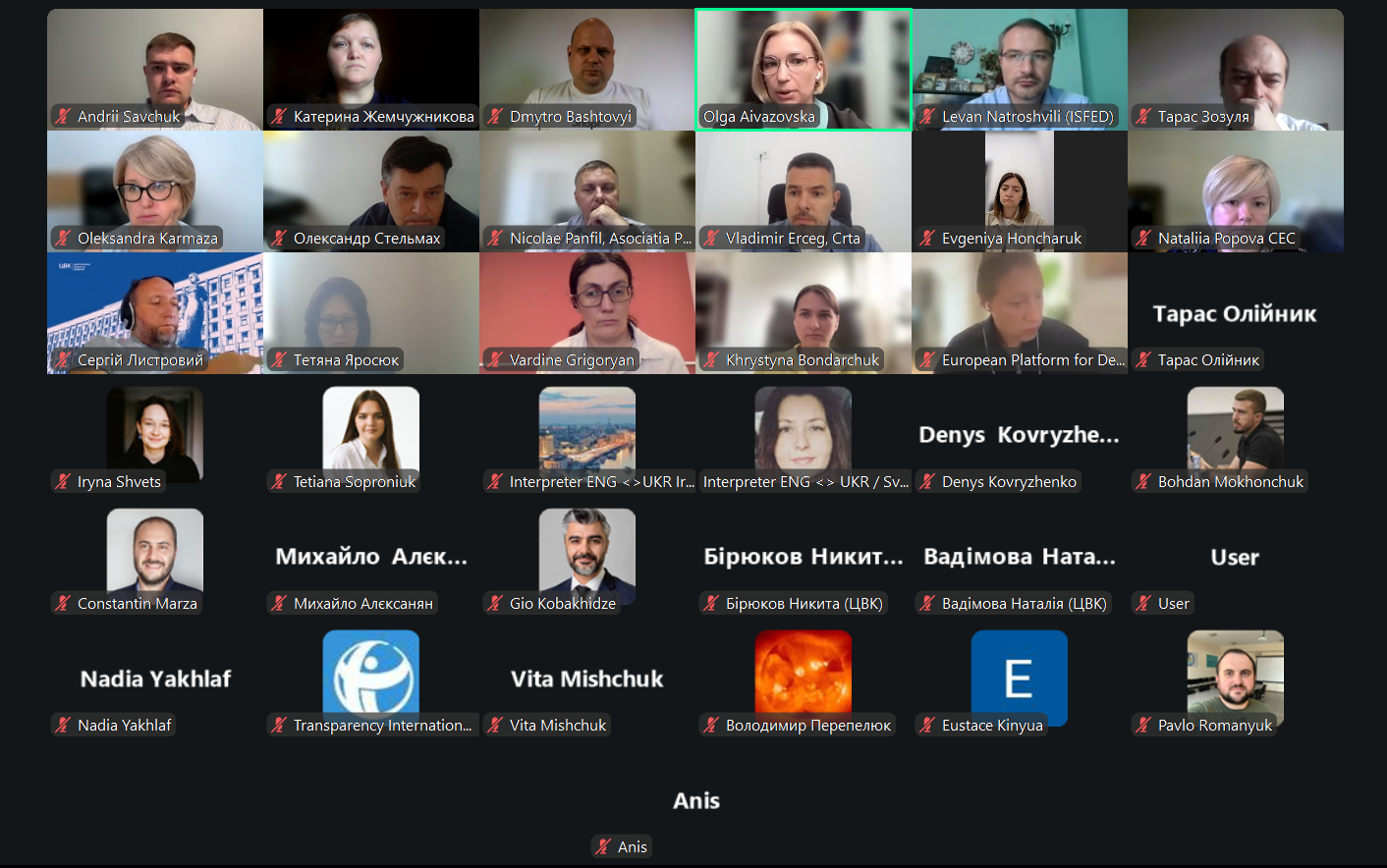
Dmytro Bashtovyi, Analyst at Civil Network OPORA (Ukraine), presented Ukraine’s experience in ensuring the quality of the State Voter Register data. He spoke about the impact of large-scale internal and cross-border migration caused by the war, the occupation of parts of Ukraine, and disruptions in the exchange of administrative data on the accuracy and currency of the register. He also presented OPORA’s approaches to independently assessing the quality of voter register data without access to personal data. These include sociological research in Ukraine and abroad, analysis of aggregated and anonymized mobile operator data, interviews and focus groups, analysis of legislation and administrative practices, testing digital services, and the #ПеревірСебеУРеєстрі information campaign. This comprehensive approach allows OPORA’s experts to assess the scale of the problem, identify the causes of inaccuracies, and develop evidence-based recommendations.
Eustace Kinyua, Electoral Processes Officer at ELOG (Kenya), spoke about the challenges associated with the rapid expansion of Kenya’s voter register. He emphasized the need to ensure both the completeness and accuracy of the register: the system should include all eligible voters while preventing duplicate records and retaining records relating to deceased or otherwise ineligible persons. Particular attention was given to the independent audit of the register conducted by ELOG in 2017. The organization combined computer-based database analysis with field verification of voters. The Kenyan experience demonstrated the importance of continuous voter registration, validating information as it is entered, connecting state databases, conducting independent audits, and involving civil society early enough to address findings before Election Day.
Vladimir Erceg, Special Program Manager at CRTA (Serbia), presented Serbia’s experience of auditing the Unified Voter Register. He explained that the accuracy of the register depends on the quality of underlying government data, information exchange between institutions, and the timeliness of actions by responsible authorities. Among the key challenges he identified were the lack of regular verification of actual residence, weaknesses in data exchange between registers, difficulties in updating information on citizens living abroad, and delays in registering deaths. He also presented Serbia’s Audit Commission and the involvement of civil society representatives, including CRTA, in its work. Among the important conditions for an effective audit, he highlighted access to aggregated data and change histories, the ability to conduct field checks, methodological independence of auditors, and transparent publication of findings.
Nicolae Panfil, Program Director at Promo-LEX (Moldova), presented Moldova’s centralized voter registration model, which is systematically updated using data from the State Population Register. He focused on challenges arising from the large number of citizens living abroad, the specific circumstances of voters from the Transnistrian region, the significant share of voters without a registered address, and delays in updating civil status information. Particular attention was given to supplementary voter lists, which allow voters who are absent from the main list to cast their ballots. In Moldova’s 2025 parliamentary elections, more than 342,000 voters were included on supplementary lists.
Nicolae Panfil also presented tools that allow voters to check their own data and electoral address, mechanisms for pre-election verification of voter lists, regular publication of aggregated register data, and cooperation between Promo-LEX and the Central Electoral Commission. Among the practices that could be useful for other countries, he highlighted combining a centralized voter register with the population register, providing a secure voter self-check service, and using supplementary lists as a safeguard for voters who are not included in the main list.
Vardine Grigoryan, Program Manager at Helsinki Citizens Assembly Vanadzor Office (Armenia), spoke about long-standing problems with Armenia’s voter register. Among the causes she identified were the passive registration system, large-scale emigration in the 1990s, and the lack of effective legal mechanisms to remove people from the register when they were actually living abroad. She also presented research illustrating the scale of the problem and the risks of using inaccurate voter lists to manipulate election results.
At the same time, Vardine Grigoryan highlighted the risks of excessive “clean-up” of voter registers, when efforts to address inaccuracies can result in restrictions on voting rights. She discussed recent changes in Armenia, including requirements related to valid identity documents and the length of residence in the country, as well as the practice of publishing scanned signed voter lists after elections. This experience illustrates the need to balance register accuracy and electoral transparency with personal data protection and the protection of universal suffrage.
Levan Natroshvili, Executive Director of ISFED (Georgia), presented Georgia’s experience, identifying discrepancies between registered and actual residence, mass emigration, delays in registering deaths, and document-related restrictions as among the main factors contributing to inaccuracies in the voter register. He also spoke about the risks of using electoral and administrative data to exert political pressure on voters and about anomalous turnout cases that may indicate problems with the integrity of the electoral process.
Georgia’s experience includes inter-agency data synchronization, the use of voter identification devices, and independent civil society oversight. At the same time, ISFED highlighted restrictions on civil society access to data and insufficient transparency of technology audits. The presentation emphasized that technological solutions can only be effective when combined with independent oversight, transparency, and adequate legal safeguards.
During the joint discussion, participants compared common and country-specific causes of voter register inaccuracies, their impact on voting rights and public trust in elections, as well as approaches to verifying and updating voter data. They also discussed the role of civil society, ranging from independent audits and data analysis to election monitoring, information verification, and advocacy for necessary reforms.
Following the first international online workshop, OPORA will prepare an analytical summary of the discussion and a draft set of recommendations. These materials will form the basis for the next workshop, where participants will continue to discuss practical solutions and their applicability across different countries.
OPORA also plans to hold the second international online workshop this autumn. It will focus on recommendations that can be used not only to prepare Ukraine’s first post-war elections, but also to improve voter register management, verification and updating systems in other countries. OPORA will share the consolidated analytical materials with stakeholders in Ukraine, as well as election experts in the EU, OSCE, Council of Europe and Venice Commission.
The workshop was held as part of the project “Every Voter Matters: Updating Ukraine’s State Voter Register for Inclusive Democracy,” implemented by Civil Network OPORA with the financial support of the German Federal Foreign Office.