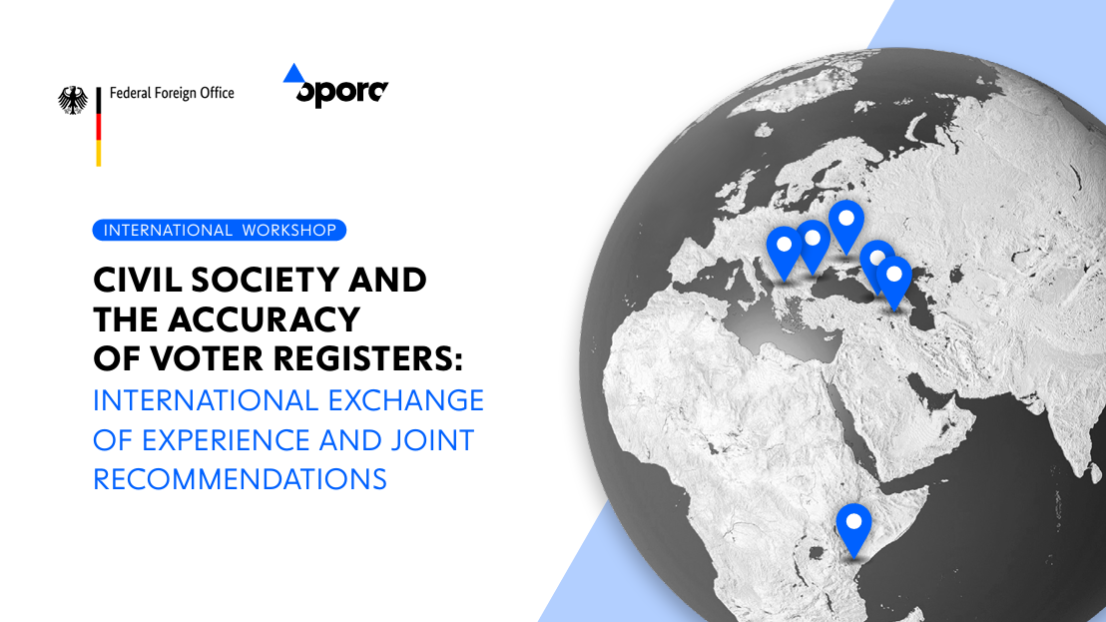
On 3 September 2026, Civil Network OPORA organised the international workshop “Civil Society and the Accuracy of the Voter Registers: International Exchange of Experience and Joint Recommendations.” During the event, NGO representatives from Armenia, Georgia, Kenya, Moldova, Serbia, and Ukraine presented overviews of practical problems in the field of voter registration and ensuring the completeness and accuracy of voter register data, the consequences of these problems, and proposed steps towards their resolution. The representatives of the Central Election Commission, Ukrainian civil society organisations and other stakeholders also participated in the discussion.
This document summarises the discussion held during the workshop and puts forward draft recommendations for improving voter registration procedures and ensuring the completeness and accuracy of voter registers.
1. Main Advantages and Disadvantages/Risks of Active and Passive Voter Registration Systems
Almost all the states whose experience was discussed during the international workshop have introduced a model of passive voter registration. The only exception is Kenya, where inclusion of a voter in the register is based on active registration.
Passive registration involves the formation and updating of voter register data largely without the participation of voters themselves, on the basis of data exchange with other state registers and information systems. The key register among these is the demographic register/population register or similar systems that record voters’ age, citizenship, and permanent place of residence. An active voter registration system assigns the key role in forming the voter register database to the voter.
Each of these registration systems has its own advantages and disadvantages/risks that must be taken into account when introducing a particular system (see the table below).
Table. Key Advantages and Disadvantages/Risks of Active and Passive Voter Registration
|
Advantages |
Disadvantages |
|
|
Active voter registration |
|
|
|
Passive voter registration |
|
|
Sources: Ace Project. Impact of Voter Registration Methods; MIT Election Data & Science Lab. Automatic Voter Registration; National Conference of State Legislatures. Automatic Voter Registration; UK Parliament Written Evidence discussing registration models on a continuum.
2. Practical Problems of Voter Registration and Their Consequenses
The experience in the regulation and practice of voter registration in Armenia, Georgia, Kenya, Moldova, Serbia, and Ukraine presented during the workshop demonstrated that the problem of inaccuracies in voter register data has been and remains relevant for all the states considered – regardless of the voter registration system in place. Only the scale of the problem differs.
The most typical inaccuracies include: multiple inclusion of the same voter in the voter register; absence from the register of voters entitled to vote; presence in the register of those who have lost the right to vote (in particular, deceased citizens); and incorrect assignment of voters to election precincts or errors in their personal data.
These inaccuracies lead to a number of negative consequences, which include:
- Difficulty or impossibility of exercising the right to vote. The absence of a voter from the voter register or the inclusion of inaccurate data in the register/voter lists prevents the voter from exercising the right to vote on election day.
- Complication of electoral logistics and inefficient use of funds for conducting elections. The lack of accurate information on the number of voters at an election precinct and in an electoral district makes it impossible to determine the number of seats to be distributed in the district (in the case of elections under a proportional system with seat allocation in multi-member districts), to establish the exact number of ballot papers for the relevant precincts and the optimal size of election commissions, or to assess the need to establish additional election precincts. These problems, in turn, may lead to long queues at polling stations, violations of the secrecy of the vote and fraud, and delays in establishing the election results.
- Political manipulation of the electoral system and election/referendum results. If the number of seats in a multi-member district or the “weight” of a voter’s vote is determined by the number of voters registered in the electoral district, inaccuracies in voter register data lead to violations of the principles of universal and equal suffrage: voters’ votes have different electoral weight in different districts; such districts become over- or under-represented in the respective elected bodies. The electoral experience of a number of states (Georgia, Armenia, Serbia) has confirmed that inaccuracies in the voter register or peculiarities of registration procedures (for example, the unrestricted possibility of changing the registered place of residence before local elections) can be used by political actors to gain electoral advantages and for abuses, including illegal use of personal data, voting for absent voters (e.g., through stuffing of ballot boxes), vote-buying, multiple voting, "electoral tourism," and reaching the turnout threshold necessary for a referendum to be declared valid (Armenia, nationwide referendum of 2015). In Armenia, the number of registered voters in some communities in certain past elections exceeded the number of citizens whose addresses were registered in those communities (including children), while in Georgia, turnout in some communities was higher than the number of voters registered there.
- Decline in trust in voter registration procedures, elections, and public authorities in general. Mass inclusion in voter lists of those who have lost the right to vote (in particular the deceased) or who do not actually reside in the relevant areas, as well as the inability of a voter to vote due to absence from the list, give rise to well-founded suspicions that inaccuracies in the register/voter lists (especially if they are of a permanent nature) are used by parties and candidates to distort election results. Mass and systemic inaccuracies in the register also create in the voters the conviction that their vote has no value and has little influence on the final election result. This, in turn, reduces voter turnout in subsequent elections, may further obsolesce register data (due to voters’ lack of interest in clarifying it), and discredits/delegitimises both the electoral process and elected public bodies.
The completeness and accuracy of voter register data depend on a complex of factors examined in more detail below.
2.1. Active Registration
The active voter registration system applied in Kenya shows that inaccuracies in the voter register in that country are caused by the following factors:
- Unwillingness of voters to register. In the 2022 nationwide elections, of the estimated 6 million unregistered voters, only 2.5 million registered. A significant proportion of them were young people and women. Among the reasons for unwillingness to register and participate in elections, they cited lack of interest in elections/unwillingness to vote, failure to understand the importance of elections, lack of trust in elections, and the perceived unimportance of their own vote.
- Lack of proper planning of the active voter registration stage, effective inter-agency coordination, and awareness-raising campaign. The activities of the Independent Electoral and Boundaries Commission (IEBC) on primary voter registration were not combined with an aggressive awareness-raising campaign and were not coordinated with the National Registration Bureau (responsible for citizen registration and passport issuance) or with local authorities (which store and directly issue passports). According to ELOG data, 51% of young people did not register to participate in elections due to the lack of passports.
- Ineffectiveness of primary registration and updating of the voter register. In Kenya the active registration system is applied not only for the initial inclusion of a voter in the register but also for updating data about them. During previous election campaigns there were frequent cases of errors/incorrect entry of personal data into the voter register or other registers, while voters often did not check the entered data – either through unwillingness or because of technical difficulties (for example, charges for SMS related to data verification). According to the results of the voter register audit conducted by KPMG before the 2022 nationwide elections, the Register was found to contain 246,456 deceased persons, 481,711 multiple inclusions, 226,143 voters registered with passports that did not belong to them, and 164,269 voters included in the voter register on the basis of invalid documents. Following the 2017 nationwide elections, ELOG identified 169,646 multiple inclusions, meaning that their number, if it did not increase, remained consistently high.
- Lack of effective and independent verification of voter register data and registration procedures. Before the 2022 elections, the Independent Electoral and Boundaries Commission itself selected the company – KPMG – to audit the Voter Register and determined the audit methodology. The time allocated for the audit was short (the audit was to take place after the completion of active voter registration and before the production and approval of the final voter lists; the audit completion deadlines were postponed). The full audit report was not published and key stakeholders were not involved in the audit. The discovery of further inaccuracies in the Voter Register at the voting stage cast doubt on confidence in the results of the audit and the methodology used.
2.2. Passive Registration
The passive voter registration model has been introduced in Armenia, Georgia, Moldova, Ukraine, and Serbia. This model allows certain elements of active registration, for example for voters abroad.
The main reasons for incompleteness and inaccuracies in voter register data under this model are the following:
- Shortcomings of the place-of-residence registration system. Since the registered place of residence determines a voter’s electoral address and the election precinct at which they will vote, any formal obstacles related to the registration of a new/actual place of residence (for example, the need to submit supporting documents, such as tenancy agreements, etc.), the significant duration of such registration, or the absence of incentives for voters to register a new place of residence (including sanctions for failure to do so) lead to substantial discrepancies between voters’ actual place of residence and their electoral addresses according to the voter register. For example, in Serbia a voter’s place of residence and electoral address remain unchanged until the voter registers a new place of residence. The absence of control and sanctions for non-registration of a new place of residence means that data in Serbia’s Unified Voter Register regarding voters’ place of residence do not correspond to actual data on their place of residence. In a number of the states whose experience was discussed during the workshop, a significant number of voters have no confirmed place of residence, are not included in the voter register, and, accordingly, cannot vote in elections. For example, in Moldova almost 10% of voters had no registered place of residence as of the beginning of August 2026, while in Ukraine almost 4% of voters had no electoral address as of 31 August 2026.
- Absence of up-to-date personal data on certain categories of voters. As a rule, the state does not have access to information on the place of residence and status of voters who permanently reside or stay outside its borders or in the temporarily occupied territory of that state (Ukraine, Moldova). These data are updated either on the initiative of the voter themselves (active registration/data update) or by third parties on the basis of supporting documents. In the case of temporarily occupied territories, updating is complicated by the fact that states may not recognise documents issued by occupation authorities. If the number of voters outside the state or in occupied territory is significant, the scale of inaccuracies in the voter register is also substantial.
- Peculiarities of inclusion and exclusion of voters in/from the voter register. In some states (Georgia, Moldova, Armenia, etc.), voters who have no confirmed place of residence, have invalid passports or have no passports at all are excluded from the voter register. In the view of ODIHR, the existence of such grounds places unjustified burdens on voters (the need to renew place-of-residence registration), restricts active suffrage (voters cannot vote in elections), and contradicts international standards (in particular Article 25 of the International Covenant on Civil and Political Rights, under which the state must facilitate voters’ registration). In the context of the 2025 parliamentary elections in Moldova, ODIHR noted that the mandatory requirement of a confirmed place of residence and identity documents may negatively affect the exercise of rights by vulnerable groups of voters, for example Roma. In Serbia only voters who have a registered place of residence on the territory of Serbia are included in the Unified Voter Register. This legislative requirement effectively encourages voters to register a place of residence on the territory of Serbia – even if the voter permanently resides outside it. A similar problem exists in Moldova – voters who permanently reside outside the state retain registration of their place of residence on the territory of Moldova. There is also another situation – in certain communities (Corjova) their residents cannot vote in local elections because their place of residence is registered on the territory of Transnistria – and this problem has remained unresolved for years.
- Ineffective data exchange between the voter register and the registers/information systems used for its formation and updating. This ineffectiveness may be caused by a number of factors: long periods for updating the voter register database on the basis of data from other registers (for example, once a quarter or less frequently), insufficient numbers of officials responsible for transmitting updated data on voters, improper performance of their duties or the absence of duties to transmit certain types of data (for example, data on deceased persons), and ineffectiveness of electronic information exchange between different registers, etc. In Ukraine the effectiveness of data exchange between the State Voter Register and other registers/information systems is negatively affected by mass migration of voters, the impossibility of the functioning of State Voter Register maintenance bodies and other state bodies in front-line territories, the unwillingness or impossibility of voters registering their actual place of residence, and other factors. The impossibility of holding elections under martial law further exacerbates these factors, as voters have no compelling arguments in favour of clarifying data about themselves in the Register. The problem of ineffective data exchange between registers is relevant not only for Ukraine but also for a number of other states, in particular Serbia and Moldova.
- Absence of updates to the voter register based on the results of voting in elections. The scale of inaccuracies in voter register data becomes most obvious on election day, when some voters cannot vote because they are absent from the lists, or when observers detect cases of illegal or multiple voting. If the state’s legislation does not provide mechanisms for conveying this information to the voter register administrator and responding to the identified problems, these inaccuracies persist and reappear in subsequent electoral cycles.
- Limited access to voter register data/voter lists. Voters’ personal data (tax identification numbers, demographic register numbers, passport numbers, information on registered place of residence, the fact of voting in elections, etc.) in most of the states whose experience was discussed during the workshop belong to restricted-access information. Therefore the law restricts access to it (either in terms of the data subject to publication, or the subjects who have access to these data, as well as the periods for which these data are published) or provides for a special procedure for its processing. Restrictions on access to such information significantly complicate its verification by parties and civil society organisations and do not allow inaccuracies in the voter register and their causes to be eliminated. For example, in the 2024 local elections in Serbia, only voters’ names and surnames were published in the Unified Voter Register, which effectively precluded the possibility of verifying Register data and detecting cases of suspicious changes in voter registration that could indicate the practice of “electoral tourism.” In this context, ODIHR recommended ensuring the publication of Unified Voter Register data to an extent that would allow proper verification of their accuracy. ODIHR also noted that despite the increased frequency of publication of data on the number of registered voters in communities, only current rather than previous data are published, which complicated the detection of suspicious deviations in the number of registered voters. In the parliamentary elections in Georgia, requests by opposition parties for lists of voters who had voted, for the purpose of verifying the fact of voting, were not granted because the legislation did not impose an obligation on election commissions to provide them to third parties, and the commissions themselves classified the relevant data as personal data not subject to disclosure. In Ukraine parties have the right to verify State Voter Register data, but the legislation provides for a number of restrictions on such verification: the right to conduct it is held only by parties that have their own factions in parliament; access to data is granted only during the electoral process, only to one party representative who must work directly on the premises of the CEC (i.e., during working hours) and in read-only mode. Such restrictions make it possible to detect individual cases of multiple inclusion in the State Voter Register, but not cases of unjustified inclusion or exclusion from the Register. In Moldova, although electoral legislation provides for the possibility of familiarisation with voter lists both online and directly at the election precinct, during the 2024 presidential elections access to the lists at different stations was uneven: at some precincts they were posted for public scrutiny, at others they were provided to voters at their request; at some precincts voter lists were available on the premises of local authorities rather than on the premises of the precinct election commission. Different approaches to the publication of lists may limit the possibilities for their verification.
- Absence of independent comprehensive verification (audit) of voter registration procedures and the voter register database. The possibilities for parties and civil society organisations to verify voter register data are objectively limited and, as a rule, do not provide for the possibility of verifying the data on the basis of which the register is formed or assessing the effectiveness/reliability of the software used to ensure the functioning of the Register. On the other hand, an audit of the register by its administrator or by public authorities either creates a conflict of interest or raises doubts about its completeness and objectivity. Under such conditions, there is a need for a comprehensive external audit of the register database and the functioning of the voter registration system as a whole. Of all the states whose experience was discussed during the workshop, such an audit has been introduced only in Serbia and Kenya (see paragraph 2.1 of this report), but even in these limited cases its conduct encounters a number of problems (in the context of Serbia, these problems are examined in more detail in paragraph 3).
3. Mechanisms for Ensuring the Completeness and Accuracy of the Voter Register Database and Problems of Their Practical Application
In most of the states whose experience was discussed during the workshop, a number of measures have been taken in recent years aimed at improving voter registration procedures, ensuring the completeness and accuracy of voter register data, and expanding opportunities for verification of these data. In Kenya the resolution of these problems is still only at an initial stage, while in Ukraine their resolution is complicated by martial law, mass displacement of voters, and political factors (implementation of electoral reforms is not a priority for the Ukrainian parliament).
The measures taken by the states and the practical problems encountered in their implementation include:
- Review of the grounds and procedures for registration of place of residence/electoral address and change of voting place. The possibility of registering an actual place of residence on a declarative basis and without supporting documents (for example, tenancy agreements, etc.) makes it possible to significantly reduce the number of voters who have no registered place of residence and, accordingly, no electoral address, while the possibility of a temporary change of voting place on the same basis enables voters to vote regardless of their location on election day. This acquires particular importance in conditions of mass migration of voters and the presence of a significant number of internally displaced persons who cannot vote in temporarily occupied territory. In Georgia until 2026, voters without place-of-residence registration were included in the Voter Register at their last registered place of residence, while internally displaced persons are included in the Voter Register at their actual place of residence. In Moldova, in order to ensure the participation in voting of voters without a registered place of residence and voters who are in the occupied territory of Transnistria or outside the state, the compilation of additional voter lists is provided for. At the same time, simplification of the procedure for registering a permanent place of residence/electoral address significantly increases the risks of “electoral tourism” in local elections or parliamentary elections conducted in single- or multi-member districts. This is confirmed by the experience of Serbia, where in the 2024 local elections numerous cases were identified of suspicious increases in the number of registered voters in certain communities (Belgrade, Niš, Novi Sad, Raška), and registration in unfinished buildings or buildings that physically could not accommodate the number of voters registered in them. Before the 2026 parliamentary elections, amendments were made to Serbian legislation providing for the mandatory residence on the territory of the community for six months in order to be included in the voter lists in that community. Similar safeguards against “electoral tourism” are provided for in the electoral legislation of Ukraine and Moldova. However, they are effective only if a change of electoral address is permitted before the formation of electoral districts begins.
- Prohibition of voting abroad. Due to the absence of up-to-date personal data on voters who reside or permanently stay outside the state, as well as the use of these data for interference in the electoral process or political manipulation, some states have directly prohibited the holding of voting outside the state (Georgia). In Armenia the right to vote in parliamentary elections is granted only to voters who have been on its territory for 366 days in the 730-day period before the elections. This approach effectively deprives of the right to vote not only those voters who permanently reside abroad but also those who maintain a connection with the state and spend a significant part of their time on its territory. In the case of Georgia, the establishment of a prohibition on voting outside the state does not contradict Article 3 of Protocol No. 1 to the ECHR. However, Armenia’s approach to resolving the problem appears more problematic, as it contradicts both the Constitution of Armenia and international standards (the restriction has retroactive effect and effectively establishes a residency requirement as a condition for the exercise of active suffrage, and moreover, in nationwide elections, which contradicts the Code of Good Practice in Electoral Matters). In Ukrainian realities the establishment of similar prohibitions would deprive more than 4 million citizens of the right to vote. This would not only violate the principle of universal and equal suffrage but could also cast doubt on the legitimacy of the relevant elected bodies and negatively affect the future involvement of this category of voters in elections and political processes in Ukraine.
- Introduction of active registration for certain categories of voters. In Moldova the problem of the absence of up-to-date personal data on voters who are outside the state or in occupied territories was resolved in a different way from that in Armenia and Georgia. In particular, for the 2025 parliamentary election, a system of voluntary prior online registration for voting at an out-of-country station and mandatory prior registration for participation in postal voting was introduced for voting by voters in the out-of-country constituency. However, the mechanisms of this prior registration proved vulnerable to external interference, vote-buying and manipulation – voters’ personal data were used for their fictitious prior registration, vote-buying and attempts to influence election results by the Russian Federation and political actors affiliated with it. This was caused by a number of reasons: an ineffective awareness-raising campaign on the risks of transferring personal data to third parties, the impossibility of effective investigation of these actions due to the absence of relevant agreements with Russia, the establishment of excessively long periods (3 months with the possibility of extension to 6 months) for consideration of complaints of personal data protection violations by the Personal Data Protection Centre, fictitious registrations of Moldovan voters on the territory of Russia, and the simplicity of the prior registration procedure itself (only passport data were required for registration; there was no voter identification channel – digital signature, etc.).
- Increasing the frequency of data exchange between the voter register and other registers/information systems used for its population and updating. Although the problem of inconsistency of data in state registers with the voter register is generally relevant for all the states whose experience was examined during the workshop, in some of them the frequency of data exchange between the voter register and the information systems used for its updating has been increased. For example, in Moldova the updating of Voter Register data is carried out daily, while in Serbia the frequency of publication of Unified Voter Register data (and, accordingly, its updates) was reduced from a quarter to 30 days. This approach makes it possible to promptly eliminate differences in data, conduct their verification, increase the overall level of transparency of the relevant procedures, and involve voters and civil society organisations in the process of clarifying and verifying data. In the context of Serbia, ODIHR classified as a problem the fact that only the latest data on voters are subject to publication, and not previous data – this complicates the detection of cases of suspicious changes in the number of registered voters and does not allow effective counteraction of “electoral tourism”.
- Introduction of electronic identification of voters on election day. The potential negative consequences of inaccuracies in voter registers (primarily the presence in them of a significant number of deceased voters or voters who do not have the right to vote) and the risks of multiple voting caused by multiple inclusion of the same voter in the register can be minimised by systems of electronic identification of voters on election day. The use of such systems is provided for by legislation, in particular in Armenia and Georgia. However, the effectiveness of their counteraction of abuses depends on a number of factors: 1) the reliability of the relevant software and the uninterrupted functioning of identification devices; 2) the existence of mechanisms to prevent the use of other voters’ biometric data (for example, electronic passports) by other voters; 3) the effectiveness of data exchange on voters who have voted among all the election precincts. In Georgia the use of the electronic voter identification system encountered a number of problems: 1) political parties and civil society organisations had no opportunity to participate in the audit of electronic identification devices and their software, which negatively affected trust in them; 2) the use of electronic technologies was accompanied by intimidation of voters (sending of SMS messages regarding the possibility of identifying the voter; installation of video cameras at stations); 3) the technology itself made it possible to verify the validity/authenticity of a passport but not its belonging to a specific person, which increased the risk of multiple voting using other voters’ passports; 4) in the 2024 elections the reliability of the equipment was called into question – due to incorrect operation of identification devices at a number of stations voting began with delays; 5) the electronic identification system did not cover all voters – in the 2024 parliamentary elections this procedure could be used by 89% of voters. These problems led to abuses – stuffing of ballots for voters by commission members, voting for other persons, and multiple voting – although they reduced the volume of the relevant abuses compared with elections in which this system was not used. National civil society organisations recommended the introduction of an additional voter verification system by fingerprint, which envisages the creation of a database of such fingerprints, its incorporation into the Voter Register database and into document identification devices for voting. ODIHR proposed that the Government of Georgia enshrine in legislation provisions that would provide for the mandatory verification and certification of electronic systems, the conduct of a repeated audit in the event of their modification (the results of which must be published before election day), and ensure stakeholders’ access to the procedure and results of the selection of the service provider, the terms of the contract with it, technical documentation, and the results of certification of the relevant electronic systems.
- Provision of additional opportunities for verification of the Register data and voter lists. The legislation of most of the states whose experience was the subject of discussion during the workshop provides for a number of instruments for additional verification of register/voter list data. They include: 1) the possibility of clarifying personal data through an electronic voter cabinet (Ukraine, Georgia, Moldova), centres for the provision of administrative services, voter register maintenance bodies, precinct election commissions or other bodies; 2) advance publication of voter lists for each election precinct (Armenia) or even for each building (Serbia), including online; 3) publication of information on the grounds for making changes to the Register/voter lists (Serbia); 4) the possibility of lodging complaints/applications regarding inaccuracies in voter lists, including regarding third parties (Armenia, Ukraine); 5) ensuring access by civil society organisations and parties to voter register data and/or voter lists (for example, before the 2024 parliamentary elections in Georgia the Unified Voter List was provided by the CEC to 4 parties and 2 civil society organisations conducting observation of the elections). The effectiveness of the above instruments depends on compliance with the legal requirements regarding the timeliness of publication of voter lists, the volume of data available for verification, the available methods of working with them (see paragraph 2.2 of this report in more detail), the scale and content of awareness-raising campaigns among voters, and the willingness of the voters themselves to clarify the relevant data. For example, in Moldova the effectiveness of the relevant instruments was reduced by the fact that at a number of stations voter lists were not transferred by the deadline established by law (the problem was resolved in the 2025 parliamentary elections, but a problem arose of excessively early transfer of voter lists to stations at which information on changes in voters’ place of residence might not have been reflected); at some stations – despite the requirements of the law – observers did not obtain access to voter lists before election day. In Armenia voter lists are published both before and after voting (with voters’ signatures on receipt of ballot papers). The publication of lists of voters who voted in elections makes it possible to detect cases of illegal voting, investigate them, and increase the degree of trust in elections in conditions where voter register data remain inaccurate. At the same time, ODIHR considers such publication a violation of international standards in the area of personal data protection and the secrecy of the vote, and following the 2021 elections, recommended that the Government of Armenia review the relevant provisions to ensure the protection of personal data and the secrecy of participation in voting (although the publication of lists of voters who voted was supported by national respondents interviewed by ODIHR).
- Introduction of an independent audit of the voter register. Of all the states whose experience was discussed during the workshop, an independent comprehensive audit of the voter register at the legislative level has been introduced only in Serbia. An external audit of the voter register was also conducted in Kenya (see paragraph 2.1 in more detail), but it can hardly be considered independent, since the election administration body itself selected the auditor and determined the methodology and timeframes for the audit. To conduct the audit of the Unified Voter Register in Serbia, on 28 February 2026, the composition of an independent Audit Commission was formed, which included representatives of the parliamentary majority (5 members), the opposition (3 members), and civil society organisations (2 members). In practice this Commission encountered a number of problems, which included: 1) lack of access to the registers containing the data used to form the Unified Voter Register database and the impossibility of verifying these data; 2) untimely provision of access to data on the dynamics of changes in voter data (place of registration, etc.), as well as provision to the Commission of data in a format that precluded the possibility of their analysis; 3) different levels of involvement of Audit Commission members in the conduct of the audit (the main initiatives came from the opposition and civil society organisations); 4) slow creation of proper conditions for the work of the Audit Commission (provision of computers, etc.); 5) initial refusals by the Government to allow the Commission to conduct an IT audit of the Unified Voter Register software. As a result, a proper audit of the Unified Register will not be able to be completed before the 2026 parliamentary elections. The parity principle of forming the composition of the Commission (5 members from the parliamentary majority and 5 from the opposition and civil society organisations), as well as the peculiarities of its decision-making (7 votes in support of a decision and no fewer than 2 votes from each of the three nominating entities in support of a decision), significantly increase the risk of the Commission’s inability to adopt decisions on matters within its competence.
4. Draft Recommendations
The recommendations below constitute a draft developed on the basis of discussions of the experiences of the countries represented at the international workshop. They reflect common challenges and possible approaches to addressing them and are intended to serve as a basis for further discussion and agreement. The applicability of individual recommendations and specific mechanisms for their implementation should be assessed with due regard to national legislation, international standards, the institutional framework, the security context, and personal data protection requirements.
- To ensure the principles of universal and equal suffrage, legislation should provide for a simple procedure for changing the electoral address and voting place on a declarative basis. At the same time, simplification of the change of electoral address should be combined with the establishment of effective safeguards against "electoral tourism." These safeguards may include: 1) periodic publication by the election administration body/voter register administrator of data on changes in the number of voters in the territories of communities, districts, election precincts and voters' addresses; 2) establishment of a cut-off deadline after which a voter is not included in the voter list at the new place of residence and/or cannot change the place of voting; 3) imposition on the election administration body of an obligation to check and provide official explanations of unusual/suspicious changes in the number of voters in certain territories (communities, districts, stations, voter addresses); 4) determination of the role and powers of law-enforcement bodies in conducting checks of such unusual/suspicious changes and their interaction with the election administration body; 5) conduct of awareness-raising campaigns among voters on the consequences of “electoral tourism” and participation in organised movements of voters; and 6) establishment of effective, dissuasive and proportionate sanctions for participation in organised voting.
- Ensuring the completeness and accuracy of voter register data should provide for: 1) exclusion of a voter from the voter register only in the event of loss of the right to vote in elections; 2) establishment of short timeframes for data exchange between the voter register and other registers/information systems used for the formation and updating of the voter register database (during the course of the electoral process such data exchange may be even shorter, ideally daily) and determination of the actual residence/stay of voters; 3) the possibility of automated cross-checking of data from the relevant registers to detect inaccuracies in personal data, multiple inclusions or unlawful exclusion of voters from the voter register, in particular using unique identifiers; 4) expansion of instruments for verification of voter register data both by the voters themselves and by political parties and civil society organisations (see Draft Recommendation 7 in more detail); and 5) imposition on the voter register administrator/voter register maintenance bodies of an obligation to take into account deficiencies in voter lists identified on election day (for example, to consider reports, applications or complaints about identified inaccuracies).
- Where there is a significant number of voters outside the state or in temporarily occupied territories, the introduction of their active registration for participation in elections is justified. Active registration of voters should provide for the establishment of safeguards against manipulation of such registration with the aim of interfering in the electoral process or distorting its results. In this regard it is necessary to: 1) ensure the simplicity and convenience of the active registration procedure, including online; 2) provide for the conduct of timely and effective information campaigns on active registration procedures and the importance of participation in elections; 3) establish effective, proportionate and dissuasive sanctions for the unlawful use of voters’ personal data/fictitious registration (including without the knowledge of the voter); 4) determine mechanisms for informing voters of changes in their personal data in connection with active registration; 5) in the case of electronic active registration – provide for mechanisms of voter authorisation (in particular the use of an electronic digital signature) and their actual location; 6) determine the procedure for the response of the election administration body/voter register to unusual/suspicious cases of registration; and 7) ensure the periodic publication of aggregated open data on such registration.
- The exclusion of the possibility of conducting voting outside the territory of the state does not in general contradict international standards and is generally permissible. However, when deciding on the exclusion of this possibility, it is necessary to take into account the potential negative consequences of such an approach, in particular the potential alienation of the relevant category of voters from participation in political processes in general and in elections in particular, possible doubts about the legitimacy of elected officials, artificial encouragement of registration on the territory of the state in order to retain the right to vote in elections, etc. In any event, legislation should not provide for a residency requirement as a condition for the exercise of active suffrage in nationwide elections or referendums.
- Electronic identification of voters on election day is generally an effective mechanism for preventing multiple or other illegal voting. However, the introduction of such electronic identification should be carried out taking into account the following requirements: 1) it should be provided for all election precincts; 2) the fact of a voter receiving a ballot paper should be recorded centrally so that the relevant voter cannot vote at another election precinct; 3) the electronic identification system should exclude the possibility of a voter receiving a ballot paper for another voter, for example by including identification of the voter by fingerprint or other biometric data; 4) the procurement of devices for electronic identification and the relevant software should be carried out transparently (which includes the publication of the criteria and procedure for selecting the supplier, the requirements for it, and the essential terms of the procurement contract) and impartially; 5) the use of identification devices and the relevant software should be preceded by their independent audit/certification for reliability and protection against external interference, the results of which should be published in a timely manner, ideally also testing of the relevant devices; and 6) legislation should determine the legal consequences of the technical impossibility of electronic identification due to incorrect operation of the relevant identification devices or software, as well as the algorithm of actions of the election commission in this case.
- The experience of Armenia related to the online publication of voter lists for each election precinct before election day and after the vote (with voters’ signatures on receipt of ballot papers) should be carefully considered by other states. This approach – although it does not comply with international standards in the field of personal data protection or the recommendations of ODIHR and the Venice Commission – makes it possible to detect cases of illegal voting, investigate them, and prevent the practice of illegal voting in subsequent elections. The main arguments in favour of introducing the Arminian approach towards transparency are as follows: 1) voters’ personal data are already published in full in the voter lists at polling stations, and an unlimited number of people have access to them. Under these circumstances, arguments for restricting access to voters’ personal data in the general register are unconvincing; 2) without publishing information about voters’ electoral addresses, it is practically impossible to detect illegal/multiple inclusions or uncommon/suspicious registrations at a particular electoral address; 3) as a general rule, the public importance of information outweighs the need to restrict access to it, even when the information is classified as restricted; 4) civic oversight of voter registration involves a large number of actors who, taken together, have far greater capacity for effective and impartial verification of the voter register than the staff of the body that administers the Register; this can significantly improve the completeness and accuracy of the voter register; 5) a voter’s electoral address is not always the same as his/her registered place of residence; 6) in some countries citizens’ personal data are made public (for example, in Ukraine information about the place of residence/registration of individual entrepreneurs, their telephone numbers, and other personal data is placed in the public domain); for that reason, refusing to extend the same approach to voters in general does not appear convincing or well-founded; and 7) publishing information on who actually voted on election day does not reveal how the voter actually voted, i.e., secrecy of vote is still respected; such publication can help increase turnout (for instance, because voters do not wish to be accused of absenteeism), while a ban on disclosing this information appears insufficiently justified in the light of the experience of the states where voting is compulsory (as absentees are held liable, and liability is impossible without first identifying the voters who did not vote).
- Ensuring proper verification of the voter register and voter lists both by the voters themselves and by civil society organisations and political parties should provide for: 1) periodic publication by the election administration body/voter register administrator of comprehensive and detailed information on changes related to voter registration and updating of voter register data, in particular on the dynamics and grounds of such changes, etc.; ensuring the possibility of sorting and other automated processing of this information by stakeholders (including parties and civil society organisations) to detect errors and inaccuracies; 2) ensuring an effective balance between the need to protect voters’ personal data and the need for effective verification of register data and the exclusion of the possibility of illegal voting; 3) posting of voter lists for each station online with determination of the access regime for voters and other subjects; 4) ensuring the possibility of reporting inaccuracies in the voter register/voter lists, determining the procedure and subjects for checking such reports; ensuring the possibility of appealing inaccuracies in voter lists regarding third parties with notification of such persons of the fact of the appeal, the start of consideration of the complaint/application and the results of its consideration; 5) expansion of opportunities for voters to familiarise themselves with and clarify (including electronically) data about themselves in the voter register and voter lists – through personal electronic cabinets, a web portal/centres for the provision of administrative services, directly at the polling station (on the premises of the precinct election commission), etc.; and 6) conduct of campaigns to inform voters of the necessity and procedure for clarifying data about themselves and/or other voters in the register or voter lists.
- Establishing the scale of inaccuracies in voter register data, the causes of these inaccuracies and assessing the effectiveness of the work of the register administrator/other public authorities in eliminating these causes and the inaccuracies themselves requires the periodic conduct of an independent audit of the voter register data. This audit should be based on the following general principles: 1) the scope, periodicity and methodology of the audit, the rights and obligations of the auditor, the principles of its interaction with other state bodies, and the procedure for selecting the auditor should be determined by law; 2) if the audit is conducted by an independent body (as, for example, in Serbia), the law should provide for effective guarantees of ensuring its independence and effectiveness, including mechanisms to prevent the blocking of decision-making by this body or the adoption of politically biased decisions; 3) depending on the methodology applied, the audit may also cover the completeness and accuracy of the data, the sources used to form and update the voter register database, the procedures for exchanging such data, as well as specific aspects of the system’s operation related to data reliability and protection against external interference; 4) the auditor should have access both to current voter register data and to data for any other period of time; 5) legislation should ensure the transparency of all information related to the selection of the auditor and the conduct of the audit, and provide for the publication of the audit opinion based on the results of the audit; and 6) the audit should be conducted in such a way that key deficiencies identified during its conduct can be eliminated before the relevant elections are held.
This publication was created as part of the project “Every Voter Matters: Updating Ukraine’s State Voter Register for Inclusive Democracy,” which is implemented by Civil Network OPORA with the financial support of the German Federal Foreign Office.