Table of Contents
INTRODUCTION
KEY CONCLUSIONS
RECOMMENDATIONS
KEY FINDINGS
DESCRIPTION OF THE SURVEY FINDINGS
Migration Experience and Return Intentions of Ukrainians Abroad
Consular Registration as the First Level of Engagement
Uptake of Diia and User Activity
Use of Diia: motivations and barriers
Qualified Electronic Signature (QES)
Awareness of Voting Procedures Abroad
Willingness to Update Voting Location Information
Potential Turnout and Key Constraints
Willingness to Serve on Election Commissions: Motivations and Barriers
Residence Requirement: The Limits of Acceptable Exceptions
Media Consumption Among Ukrainians Abroad
Interest in political developments in Ukraine
Sources of information
Trust in information sources
Information from Ukrainian public authorities
Information about elections: information needs and communication channels
Trust in sources of election information
Experiment on a Hypothetical Restriction of Voting Rights
METHODOLOGY
SOCIO-DEMOGRAPHIC PROFILE OF RESPONDENTS
INTRODUCTION
To explore the specific features of Ukrainians’ participation in post-war elections while residing abroad, the Civil Network OPORA conducted a survey of Ukrainian citizens living in Poland, Germany and the Czech Republic. The fieldwork was carried out by the Rating Sociological Group through an online survey conducted between 17 April and 2 May 2026. The total sample comprised 1,500 respondents, with 500 individuals surveyed in each country.
The full research methodology and the respondents’ socio-demographic profile are provided at the end of this report.
Following the start of the Russian Federation’s full-scale invasion, Ukraine experienced the largest wave of forced migration in its modern history. According to various estimates, around 8 million Ukrainian citizens are currently living abroad, a significant proportion of whom left the country after 24 February 2022. The scale of this displacement presents new challenges for safeguarding citizens’ electoral rights and organising future elections outside Ukraine.
Unlike internal migration, the state has considerably fewer mechanisms for tracking citizens residing abroad. Preparations for the first post-war elections require not only the development of electoral infrastructure overseas, but also a deeper understanding of the Ukrainian communities living there. Key areas of interest include their migration profile, intentions regarding return to Ukraine, level of engagement in Ukraine’s socio-political life, willingness to participate in elections, interaction with state institutions, and use of digital services.
For this reason, the Civil Network OPORA conducted a study among Ukrainians living abroad as part of a broader effort aimed at identifying effective solutions for updating the State Register of Voters, safeguarding citizens’ electoral rights, and preparing for the first post-war elections.
Download full report in pdf.
KEY CONCLUSIONS
Ukrainian citizens living abroad remain an integral part of Ukrainian society. Despite having spent extended periods outside Ukraine, the majority of respondents continue to maintain ties with the state, follow developments in Ukrainian politics and express a willingness to participate in elections. Overall, 74% of respondents say they intend to take part in post-war elections, including 40% who state that they are definitely willing to vote. Ensuring the electoral rights of citizens abroad cannot be treated as a secondary issue, as it concerns millions of Ukrainian citizens whose participation will play a significant role in determining the representativeness and legitimacy of future elections.
The study confirms that the surveyed Ukrainian community abroad has largely been shaped by the full-scale war. Nearly 75% of respondents began living abroad after 24 February 2022, while 61% currently hold temporary protection status. For a substantial proportion of respondents, living abroad is the result of forced displacement driven by security concerns rather than traditional labour migration. Maintaining ties with this group of citizens is therefore not only a matter of electoral rights but also an important element of state policy aimed at preserving the country’s human capital.
The end of the war will not automatically result in the large-scale return of citizens. While 37% of respondents consider their return to Ukraine likely, 48% view it as unlikely. For most respondents, the decision to return depends on security conditions, economic prospects, employment opportunities, housing conditions and overall quality of life. Consequently, policies aimed at encouraging citizens to return should be based not only on security considerations but also on creating favourable and competitive conditions for living and working in Ukraine.
Despite living abroad, Ukrainians remain deeply integrated into Ukraine’s information space. Some 79% of respondents report that they regularly or frequently follow political developments in Ukraine. Social media platforms and messaging applications are the primary source of information (76%), with Telegram dominating among them (73%). At the same time, the level of political interest is one of the most important factors influencing willingness to vote, update electoral information and serve on election commissions.
One of the greatest challenges for post-war elections remains the accuracy and currency of voter data for citizens living abroad. The current consular registration system covers only a small proportion of the millions of Ukrainians residing outside the country. According to the survey findings, only 16% of respondents are registered with a Ukrainian consulate, 60% are not registered, and almost one quarter are unable to clearly identify their status. Most respondents who are not registered explain this either by a lack of need (47%) or by being unaware that such registration is possible (26%). As a result, the current consular registration model cannot be regarded as a sufficient tool for estimating the number of potential voters or planning electoral infrastructure abroad.
Under these circumstances, active voter registration mechanisms and modern digital services become particularly important. The Diia application is installed on the devices of 81% of respondents, and 49% have used it within the past three months. Respondents most frequently identify Diia as the most convenient channel for receiving official election-related information (44%), as well as one of the most acceptable methods for updating their voting address.
The transfer of Ukrainian citizens’ personal data from EU countries to Ukraine is restricted by the requirements of the EU General Data Protection Regulation (GDPR). As a result, updating voter records for citizens abroad will inevitably require active involvement on the part of the citizens themselves. In this context, the survey findings are encouraging: 49% of respondents are willing to independently update or confirm their voting address, while this figure rises to 71% if they receive a direct request from the state.
At the same time, one of the main challenges remains the limited awareness among citizens of the procedures for voting abroad. A significant proportion of respondents are unable to correctly explain the steps required to participate in elections. Respondents need information about where and when to vote (60%), how to check whether they are included on the voter register (47%), how voting will take place (41%), and how to change their voting address (35%).
Electoral infrastructure presents another major challenge. Although willingness among respondents abroad to vote in the first post-war elections remains high (74%), this figure falls to 59% if voting requires travelling to the nearest major city. The distance to a polling station also reduces citizens’ willingness to serve on election commissions. The number and location of polling stations will therefore have a direct impact on actual voter participation. Planning electoral infrastructure must take into account the geographical distribution of Ukrainians abroad and should become a key element of Ukraine’s engagement with foreign governments when organising voting outside the country.
The study found a high level of trust among Ukrainians in the institutions of their host countries. Overall, 86% of respondents either fully or somewhat trust the government of their country of residence with regard to organising Ukrainian elections, while 73% believe that these governments are interested in facilitating elections on their territory. This creates favourable opportunities not only for the development of electoral infrastructure, but also for engagement with Ukrainian communities, dissemination of information about electoral procedures, and support for organisational processes.
The formation of election commissions abroad may also present a distinct organisational challenge. The study indicates the existence of a considerable pool of potential personnel: 40% of respondents express either full or partial willingness to serve on election commissions. At the same time, a further 15% do not know what such work involves. Some staffing challenges could be addressed through early information campaigns, training programmes and the establishment of a personnel reserve within Ukrainian communities abroad.
The issue of residency requirements also warrants particular attention. The survey findings do not indicate a clear public demand for a strict prohibition on standing for election for citizens who have spent extended periods abroad. At the same time, respondents do not support completely disregarding the circumstances of a person’s departure from Ukraine. The approaches receiving the strongest support are those that take into account whether the departure was forced, whether it was lawful, and whether the individual returned to Ukraine before the election.
Overall, the findings demonstrate that safeguarding the electoral rights of Ukrainians abroad is not merely a technical or organisational task. It requires a comprehensive state policy that combines maintaining ties with citizens living abroad, developing digital services, creating mechanisms for active voter registration, building an accessible electoral infrastructure, and ensuring systematic communication about electoral procedures. The extent to which the state succeeds in bringing these elements together will largely determine how fully millions of Ukrainian citizens abroad are able to exercise their right to vote in the first post-war elections.
RECOMMENDATIONS
The process of updating the electoral records of Ukrainian citizens residing abroad should be viewed not merely as a matter of consular registration or a technical update of the State Register of Voters, but also as an essential component of planning electoral infrastructure abroad, ensuring access to voting, and enabling the effective exercise of the right to vote in the first post-war elections.
1. Verkhovna Rada of Ukraine
1.1. Establish a legal framework for the active registration of voters in the overseas electoral constituency before the end of martial law.
- When developing special legislation governing the organisation and conduct of the first post-war nationwide elections, consideration should be given to the proposals contained in the draft law prepared by the Central Election Commission and approved by Resolution No. 1 of 7 January 2026. In particular, these include provisions on the active registration of Ukrainian citizens residing abroad who intend to vote outside Ukraine. Such registration would not result in a change of electoral address and would serve as an additional tool for estimating the number of voters in specific regions of foreign countries for the purposes of planning electoral infrastructure abroad, logistics, commission composition, ballot quantities and the design of information campaigns.
- The legislation should define the responsible authorities, deadlines and legal consequences of submitting an application for active registration, as well as the procedures for processing such applications, the grounds for refusal and the procedure for notifying voters of the outcome.
- The active registration procedure should allow applications to be submitted through the Voter’s Personal Account, the Diia portal or application, other integrated state electronic services, as well as in paper form through Ukraine’s diplomatic missions abroad. The development of electronic channels should not restrict access to active registration for voters who are unable or unwilling to use digital services.
- The legislation should clearly specify how the Central Election Commission and the Ministry of Foreign Affairs are to take the results of active registration into account when determining the need to establish additional overseas polling stations, including those located outside the premises of Ukraine’s diplomatic missions abroad. Such regulation should take into consideration the number of applications submitted, their territorial distribution within regions of foreign countries, decision-making deadlines, the responsibilities of the Ministry of Foreign Affairs in engaging with foreign governments, and the procedures for informing voters.
1.2. Improve the legislative framework governing the expansion of electoral infrastructure abroad.
- When developing special legislation governing the first post-war nationwide elections, consideration should be given to the approach set out in the draft law prepared by the Central Election Commission and approved by Resolution No. 1 of 7 January 2026, under which the initiation of additional overseas polling stations is linked to the active registration of voters abroad. At the same time, this mechanism requires further specification, as active registration itself should not remain merely a data-gathering tool without clear legal consequences for the planning of electoral infrastructure abroad. The legislation should establish a clear procedure for creating such polling stations, including those located outside the premises of Ukraine’s diplomatic missions abroad; criteria for taking active registration results into account; sufficient timeframes for decision-making; the formation of precinct election commissions; training of commission members; compilation of voter lists; informing voters of their polling locations; and organisational and logistical preparations. Separate provisions should also establish the timelines and procedures for actions by the Ministry of Foreign Affairs regarding negotiations with foreign governments on the establishment of additional polling stations and the conditions under which they may operate.
- The mechanism for establishing additional overseas polling stations should not depend solely on the number of applications submitted through active registration or on the initiative of individual actors. Where data from active registration, consular registration, and the State Register of Voters, as well as data on changes to voting locations, the electoral addresses of voters in the overseas electoral constituency, or other official data prescribed by law indicate a significant concentration of voters in a particular region of a foreign country, the Central Election Commission should be empowered to initiate the establishment of additional overseas polling stations in cooperation with the Ministry of Foreign Affairs and subject to the agreement of the respective state. Such an approach would allow active registration to serve as an important, but not the sole, instrument for planning electoral infrastructure abroad.
- The legislation should establish minimum requirements for overseas polling premises, including standards relating to security, accessibility for persons with disabilities, capacity, protection of electoral documentation, the functioning of precinct election commissions, election observation, and the transportation of electoral materials, taking into account the specific circumstances of the respective foreign state.
1.3. Ensure the timely legislative regulation of procedures for updating electoral records.
- As a significant number of decisions concerning voting by Ukrainian citizens abroad, including the proposals developed by the Central Election Commission, have already been discussed within the Parliamentary Working Group on the preparation of comprehensive legislative proposals concerning elections during a special period or the post-war period, the next step should be to consolidate these proposals into an agreed draft law and submit it to the Verkhovna Rada of Ukraine for consideration.
- The legislative framework should be developed in accordance with the principle of legal certainty, ensuring that voters residing abroad can clearly distinguish between active registration, consular registration, changing their electoral address, verifying their information in the State Register of Voters, and inclusion in the voter list, while also understanding the legal consequences associated with each of these mechanisms. Consular registration may serve as an important source of information and a communication channel; however, given the low proportion of citizens registered in this way, it should remain only one of several mechanisms for facilitating voter participation abroad.
1.4. Further regulate procedural safeguards for the organisation of voting in the overseas electoral constituency.
- Ensure effective access for voters abroad to information regarding their inclusion on voter lists. The legislation should provide for a legally secure mechanism enabling voters to verify whether they have been included or excluded from the voter list at their respective overseas polling station without disclosing the full voter list and without breaching personal data protection requirements. Such a mechanism may include verification through the electronic services of the State Register of Voters, the Voter’s Personal Account, other secure electronic channels, or by applying to an authorised body. The procedure and jurisdiction for disputes concerning the correction of voter lists in the overseas electoral constituency should also be specified in greater detail.
- Continue expert discussions on the duration of voting in the overseas electoral constituency. The issue of changing the duration of voting abroad, including extending voting hours on election day or introducing voting over multiple days, was not conclusively resolved within the Working Group. Nevertheless, the issue remains relevant given the scale of Ukrainian citizens’ presence abroad, the geographical distance to polling stations, and differing levels of transport accessibility across host countries. Any further regulation in this area should be based on an assessment of the organisational capacity of overseas polling stations, security conditions, the ability to securely store electoral materials, arrangements for election observation, and the risk of unequal access to voting opportunities.
- Establish safeguards to ensure an adequate supply of ballot papers and contingency logistical arrangements for the overseas electoral constituency. As the Working Group did not support the proposal to allow precinct election commissions abroad to produce ballot papers directly using high-security control stamps, the legislation should provide alternative safeguards to ensure a sufficient supply of ballot papers and the proper logistics for their delivery. In particular, the legislation should specify how active voter registration, polling station capacity, previous voter turnout, potential increases in the number of voters following corrections to voter lists, and the procedures and timeframes for responding to significant changes in the number of voters assigned to a particular overseas polling station are to be taken into account when determining the quantity of ballot papers required. Such an approach would reduce the risk of ballot shortages or delays in their delivery.
2. Central Election Commission
2.1. Develop procedures for the active registration of voters abroad and a methodology for planning electoral infrastructure overseas.
- Following the legislative regulation of the active voter registration mechanism and building on the preparatory work already undertaken, it would be advisable to adopt a procedure that, at the secondary legislative level, defines the format of the relevant application, submission channels, voter identification procedures, application processing procedures, notification of outcomes, correction of errors, withdrawal or amendment of applications, and the use of aggregated data for planning overseas polling stations.
- The Central Election Commission, in cooperation with the Ministry of Foreign Affairs, should develop a methodology for assessing the need for additional overseas polling stations. This methodology should take into account data from the State Register of Voters, active voter registration and consular registration, the geographical distribution of voters, transport accessibility, venue capacity, security conditions, and the feasibility of cooperation with the authorities of foreign states.
- The results of active registration, together with other data prescribed by law, should be used to estimate the number of voters by country, region and locality; assess the need for additional polling stations; and determine the required number of precinct election commission members, ballot papers, premises, equipment and information materials.
- Decisions on the establishment of additional overseas polling stations should be taken sufficiently far in advance to allow for the formation of precinct election commissions, the training of commission members, the compilation and revision of voter lists, the notification of voters regarding their assigned polling station, and the completion of all necessary organisational and logistical preparations. The late establishment of such polling stations limits the time available for these activities and may adversely affect both the organisation of voting and voters’ ability to exercise their right to vote.
- Ensure that voters are informed of their assignment to a specific overseas polling station. Once the network of overseas polling stations has been determined, the Central Election Commission should ensure, through official digital resources, including the website of the State Register of Voters, the Voter’s Personal Account, Diia, the Ministry of Foreign Affairs, Ukraine’s diplomatic missions abroad, and other communication channels, that voters receive information about their polling location, the procedure for checking their inclusion on the voter list, the relevant deadlines for submitting requests, and the process for correcting errors.
2.3. Include a dedicated section on voters abroad in the Action Plan for the implementation of the CEC Communication Strategy.
- The Action Plan for the implementation of the Central Election Commission’s Communication Strategy should include a dedicated section addressing Ukrainian citizens residing abroad. This section should cover procedures for verifying information in the State Register of Voters, changing an electoral address, consular registration, active voter registration, inclusion on voter lists, polling locations, application deadlines, available electronic and paper-based mechanisms, and the steps voters should take if they identify an error or are not included on the voter list.
- Information materials should explain not only individual procedures but also which mechanism should be used in specific real-life circumstances, including: permanent residence abroad, temporary residence outside Ukraine, whether or not a voter is registered with a Ukrainian consulate, uncertainty regarding an electoral address, a wish to vote outside the capital city of the host country, inability or unwillingness to use Diia, loss of an identity document, uncertainty as to whether the voter will return to Ukraine before election day. The findings of the study demonstrate that a significant proportion of voters abroad do not have a clear understanding of the appropriate steps required to participate in voting.
- Given the high level of popularity of the Diia application among Ukrainians abroad, it would be advisable to use it for push notifications, personalised reminders, directing voters to the appropriate procedure, and providing access to information on polling locations and application deadlines. At the same time, Diia cannot serve as the sole channel for communication or the submission of applications, as some voters do not use the application or do not consider it necessary while living abroad.
- The Central Election Commission should establish a system for monitoring the effectiveness of communication with voters abroad based on clearly defined indicators, including: voter reach by country, the number of visits to electronic services, the number of active registration applications submitted, the level of understanding of the differences between consular registration, electoral address and active voter registration, the proportion of voters who completed the required action after receiving information.
2.4. Provide methodological support for a network of community advisers to assist in informing voters abroad.
- As part of the Action Plan for the implementation of the Central Election Commission’s Communication Strategy, consideration should be given to developing standardised guidance materials for community advisers who may be engaged by Ukrainian communities, diaspora organisations or Ukraine’s diplomatic missions abroad to assist in informing voters residing outside Ukraine. These materials should cover the verification of voter information in the State Register of Voters, changes to electoral addresses, consular registration, active voter registration, should it be introduced in legislation, polling locations, application deadlines, and the steps voters should take in the event of an error or if they are not included on the voter list. Community advisers should rely exclusively on official guidance issued by the Central Election Commission and perform a supporting informational and signposting role. They should not replace the functions of the Central Election Commission, the Ministry of Foreign Affairs, Ukraine’s diplomatic missions abroad, or the authorities responsible for maintaining the State Register of Voters.
3. Ministry of Foreign Affairs of Ukraine and Ukraine’s Diplomatic Missions Abroad
3.1. Optimise consular registration as a channel for engagement with voters abroad without turning it into the sole mechanism for participation in voting.
- The Ministry of Foreign Affairs and Ukraine’s diplomatic missions abroad should systematically explain to Ukrainian citizens residing abroad the legal significance of consular registration, the procedure for registering, and its relationship to electoral addresses, the State Register of Voters, active voter registration, and the planning of overseas polling stations. Communication efforts should clearly explain that consular registration is not an end in itself, but that it may serve as an important channel through which the state maintains contact with citizens abroad.
- Consideration should be given to expanding electronic options for submitting documents, making appointments, obtaining consultations, receiving updates on the status of requests, and providing clear guidance on consular registration for different categories of citizens. Particular attention should be paid to countries and regions with a high concentration of Ukrainians and limited physical access to consular facilities.
3.2. Ensure that voters abroad are informed about procedures for exercising their right to vote.
- Disseminate standardised information issued by the Central Election Commission regarding the State Register of Voters, corrections to voter lists, active voter registration, changes to electoral addresses, polling locations, application deadlines, and voting procedures abroad. Such communication should form part of a single, coordinated information campaign rather than a parallel or substantively different communication effort.
- Engage a network of community advisers to assist in informing voters abroad in regions with significant concentrations of Ukrainian citizens and limited physical access to diplomatic missions.
3.3. Ensure timely engagement with foreign states regarding the organisation of voting for Ukrainian citizens.
- The Ministry of Foreign Affairs should identify, well in advance, the countries, regions and cities where there may be a need to establish additional overseas polling stations and initiate discussions with the competent authorities of the respective states regarding the possibility of establishing such polling stations and the legal, security, organisational and logistical conditions under which they may operate. As the proposals of the Central Election Commission approved by Resolution No. 1 of 7 January 2026 do not establish clear timeframes for actions by the Ministry of Foreign Affairs in initiating such discussions, it would be advisable to regulate the relevant deadlines and procedures for engagement with foreign states separately in order to avoid delays in decisions on the establishment of additional polling stations.
- Standard approaches should be developed for cooperation with the authorities of foreign states regarding the use of premises, maintenance of public order, logistics, accessibility for persons with disabilities, the storage and transportation of electoral materials, and communication with local communities.
- When planning cooperation with foreign states, consideration should be given to the fact that the majority of Ukrainians surveyed abroad generally trust the governments of their countries of residence with regard to the organisation of Ukrainian elections. This creates additional opportunities for involving the institutions of those states in providing organisational support for elections, while preserving Ukraine’s leading role in the administration of the electoral process.
4. Ministry of Digital Transformation of Ukraine and Other Central Executive Authorities
4.1. Ensure digital and interagency support for voting procedures for citizens abroad.
- Ensure the technical integration of Diia, the Voter’s Personal Account and the services of the State Register of Voters. The Cabinet of Ministers of Ukraine, the Ministry of Digital Transformation of Ukraine and the Central Election Commission should establish the necessary technical and legal conditions for the use of Diia and the Voter’s Personal Account for informing voters abroad, submitting applications, checking the status of requests, obtaining information on electoral addresses and polling locations, and directing voters to the appropriate procedure.
- Ensure personal data protection and cybersecurity for electronic procedures. The expansion of electronic services for voters abroad should be accompanied by robust safeguards for personal data protection, secure identification procedures, access auditing, data minimisation, protection against unauthorised interference, and transparent communication to voters regarding the legal consequences of each action.
- Ensure budgetary and organisational planning for digital and communication measures. Given the scale of the tasks involved in engaging voters abroad, the Government should make timely provision for adequate funding of digital services, cybersecurity measures, information campaigns, cooperation with the Ministry of Foreign Affairs, training for those involved in advising voters, and preparations for active voter registration.
5. Relevant Civil Society Organisations, Including Those Representing the Ukrainian Diaspora, and Ukrainian Communities Abroad
5.1. Contribute to voter education efforts among Ukrainians abroad on the basis of standardised CEC messaging.
- Civil society organisations, Ukrainian communities and diaspora organisations can play an important role in disseminating official guidance issued by the Central Election Commission regarding verification of voter information in the State Register of Voters, active voter registration, consular registration, changes to electoral addresses, polling locations, application deadlines and voting procedures abroad. Such activities should complement, rather than replace, the official communication of the Central Election Commission and the Ministry of Foreign Affairs.
- Information materials should be prepared in plain language and accessible formats, taking into account voters’ country of residence, level of digital access, age, length of residence abroad, legal status, preferred language of communication and degree of engagement with Ukraine’s information space.
- Civil society and diaspora organisations may collect and share anonymised information with the Central Election Commission and the Ministry of Foreign Affairs regarding common voter enquiries, difficulties with consular registration, misunderstandings of procedures, digital barriers, the geographical inaccessibility of potential polling stations and information gaps.
- Contribute to the establishment of a network of community advisers providing information and advisory support to Ukrainian voters abroad.
5.2. Conduct independent civic monitoring of the accessibility of procedures for voters abroad.
- Civic monitoring should focus on the accessibility of active voter registration, changes to electoral addresses, verification of voter information in the State Register of Voters, consular registration, electronic services, paper-based application channels, as well as the clarity of information provided and voters’ practical ability to complete the necessary procedures in a timely manner.
- Civil society organisations may assess whether the network of overseas polling stations corresponds to the actual geographical distribution of voters, transport accessibility, the concentration of Ukrainians in the respective countries, and the risk of reduced voter participation resulting from the need to travel to a distant major city.
6. Political Parties
6.1. Contribute to voter education efforts aimed at voters abroad regarding the verification and updating of electoral records.
- Political parties may use their own communication channels to inform Ukrainian citizens abroad about procedures for verifying information in the State Register of Voters, active voter registration, changing electoral addresses, consular registration, application deadlines and polling locations. Such activities should be based on official guidance issued by the Central Election Commission and should not create alternative or politically biased interpretations of these procedures.
- Political parties should refrain from disseminating unverified claims regarding the status of the State Register of Voters, the alleged “mass exclusion” of voters abroad from voter lists, the inability of citizens to vote, or the risks associated with electronic services, unless such claims are supported by appropriate factual and legal evidence.
6.2. Monitor the accessibility of procedures for voters abroad.
- Such monitoring should focus on the accessibility of active voter registration, changes to electoral addresses, verification of voter information in the State Register of Voters, consular registration, electronic services, paper-based application channels, as well as the clarity of information provided and voters’ practical ability to complete the necessary procedures in a timely manner.
7. International Partners, Foreign Diplomatic Missions and International Organisations
7.1. Designate support for the Central Election Commission and the Ministry of Foreign Affairs on issues related to voting by citizens abroad as a priority area of international assistance.
- Within the framework of international support for democratic processes and preparations for the first post-war elections, priority should be given to providing the Central Election Commission and the Ministry of Foreign Affairs with financial, technical and expert assistance relating to active voter registration abroad, analysis of the geographical distribution of citizens, cooperation with the competent authorities of host countries, modelling the network of additional overseas polling stations, logistics, cybersecurity, personal data protection and the preparation of communication campaigns.
- International expert assistance may focus on developing methodologies for the use of active registration data, criteria for establishing additional overseas polling stations, standards for the secure processing of data, assessments of transport accessibility, planning polling station workloads, and mechanisms for informing voters.
7.2. Provide financial, technical or expert assistance for a comprehensive information campaign targeting voters abroad.
- Given the scale and complexity of preparations for Ukraine’s first post-war elections, as well as the limitations of state financial resources available to implement the full range of preparatory measures, international financial, technical and expert assistance should strengthen the capacity of the Central Election Commission and the Ministry of Foreign Affairs to ensure systematic and consistent communication with voters abroad. Such assistance should support the dissemination of unified messages issued by the Central Election Commission within the framework of the Action Plan for the implementation of its Communication Strategy, rather than creating parallel communication channels.
- Assistance may include the development of information materials, public information campaigns, accessible formats for persons with disabilities, materials for Ukraine’s diplomatic missions abroad, Ukrainian communities, diaspora organisations, local media, civil society organisations, social services and digital platforms that may be used to communicate official information to voters. It may also support the work of community advisers providing information and advisory assistance to Ukrainian voters abroad.
KEY FINDINGS
Migration Profile of Ukrainians Surveyed Abroad
- The overwhelming majority of Ukrainians surveyed abroad belong to the wave of forced migration following the start of the full-scale invasion: 74.7% began living abroad after 24 February 2022, while 25.2% had left Ukraine before the outbreak of the full-scale war.
- For many respondents, living abroad is no longer a short-term experience. Some 72% have lived in their current country of residence for more than 3 years, while a further 10% have resided there for between 2 and 3 years. Only 8% of respondents have lived in their host country for less than one year.
- Most respondents (61%) hold temporary protection status, while a further 19% have a temporary residence permit. Temporary protection is most common among respondents in Germany (75%) and least common in Poland (46%), where the proportion of respondents holding a temporary residence permit is correspondingly higher (36%).
- Ukrainians surveyed abroad predominantly live outside capital cities: only 18% reside in capitals, while 70% live in either large cities (28%) or smaller towns and cities (42%). This is an important consideration when planning electoral infrastructure abroad, as the distance to a polling station is one of the key factors influencing Ukrainians’ willingness to participate in elections.
- Most Ukrainians have not changed their country of residence since leaving Ukraine: 78% of respondents have not moved between countries at all. Among those who changed their country of residence after leaving Ukraine (22% of all respondents), the main reasons for their most recent move were the search for employment or better job opportunities (30.3%) and the search for safety and security (28.9%).
- For those who moved to Germany, social support (24%) and legal status (21%) were particularly important considerations. For respondents in Poland, cultural proximity was a more significant factor (20%), while for those in the Czech Republic employment opportunities played the most prominent role (39%).
- Migration patterns vary according to respondents’ age and gender. Among respondents aged 18–35, the main reasons for changing country of residence were employment (35%) and safety and security (29%). Among respondents aged 51 and over, family reunification becomes significantly more important (19%). Men are more likely to be motivated by economic considerations and legal status, while women are more frequently influenced by security concerns and family-related factors.
- Ukrainians who left before and after 2022 demonstrate different migration patterns and motivations. Among those who began living abroad before the full-scale war, almost half (47%) identified employment or better job opportunities as the primary reason for moving between countries. By contrast, among those who left after 24 February 2022, safety and security (36% compared with 13%) and social support (16% compared with 2%) play a considerably greater role.
Intentions and Conditions for Returning to Ukraine
- Returning to Ukraine after the lifting of martial law is not the predominant scenario among Ukrainians surveyed abroad. Overall, 48% consider their return either somewhat unlikely or very unlikely, while 37% regard it as somewhat or very likely. A further 14% have not yet formed a clear position, indicating that there remains significant potential for future changes in intentions.
- Older respondents, pensioners and those with lower incomes are the most inclined to return. By contrast, younger people, economically active individuals and financially secure Ukrainians are considerably more likely to envisage a long-term future abroad. In particular, among respondents aged 18–35, the proportion who consider a return to Ukraine very unlikely reaches 40%.
- Willingness to return is strongly influenced by when respondents left Ukraine. Among those who began living abroad after 24 February 2022, 52% consider their return likely, compared with only 38% among those who left before that date.
- Intentions to return are closely linked to maintaining ties with Ukraine. Among respondents who consistently follow political developments in Ukraine, 59% consider a return likely. Among those who do not follow events in Ukraine at all, this figure falls to 18%.
- For most respondents, the decision to return depends on a combination of factors rather than a single event or decision. The factors most frequently identified as decisive are the official end of the war (55%), an improvement in living standards in Ukraine (46%), an improvement in the economic situation (46%), and the cessation of hostilities and shelling (36%). Even after the war ends, economic considerations are likely to remain at least as important as security-related factors.
- For Ukrainians who left after the outbreak of the full-scale war, intentions to return are much more closely tied to security conditions. They are more likely to identify the end of the war (58% compared with 48% among those who left earlier), the cessation of hostilities (39% compared with 25%), and the de-occupation of Ukrainian territories (9% compared with 4%) as important factors influencing their decision.
- The discontinuation of social benefits in host countries is not a significant factor driving return. Overall, only 3% of respondents identified this as a reason, suggesting that such measures have limited influence on migration decisions among Ukrainians living abroad.
- For most Ukrainians, decisions regarding return are relatively stable: 67% have never changed their position while living abroad. At the same time, one-third of respondents have reconsidered their intentions at least once, indicating that these decisions remain sensitive to developments in Ukraine.
- Respondents with firmly established views are the most consistent in their intentions. Among those who consider a return very likely, 78% have never changed their opinion, while the corresponding figure among those who regard a return as very unlikely is 73%.
Consular Registration
- Although 37.4% of respondents had experience interacting with Ukrainian consulates or embassies in their country of residence, consular registration remains relatively uncommon. Only 15.7% of respondents are registered with a Ukrainian consulate in their country of residence, while 60.1% are not registered at all.
- The low level of consular registration presents a challenge for the organisation of voting abroad, as consular registration is currently used to estimate the number of potential voters and to plan electoral infrastructure.
- Respondents generally assess the quality of consular services positively. Among those who had contacted a Ukrainian consulate or embassy, 79.3% reported receiving the required service in full, while a further 10.3% stated that they received it partially. However, positive experiences with consular services do not necessarily translate into a willingness to register with a consulate.
- The main reason for not being registered with a consulate is not the complexity of the procedure but a lack of motivation. Among respondents who are not registered, 46.8% see no need to do so, while 26.2% were unaware that such registration was possible.
- Among those who began living abroad after 2022, 30% were unaware of the possibility of consular registration. By contrast, respondents who left Ukraine earlier are more likely to report that they see no need for consular registration (54%) and that they do not trust Ukrainian public authorities (20%).
- Younger Ukrainians are less aware of consular registration than older generations. Among respondents aged 18–35, 31% were unaware of this possibility, compared with 20% among respondents aged 51 and over.
Digital Connectivity with Ukraine: Opportunities and Limitations
- Digital tools reach substantially more Ukrainians abroad than traditional channels of interaction with the state. While only 15.7% of respondents are registered with a Ukrainian consulate, the Diia application is installed on the devices of more than 80% of respondents, and 48.7% have used it within the past three months.
- The most active users of Ukrainian digital services are respondents who left Ukraine after the start of the full-scale invasion: Diia is installed on the devices of 86% of these respondents, compared with 69% among those who have lived abroad for a longer period.
- For most Ukrainians abroad, Diia remains a tool for occasional access to specific services rather than a platform used in everyday life. Among respondents who had used the application during the previous three months, 63.4% did so less frequently than several times per month. Only 5.7% reported using Diia daily or several times a week.
- The main barrier to using Diia is not technical difficulties but a lack of practical need. Among respondents who had not used the application during the previous three months, 64.7% stated that they saw no need to do so, while 35.5% believed that the service was unnecessary while living abroad. Among respondents aged 18–35 who had not used the application, 73% reported that they did not see any practical need for it.
- Among those unable to register for Diia, the main obstacles are the lack of access to a Ukrainian mobile phone number (71.7%) and the inability to use Ukrainian banking identification tools through BankID (67.7%).
- Ukrainians abroad demonstrate a relatively high level of readiness to use electronic services. A qualified electronic signature (QES) is held by 57.4% of respondents, rising to 61% among those who left Ukraine after 2022. This creates opportunities for broader use of electronic interaction between citizens and the state, including in relation to electoral and administrative procedures.
Awareness of Voting Procedures Abroad
- Although 76% of respondents have previous experience of voting in elections in Ukraine, only around 2% have voted abroad. Approximately 12% of respondents were not eligible to vote in previous elections due to their age. As a result, participation in the first post-war elections is likely to be the first voting experience abroad for a significant proportion of Ukrainians residing outside the country.
- Awareness of voting procedures abroad remains low. Only 17.5% of respondents report that they have a good understanding of how to vote abroad, while a further 22.5% say they are somewhat familiar with the procedure. By contrast, 59% do not have a clear understanding of the voting process.
- The lowest levels of awareness are observed among younger respondents. Among those aged 18–35, 63% do not know how to vote abroad, compared with approximately 56% among older age groups.
- Ukrainians who left the country after the start of the full-scale war are less familiar with electoral procedures. Among this group, only 14% report a good understanding of how to vote abroad. Among those who have lived abroad for a longer period, the proportion is twice as high, at 28%.
- The most striking finding is the lack of understanding of the specific steps required to participate in voting. Half of all respondents (49.8%) were unable to explain what a citizen permanently residing abroad must do in order to take part in elections. Only 21% mentioned consular registration, while 15% referred to changing their electoral address. A further 17% believed that no additional action was required in order to vote, and 8% were convinced that they should contact the authorities of their host country.
- The role of consular registration in facilitating voting abroad remains unclear to most citizens. Some 53% of respondents do not know whether additional steps are required to vote if they are not registered with a Ukrainian consulate, while a further 14% incorrectly believe that no action is necessary.
- Changing an electoral address is one of the least understood electoral procedures. Only 10% of respondents correctly identify it as a permanent change of voting location. By contrast, 40% confuse it with a temporary change of voting location, while a further 16% associate it with residential registration (“propyska”).
- Awareness of electoral procedures is directly linked to willingness to participate in elections. Among respondents who definitely intend to vote in the post-war elections, 37% correctly understand that additional steps are required in order to vote if they are not registered with a Ukrainian consulate. Among those who definitely do not intend to vote, the corresponding figure is only 24%. A similar pattern is observed with regard to understanding the procedure for changing an electoral address.
- Low levels of procedural awareness are not merely an informational challenge but also a potential barrier to participation in post-war elections. The survey findings suggest that some Ukrainians abroad may fail to exercise their right to vote not because of a lack of motivation, but because they do not understand the procedures and practical steps required to do so.
Willingness to Update Voting Location Information
- Nearly half of Ukrainians surveyed abroad (49%) are willing to independently update or confirm their voting address. A further 32% are unwilling to do so, while 20% remain undecided. Without additional incentives or encouragement, a significant proportion of potential voters may remain outside the process of updating their electoral information.
- Willingness to update voting location information is closely linked to political engagement. Among respondents who definitely intend to vote in the post-war elections, 83% are willing to update their information independently, compared with only 3% among those who definitely do not intend to vote. Among citizens who consistently follow political developments in Ukraine, willingness reaches 72%, whereas among those who rarely follow such developments it falls to just 12%.
- Proactive communication by the state could significantly expand the number of citizens willing to update their information. While 49% of respondents are prepared to do so on their own initiative, this figure increases to 61% following a direct request from the state. At the same time, the proportion of undecided respondents falls almost by half, from 20% to 12%.
- The highest level of willingness to update voting location information is found among respondents aged 36–50 (57%). By contrast, younger respondents aged 18–35 are less willing to take such action (43%), despite having higher levels of digital literacy and making more active use of digital services.
- Among citizens willing to update their voting location information, there is a clear preference for digital services. Some 82% identify the Diia application as the most convenient means of updating their information, while 21% prefer the website of the State Register of Voters and only 10% favour consular institutions. Demand for using Diia is particularly high among younger respondents, reaching 92%.
- The main barriers to updating voting location information are not procedural complexity but issues of trust. Among respondents unwilling to update their information, 41% cite distrust of the state, while 37% express concerns about the protection of personal data. By comparison, lack of understanding of procedures (17%) and the time required to complete them (11%) are mentioned much less frequently.
- Distrust of the state and concerns about personal data protection are closely associated with actual use of digital services. Among users of the Diia application, these barriers are cited two to three times less frequently than among non-users. This suggests that practical experience of interacting with state digital services may have a positive effect on trust in procedures for updating electoral information.
- Younger and older generations explain their unwillingness to update information in different ways. Younger respondents are more likely to cite distrust of the state (48%) and a lack of interest in participating in elections (29%), whereas older respondents more frequently encounter informational barriers and difficulties in understanding the relevant procedures.
Potential Participation in Post-War Elections
- Despite having lived abroad for extended periods, Ukrainians retain a high potential for electoral participation. Under a standard voting schedule (Sunday, 8:00 a.m. to 8:00 p.m.), 74% of respondents state that they would be willing to participate in post-war elections, including 40% who are certain that they would vote.
- Citizens who remain engaged with Ukraine’s political life are the most motivated to participate in elections. Among respondents who consistently follow political developments in Ukraine, 91% express a willingness to vote, compared with only 33% among those who do not follow Ukrainian politics at all.
- Willingness to participate in elections is directly linked to previous voting experience. Among respondents who have voted in elections in Ukraine before, 86% indicate that they are willing to vote, compared with 66% among those who have no previous voting experience.
- As with willingness to update voting location information, low awareness of electoral procedures is not merely an informational issue but also a potential factor contributing to lower participation. Among respondents who definitely do not intend to vote, 61% do not know how to vote abroad, whereas the corresponding figure among those who definitely intend to participate is 33%.
- Extending voting hours or increasing the number of voting days has very little effect on potential turnout. Extending polling hours to 7:00 a.m.–10:00 p.m. does not change the overall level of willingness to vote (74%), while introducing voting on Friday and Saturday in addition to election day increases it by only one percentage point, to 75%. Such changes increase the confidence of already motivated voters but do not attract new participants. However, given the number of citizens willing to participate in post-war elections, increasing polling capacity through extended voting hours may nevertheless be a reasonable option.
- The main barriers to electoral participation are a lack of information about voting procedures (33%), the distance to polling stations (31%), and the complexity of procedures (30%). Additional costs (19%), queues (16%), and voting taking place on a working day (11%) are mentioned considerably less frequently.
- The most significant organisational barrier to participation is the physical accessibility of polling stations. If voters were required to travel to the nearest major city, willingness to vote would fall from 74% to 59%, while the proportion of respondents who do not intend to participate would almost double, increasing from 17% to 31%.
- Even among citizens who would be willing to vote under standard conditions, one in five would choose not to participate if doing so required travelling to a major city. This suggests that the geographical location of polling stations may have a greater impact on turnout than changes to polling hours. Ensuring a sufficient number of accessible polling stations may therefore become one of the key challenges in the organisation of elections abroad.
Potential for Establishing Election Commissions Abroad
- The formation of election commissions abroad may become one of the most significant organisational challenges of the post-war elections. The survey findings indicate that there is scope to expand the available pool of personnel through targeted information and awareness-raising efforts.
- Although 40% of respondents express either full or partial willingness to serve on an election commission, a further 39% are unwilling to do so. At the same time, 15% of respondents do not know what such work involves. Notably, the proportion of citizens who do not understand the nature of election commission work is almost equal to the proportion who are unconditionally willing to serve on a commission (18%). This suggests that part of any staffing shortfall could potentially be addressed through better public information about the roles, responsibilities and working conditions of election commission members.
- Women, middle-aged and older respondents, as well as citizens who are temporarily unemployed or seeking work, represent the groups with the greatest potential for recruitment to election commissions. By contrast, respondents aged 18–35 demonstrate a noticeably lower level of willingness to participate (32%) than those aged 36–50 (46%) and those aged 51 and over (44%).
- Willingness to serve on an election commission is directly linked to overall political engagement. Among respondents who intend to participate in the post-war elections, 49% are willing to work on an election commission, compared with only 10% among those who do not intend to vote. Among citizens who consistently follow political developments in Ukraine, willingness reaches 47%, whereas among those who show little interest in such developments it falls to just 12%.
- The principal barrier to participation in election commissions is the difficulty of combining this work with employment or studies. This concern was cited by 34% of respondents. A substantial proportion also see no personal benefit in undertaking such work (22%) or do not sufficiently understand the responsibilities involved (20%).
- For some potential election commission members, the accessibility of electoral infrastructure remains an important consideration. The distance to a polling station was identified as a barrier by 21% of respondents and by as many as 32% of those who generally lean towards serving on a commission (“somewhat willing”). This indicates that the location of polling stations affects not only voter turnout but also the ability to recruit and staff election commissions.
- Some citizens who may be willing to participate could be encouraged through improvements in the organisational conditions of service. The most frequently cited incentives for serving on an election commission were a clear explanation of responsibilities (33%), reimbursement of expenses (23%), the possibility of combining commission work with regular employment (22%), and security guarantees (22%). At the same time, 34% of respondents stated that none of the proposed incentives would encourage them to serve on an election commission.
Communication Channels and Trust in Institutions
- Despite living abroad for extended periods, Ukrainians remain closely connected to Ukraine’s information space. Some 79% of respondents report that they consistently or frequently follow political developments in Ukraine, rising to 89% among respondents aged 51 and over.
- Among respondents who follow political developments in Ukraine, 76% obtain information through social media platforms and messaging applications. Online media are used by 36%, while only 11% rely on Ukrainian television.
- Telegram is the primary source of information about developments in Ukraine among Ukrainians abroad, used by 73% of respondents who follow political events. Patterns of media consumption differ significantly across generations: younger respondents tend to favour Instagram, TikTok and Threads, whereas older respondents are more likely to use Facebook, YouTube and Viber.
- Social media platforms and messaging applications are trusted by 44% of respondents, compared with 26% for online media and only 8% for Ukrainian television. At the same time, 22% of respondents do not trust any of the proposed sources of information.
- Citizens are most interested in practical information relating to elections. Some 60% of respondents want information on where and when to vote, 47% on how to check whether they are included on voter lists, 41% on how voting will take place, and 35% on how to change their voting location. This demonstrates that the primary demand is for procedural information rather than political campaigning.
- Attitudes towards political campaigning are generally restrained. Nearly two-thirds of respondents (65%) do not wish to receive campaign materials from candidates or political parties. Even among those who definitely intend to vote, 55% hold this view.
- Those voters who are willing to receive political campaign materials prefer digital channels of communication. The most convenient channels are social media platforms and messaging applications (both 53%). Email is preferred by 13% of respondents, online advertising by 12%, while face-to-face meetings with candidates, television, SMS messages and postal mailings each receive support from no more than 10% of respondents.
- For official election-related information, Ukrainians abroad prefer official government channels. The Diia application is considered the most convenient channel by 44% of respondents, followed by official social media accounts of public authorities (27%) and official government websites (23%).
- The highest levels of trust in election-related information are accorded to election observation organisations (40%), followed by Ukrainian embassies and consulates (32%), civil society organisations (31%), and the Central Election Commission (28%). Only 3% of respondents trust political parties, while 5% trust candidates.
- Ukrainians abroad demonstrate a high level of trust in the governments of their host countries regarding the organisation of Ukrainian elections. Overall, 86% of respondents either fully or somewhat trust the government of their country of residence in this regard, while 73% believe that those governments are interested in facilitating Ukrainian elections on their territory.
Attitudes Towards Exemptions from the Residency Requirement
- Ukrainians living abroad do not demonstrate unequivocal support for the strict retention of the current residency requirement. Some 40% of respondents oppose any exemptions, 31% support exemptions for certain categories of citizens, while a further 29% have not formed a clear position on the issue.
- Among respondents who support the possibility of exemptions from the residency requirement, or who remain undecided, the most widely supported position (53%) is that all citizens who have lived abroad since 24 February 2022 should be eligible to stand for election.
- Taken together, responses favouring restrictions for certain categories of citizens account for 60%. This suggests that the debate on the residency requirement is not simply a choice between a complete prohibition and the complete absence of restrictions. A more detailed analysis indicates that a significant proportion of respondents believe that the specific circumstances of a person’s departure from and residence outside Ukraine should be taken into account when determining possible exemptions.
- The involuntary nature and legality of a person’s stay abroad are the key criteria shaping respondents’ views on the acceptability of exemptions. Among those who support exemptions from the residency requirement or were unable to provide a definite answer, the most commonly supported positions are the removal of candidacy restrictions for individuals who returned to Ukraine before the election (66%) and for those who left areas affected by hostilities or occupation (68%).
- There is also considerable support for citizens who were not subject to military service obligations. The possibility of such individuals standing for election is supported by 61% of respondents. By contrast, support falls to 53% for individuals who left regions where there were neither hostilities nor occupation.
- The lowest level of support is observed for citizens who were subject to military service obligations but did not return to Ukraine. Only 40% consider it acceptable for such individuals to stand for election, while 31% explicitly state that they should not be granted the right to do so.
- Overall, the findings indicate that among respondents who are open to revising the current rules, there is a clear expectation that specific personal circumstances should be taken into account when regulating the residency requirement. The approaches receiving the strongest support are those that take into account whether the departure was forced, whether it was lawful, and whether the individual returned to Ukraine before the election.
DESCRIPTION OF THE SURVEY FINDINGS
Migration Experience and Return Intentions of Ukrainians Abroad
Living Abroad
The full-scale invasion was the key factor driving the large-scale relocation of the Ukrainians surveyed: 75% of respondents began living abroad after 24 February 2022. By contrast, 21% moved abroad between 2014 and the start of the full-scale war, while a further 4% had left before 2014. The highest proportion of respondents who moved abroad after 24 February 2022 was recorded in Germany (86%). The corresponding figures were lower in Poland and the Czech Republic, at 70% and 67% respectively.
.jpg)
Currently, 18% of respondents live in capital cities, 28% in large cities and 42% in smaller towns and cities. A further 8% reside in villages or rural settlements, while 4% live in the suburbs of large cities. Respondents in the Czech Republic are more concentrated in the capital, those in Poland are more concentrated in large cities, while respondents in Germany are more likely to live in smaller towns and cities or rural areas. The geographical distribution of Ukrainians abroad is an important consideration when planning future electoral infrastructure and voting logistics outside Ukraine.
For most respondents, living abroad can no longer be regarded as a short-term experience. As a result of the prolonged war, it has increasingly taken on the characteristics of forced displacement for an indefinite period. Some 72% have lived in their current country of residence for more than 3 years, while a further 10% have resided there for between 2 and 3 years. Only 8% of respondents have lived in their host country for less than one year.
Temporary protection status is held by 61% of respondents. A further 19% hold temporary residence permits, 8% have permanent residence permits, and 5% hold refugee status or another form of subsidiary or humanitarian protection. The situation varies considerably across countries: in Germany, 75% of respondents hold temporary protection status, compared with 61% in the Czech Republic and only 46% in Poland (where 36% of respondents hold temporary residence permits).
After leaving Ukraine, most respondents did not change their country of residence: overall, 78% have never moved from one country to another, 16% have changed country once, and 4% have done so twice. The highest proportion of the least mobile respondents was recorded in the Czech Republic, where 84% had not changed their country of residence, compared with 74–75% in Poland and Germany.
Among respondents who had experience of changing their country of residence, the main reasons for their most recent move were the search for employment or better job opportunities (30%) and the search for safety and security (29%). Less common but still important motivations included legal status in the host country (14%), social support, cultural proximity, attitudes towards Ukrainians, and job loss (each cited by approximately 12% of respondents). Distinct migration patterns can be observed across countries: for Ukrainians whose most recent move was to Germany, social support (24%) and legal status (21%) were particularly important considerations. For those who moved to Poland, cultural proximity was a more significant factor (20%), while for respondents in the Czech Republic the search for employment or better job opportunities was the dominant motivation (39%).
.jpg)
Patterns of movement between countries vary significantly depending on respondents’ socio-demographic characteristics. Among respondents aged 18–35, the key motivations are the search for employment (35%) and safety and security (29%). In the 36–50 age group, economic considerations remain important (27%), while the importance of safety and security increases (32%). Among older respondents (aged 51 and over), economic motivations become less prominent (21%), whereas family reunification gains importance (19%).
Among men, economic considerations are more frequently cited, particularly the search for employment (33%) and legal status (22%). Women, by contrast, place greater emphasis on security-related factors (31%), family considerations (family reunification — 14%), and cultural proximity (14%).
The stability of residence abroad also varies according to when respondents left Ukraine. Among those who moved abroad after 24 February 2022, the proportion who have never changed their country of residence is higher, at 80%, compared with 72% among those who began living abroad before 2022. Conversely, respondents with longer experience of living abroad are more likely to have moved between countries multiple times: 8% of those who left Ukraine before 2022 had changed country more than once, compared with 5% among those who left after the start of the full-scale war.
The reasons for the most recent move between countries also differ substantially depending on when respondents left Ukraine. Among those who began living abroad before 24 February 2022, economic considerations feature much more prominently, with the search for employment or better job opportunities being cited considerably more often. By contrast, among the more recent wave of migrants, security-related and social factors play a much greater role: 36% cited the search for safety and security, compared with 13% among those who left before 2022, while 16% cited social support, compared with only 2% among earlier migrants.
Returning to Ukraine
Intentions regarding a return to Ukraine remain mixed. Overall, 37% of respondents consider it either very likely or somewhat likely that they will return to Ukraine for permanent residence after the lifting of martial law. At the same time, 48% regard such a return as somewhat or very unlikely, while a further 14% remain undecided.
.jpg)
The highest willingness to return is observed among older respondents (aged 51 and over), 37% of whom state that they are very likely to return. This is substantially higher than among respondents aged 18–35, where the corresponding figure is only 16%. At the same time, the younger age group contains a much larger proportion of respondents who do not intend to return, with up to 40% describing a return as very unlikely, indicating a deeper level of integration into their host countries.
Among respondents with lower incomes, the proportion who consider a return very likely reaches 37%, compared with only 18% among financially secure respondents. Conversely, 40% of financially secure respondents regard a return as very unlikely.
By employment status, the highest willingness to return is observed among pensioners, 48% of whom describe a return as very likely. Among those who are employed, the corresponding figure is only 20%, while 36% consider a return very unlikely. Students also demonstrate a relatively strong orientation towards remaining abroad, with 37% describing a return as very unlikely.
The factors most frequently identified as influencing a potential return are the official end of the war (55%), higher living standards in Ukraine (46%), an improvement in the economic situation (46%), and the cessation of hostilities, including shelling in the respondent’s previous place of residence (36%). Other important factors include the lifting of travel restrictions for persons liable for military service (27%), employment opportunities in Ukraine (27%), and the availability of housing (24%). By contrast, the termination of social benefits in the host country is not a major incentive for return. Only 3% of respondents identified this factor, although the proportion is somewhat higher in Germany, at 6%.
.jpg)
Across socio-demographic groups, younger respondents aged 18–35 are primarily motivated by economic considerations, particularly higher living standards (60%) and an improved economic situation in Ukraine (60%). Older respondents (aged 51 and over) mention economic factors considerably less frequently (25–26%) and are more likely to refer to the expiry of temporary protection status.
Men are significantly more likely to emphasise the lifting of travel restrictions for persons liable for military service (38%, compared with 21% among women), while women place greater emphasis on security-related and social considerations. Respondents originating from eastern Ukraine more frequently identify the cessation of hostilities (42%) and the availability of housing (35%) as important factors. Those from western and central Ukraine place greater emphasis on economic conditions. Among respondents originating from Kyiv, economic incentives are less important, while a noticeably higher proportion state that no factor would persuade them to return.
Willingness to return to Ukraine is higher among those who left after 24 February 2022: 52% of this group consider a return likely, compared with 38% among those who began living abroad earlier. By contrast, among migrants who left before the full-scale war, the prevailing outlook is one of non-return, with 62% considering a return unlikely, compared with 48% among the more recent wave of migrants.
Intentions to return are closely linked to the level of engagement with developments in Ukraine. Among respondents who consistently follow political events in Ukraine, 59% consider a return likely. This figure falls to 41% among those who follow such events frequently, 33% among those who do so occasionally, 28% among those who do so rarely, and just 18% among those who do not follow developments in Ukraine at all. In other words, increasing detachment from Ukraine’s information space is associated with a significantly lower willingness to return.
For those who left Ukraine after 24 February 2022, intentions to return are much more closely linked to wartime and security-related conditions. The official end of the war was identified as a condition for return by 58% of respondents in this group, compared with 48% among those who left earlier; the cessation of hostilities by 39% compared with 25%; and the de-occupation of their previous place of residence by 9% compared with 4%. The expiry of temporary protection status is also considerably more important for the more recent wave of migrants (12% compared with 3%). By contrast, the termination of social benefits in the host country remains a weak incentive for both groups, although it is mentioned slightly more frequently by those who left after 2022 (4% compared with 1%).
For most respondents, their decision regarding the possibility of returning remains relatively stable: 67% have never changed their position during their time abroad. At the same time, one-third have reconsidered their views at least once, indicating that this issue remains sensitive to changing circumstances, particularly developments within Ukraine itself. Among those who have changed their decision regarding return, the main factors were changes in the security situation in Ukraine (38%), changes in Ukraine’s economic situation (28%), the availability or absence of employment (18%), changes to restrictions on leaving Ukraine (18%), and the availability or absence of accommodation (17%).
Intentions regarding return are most stable among respondents with firmly established views. Among those who consider a return to Ukraine very likely, 78% have never changed their decision. A similar degree of stability is observed among those who regard a return as very unlikely, of whom 73% have never revised their position. By contrast, among respondents who consider a return somewhat likely, 61% have maintained the same view throughout their time abroad, while among those who regard it as somewhat unlikely, the figure falls to 54%. The greatest degree of uncertainty is found among respondents who have not yet formed a definitive position regarding a return to Ukraine.
Among respondents who have changed their views on returning at least once, the influence of Ukraine’s economic situation varies considerably depending on their current intentions. Only 13% of those who consider a return to Ukraine very likely identified the economic situation as a factor affecting their decision. Among those who regard a return as unlikely, however, approximately 35–37% cited economic conditions as an important consideration. This suggests that for citizens who are not currently inclined to return, Ukraine’s economic prospects remain one of the key factors that could lead them to reconsider their plans.
Overall, the findings indicate that Ukrainians surveyed in Poland, Germany and the Czech Republic have, to a significant extent, moved beyond the initial phase of displacement and established more stable lives abroad. However, this does not imply a definitive break with Ukraine. Return remains a realistic possibility for a substantial proportion of respondents, but it depends not only on the end of the war, but also on security, economic, housing and legal conditions. This suggests that state policy towards Ukrainians abroad should reflect the reality of prolonged residence outside Ukraine while at the same time maintaining sustainable channels for engagement and participation.
Consular Registration as the First Level of Engagement
Overall, 37.4% of respondents had contacted a Ukrainian consulate or embassy in their country of residence (32.2% in Poland, 39.8% in Germany and 40.2% in the Czech Republic). Among them, the overwhelming majority (79.3%) reported that they had received the service they requested in full, while 10.3% received it only partially and 10.4% did not receive the requested service at all. Respondents in Germany were the most likely to report that their request had been fully satisfied (82%), compared with 78% in the Czech Republic and 77% in Poland. This suggests that Ukrainians across the three countries perceive the overall quality of consular services in broadly similar terms.
However, consular registration remains the exception rather than the norm: only 15.7% of respondents are registered with a Ukrainian consulate in their current country of residence, while a further 0.4% are registered in another country. By contrast, 60.1% are not registered at all, and 23.8% either do not know or could not specify their status (“difficult to say”). The highest proportion of respondents registered with a consulate is found in Germany (19.7%), followed by the Czech Republic (17.6%), while Poland records the lowest level (8.3%).
The likelihood of being registered with a consulate is also linked to the length of time spent abroad. Among respondents who began living abroad before 24 February 2022, 20% are registered with a consulate, compared with 15% among those who left after the start of the full-scale invasion. At the same time, among the more recent wave of migrants, the proportion of respondents who do not know their consular registration status is more than twice as high (28% compared with 13%). This indicates that the challenge is not only the absence of registration itself, but also lower levels of awareness among some citizens regarding the consular registration system.
The reasons for not registering with a consulate vary considerably. Some 46.8% of respondents see no need to register, while 26.2% were unaware that such registration was possible. A further 15.2% do not trust Ukrainian public authorities, and 9.2% do not wish their personal data to be included in government registers. Notably, 11.4% do not know how to register, 14% report that they do not have sufficient time, and 7.7% consider the procedure to be complicated or difficult to understand.
.jpg)
The highest proportion of respondents who see no need to register with a consulate is found in Poland (51%). In Germany and the Czech Republic, respondents more frequently referred to difficulties in securing appointments at consular offices. Younger respondents (aged 18–35) are more than twice as likely as those aged 51 and over to say that they were unaware of the possibility of consular registration (31% compared with 20%). Older respondents are more likely to select the response “I do not plan to stay abroad for long” (14% compared with 8% among younger respondents).
The reasons for not registering with a consulate also vary depending on when respondents left Ukraine. Among those who began living abroad after 24 February 2022, lack of awareness of the possibility of consular registration is significantly more common (30% compared with 17% among those who left earlier), as is the belief that their stay abroad is temporary (11% compared with 4%). By contrast, among respondents with longer experience of living abroad, the most common explanations are the absence of any perceived need for consular registration (54% compared with 44%) and distrust of Ukrainian public authorities (20% compared with 14%).
Unfortunately, the low level of formal registration directly limits the state’s ability to establish an institutional channel of communication with its citizens abroad on electoral matters. Under the current framework, consular registration serves as a basis for the establishment of overseas polling stations and for estimating expected voter turnout abroad.
Uptake of Diia and User Activity
Among Ukrainians living abroad, the Diia application is installed on the devices of 81.3% of respondents: 80.4% in Poland, 82.2% in Germany and 81.2% in the Czech Republic.
Overall, 48.7% of respondents had used the application at least once during the previous three months: 49.3% in Poland, 47.7% in Germany and 49.3% in the Czech Republic. This suggests that approximately half of the Ukrainian community abroad remains in regular contact with the Ukrainian state through this channel.
Women are more likely than men to have the Diia application installed, with adoption rates of 85% and 75%, respectively.
For the more recent wave of migration, Ukraine’s digital services play a more important role as a means of interaction with the state. Among respondents who began living abroad after 2022, Diia is installed on the devices of 86%, compared with 69% among those who left Ukraine earlier.
A similar pattern can be observed in actual usage of the service. Among respondents who left Ukraine after the start of the full-scale war, 51% had used Diia during the previous 3 months, compared with 41% among those who had been living abroad for a longer period. This is likely attributable both to the stronger ties that the more recent wave of migrants maintains with Ukrainian institutions and to the significant expansion of the application’s functionality in recent years.
.jpg)
Ukrainians abroad generally use Diia on an infrequent basis: among respondents who had used the application during the previous three months, 63.4% did so less often than several times per month, while 30.9% used it several times per month. Only 3.8% reported using the application several times a week, and 1.9% used it almost daily. These findings suggest that Diia functions primarily as a channel for occasional access to services—such as digital documents, extracts and status updates—rather than as an application used on a daily basis. Across the countries surveyed, the application is used most frequently in Poland, where 5.4% of respondents use it daily or several times a week and 34.5% use it several times per month. Usage is somewhat less frequent in the Czech Republic and Germany.
Use of Diia: Motivations and Barriers
Among respondents who had not used Diia during the previous three months, 64.7% stated that they saw no need to do so, while 35.5% believed that “this service is not needed abroad”. At the same time, 14.4% expressed concerns about the security of their personal data, 6.2% reported that they had been unable to register (due to the lack of a smartphone, internet access or a Ukrainian mobile SIM card), and 5.4% had encountered technical difficulties.
Among respondents who left Ukraine before 24 February 2022, 11% reported being unable to register because they lacked the necessary technical prerequisites, compared with only 4% among those who left after the start of the full-scale war. This is likely because more recent migrants are more likely to have retained access to Ukrainian digital and banking services, whereas some of those who have lived abroad for a longer period have lost access to Ukrainian phone numbers or identification tools.
Younger respondents are more likely to say that they see no need to use Diia (73%). Men are more likely than women to express concerns about the security of personal data within the application (21% compared with 10%).
Among respondents who reported being objectively unable to register, the principal barriers were the absence of a Ukrainian SIM card or access to a Ukrainian mobile phone number (71.7%) and the loss of access to a Ukrainian bank account required for identification through BankID (67.7%). While the integration of Diia with mobile phone numbers and BankID functions effectively within Ukraine, it becomes a barrier for users who have lost access to these services while living abroad. Less frequently cited obstacles include the inability to use eSIM technology (9.2%) and the absence of a biometric identity document (7.8%).
Qualified Electronic Signature (QES)
Overall, 57.4% of respondents reported having a Qualified Electronic Signature (QES), a tool that enables the execution of electronic documents, including, potentially, documents related to electoral procedures. The highest rates of QES ownership were recorded in the Czech Republic (60%) and Poland (59%), while the figure was somewhat lower in Germany (54%).
A QES is slightly more common among younger respondents, with 62% of those aged 18–35 reporting that they have one, compared with 55% of respondents aged 36–50 and 52% of those aged 51 and over. Ownership is also noticeably higher among respondents who left Ukraine after 24 February 2022 (61%), compared with those who moved abroad before 2022 (48%).
Overall, the Diia digital ecosystem reaches approximately 80% of the Ukrainian community abroad, while around half of the respondents actively use its services.
Awareness of Voting Procedures Abroad
The survey findings point to a generally low level of awareness among citizens regarding voting procedures abroad, despite the fact that most respondents have previous experience of participating in elections in Ukraine.
Overall, 76% of respondents had previously voted in Ukraine. By contrast, the experience of voting abroad is extremely limited, with only around 2% having done so. These figures do not vary significantly across the countries surveyed.
The proportion of respondents who had never voted in Ukraine despite being eligible to do so is higher in the Czech Republic (13%) than in Poland (10%) and, particularly, Germany (5%).
Particular attention should be paid to respondents who were not eligible to vote in previous elections. On average, this group accounts for 12% of all respondents. These are younger voters who became eligible to vote only after the 2020 local elections and, therefore, have no practical experience of participating in the electoral process. In other words, nearly one in eight respondents has never taken part in an election. Across the surveyed countries, the proportion of such respondents ranges from 9% in Germany to 13% in Poland and 14% in the Czech Republic.
Among those who began living abroad after 2022, 15% had not been eligible to vote in previous elections, compared with 5% among those who had already been living abroad before the full-scale invasion.
Against this backdrop, the reported level of awareness of voting procedures abroad remains low. Only 18% of respondents stated that they know with confidence how to vote abroad, while a further 23% said they generally know the procedure but are uncertain about some of the details. By contrast, 59% do not have a clear understanding of the process. These figures are almost identical across the three countries: the proportion of respondents who do not know how to vote abroad at all consistently stands at 38–39%, indicating that this is a systemic issue rather than a country-specific one.
Germany records a slightly higher proportion of respondents who “generally know but are not sure of all the details” (26%), while the Czech Republic has a somewhat higher share of respondents who confidently understand the procedure (20%) compared with Poland (16%). Nevertheless, these differences do not alter the overall picture: in none of the countries surveyed does the proportion of confidently informed respondents exceed one-fifth of the sample.
.jpg)
Respondents aged 18–35 assess their knowledge most negatively, with 63% stating that they do not know how to vote abroad. Among older age groups, the proportion of respondents lacking such knowledge averages around 56%.
Awareness is also closely linked to the length of time spent abroad. Among respondents who had been living outside Ukraine before the start of the full-scale invasion, 28% reported that they knew well how to vote abroad. Among those who left after 24 February 2022, the corresponding figure is only 14%. Conversely, the proportion of respondents who do not know the voting procedure at all reaches 41% among the most recent wave of migrants, compared with 29% among those with longer experience of living abroad.
Even more revealing are respondents’ answers regarding the specific actions required in order to vote. Participants were presented with a scenario in which a citizen had recently moved abroad and intended to vote if elections were called in Ukraine. Respondents were asked to identify the steps that such a person would need to take in order to participate in the election. Under the current framework, the appropriate actions would be either to change one’s electoral address (a permanent change of voting location) or to register with a Ukrainian consulate.
The most common response was “difficult to say”, selected by 50% of respondents. Among the specific answers provided, the most frequently chosen options were consular registration (21%) and changing one’s electoral address to an overseas electoral address (15%). However, a considerable share of responses reflected incorrect or irrelevant actions: some 17% of respondents believed that no additional action would be required, while 8% stated that a person should contact the authorities of the host country.
.jpg)
In Poland, respondents were more likely to mention the need to register with a Ukrainian consulate (24%) than those in Germany (22%) or the Czech Republic (18%). By contrast, respondents in Germany were somewhat more likely to identify changing one’s electoral address to an overseas electoral address as the appropriate action (18%), compared with 14% in both Poland and the Czech Republic. In the Czech Republic, respondents were relatively more likely than elsewhere to believe that no additional action was required, with 21% selecting this option, compared with 15% in Poland and 16% in Germany.
Although younger voters (aged 18–35) more frequently reported low levels of awareness regarding voting abroad, they were more likely than respondents aged 51 and over to provide the correct answer when presented with the practical scenario.
Nevertheless, several aspects of voting abroad remain poorly understood by the majority of respondents. In particular, 53% do not know whether any additional steps (such as submitting an application) are required in order to vote if they are not registered with a Ukrainian consulate. This figure is virtually identical across all three countries (53–55%). A further 14% believe that no action is required in order to vote abroad.
Understanding of the role of consular registration is lower among citizens who left Ukraine after the start of the full-scale invasion. Among respondents who moved abroad after 24 February 2022, 56% do not know whether additional steps are required to participate in voting if they are not registered with a consulate, compared with 46% among those who have lived abroad for a longer period.
A similar pattern is observed with regard to understanding the procedure for changing an electoral address. Only 10% of respondents correctly identify it as a permanent change of voting location, while 40% incorrectly interpret it as a temporary change of voting location. A further 16% confuse it with residential registration (“propyska”), and 35% are unable to answer. The situation is broadly consistent across countries. The proportion of correct responses ranges from 9% to 11% (9% in Poland, 10% in Germany and 11% in the Czech Republic). At the same time, Germany records a somewhat lower proportion of respondents unable to answer (31%) compared with Poland (38%) and the Czech Republic (35%).
Notably, among respondents who definitely intend to vote in the first post-war elections, 37% believe that additional steps are required in order to participate if they are not registered with a consulate. Among those who definitely do not intend to vote, only 24% selected this answer. Conversely, the proportion of respondents unable to answer the question increases from 49% among the most motivated voters to 56–67% among those who do not intend to vote or remain undecided.
A similar pattern is observed with regard to understanding the procedure for changing an electoral address. Among respondents who definitely intend to participate in voting, only 29% were unable to explain what this procedure entails (“difficult to say”). Among those who definitely do not intend to vote, the corresponding figure rises to 55%.
Changing one’s electoral address is one of the least understood electoral procedures among respondents, and the prevalence of incorrect interpretations creates a risk of widespread misunderstanding of the requirements for participating in elections abroad. This may affect both the number of voters ultimately able to cast a ballot and their overall willingness to participate, given that awareness of electoral procedures is itself an important motivational factor.
In this context, a comprehensive information campaign is critically important. Such a campaign should focus not only on raising general awareness but also on explaining specific procedures and the available mechanisms for exercising electoral rights abroad. It should be action-oriented and take into account the varying levels of prior experience and awareness among potential voters.
Willingness to Update Voting Location Information
Approximately half of the surveyed Ukrainians living abroad are willing to update or confirm their voting location independently. Overall, 49% of respondents indicated that they would be prepared to do so on their own initiative (23% answering “yes” and 26% “probably yes”), while 32% are unwilling and a further 20% remain undecided. These figures do not vary significantly across the countries surveyed.
The highest level of willingness to update voting location information is observed among respondents aged 36–50 (57%). The figure is somewhat lower among those aged 51 and over (49%) and noticeably lower among younger respondents aged 18–35 (43%). Women are slightly more likely than men to express such willingness (around 50% compared with 48%). Economic circumstances also play a role: 51% of financially secure respondents are willing to update their electoral information, compared with only 38% among those with fewer financial resources.
Willingness to update voting location information is closely linked to the overall intention to participate in the first post-war elections. Among respondents who definitely plan to vote, 83% are willing to independently update or confirm their voting location abroad. By comparison, only 3% of those who definitely do not intend to participate in the elections are willing to do so.
A similar relationship can be observed with regard to interest in political developments in Ukraine: among respondents who closely follow Ukrainian politics, 72% are willing to update their electoral information, compared with only 12% among those who rarely take an interest in political events.
However, if citizens receive a direct appeal from the state, the proportion willing to update their voting location rises to 61%, while the share of those unwilling falls to 27% and the proportion of undecided respondents declines to 12%. This suggests that proactive communication by public authorities could substantially broaden the pool of citizens willing to update their information.
.jpg)
Even among less motivated groups, a direct appeal from the state can significantly increase willingness to update electoral information. While 65% of respondents who are somewhat inclined to participate in voting would independently update their information, this figure rises to 79% following a direct appeal from public authorities. This indicates that many citizens require not so much additional services as a clear signal from state institutions.
Among those willing to update their information, there is a clear preference for digital tools. Some 82% identify the Diia application as the most convenient option. Far fewer respondents favour alternative channels: 21% would use the website of the State Register of Voters, while 10% would contact consular institutions. Only 4% stated that none of the proposed options would be suitable for them.
This preference also varies by age: among respondents aged 18–35, as many as 92% identify Diia as their preferred option, compared with 81% among those aged 36–50 and 70% among respondents aged 51 and over. By contrast, offline channels, particularly contact with consular institutions, play a somewhat greater role among older respondents.
Demand for using Diia is higher among those who moved abroad after the start of the full-scale war. While 54% of respondents with longer experience of living abroad prefer this option, the figure rises to 63% among those who left Ukraine after 24 February 2022.
Among respondents unwilling to update their information, the dominant barriers are not procedural but value-based and informational. The most frequently cited reasons are distrust of the state (41%) and concerns about the protection of personal data (37%). A significant proportion (23%) also stated that they do not intend to participate in elections at all. Barriers related to the complexity of the process are mentioned much less frequently: only 17% do not know how to update their information, while 11% believe that doing so would require too much time.
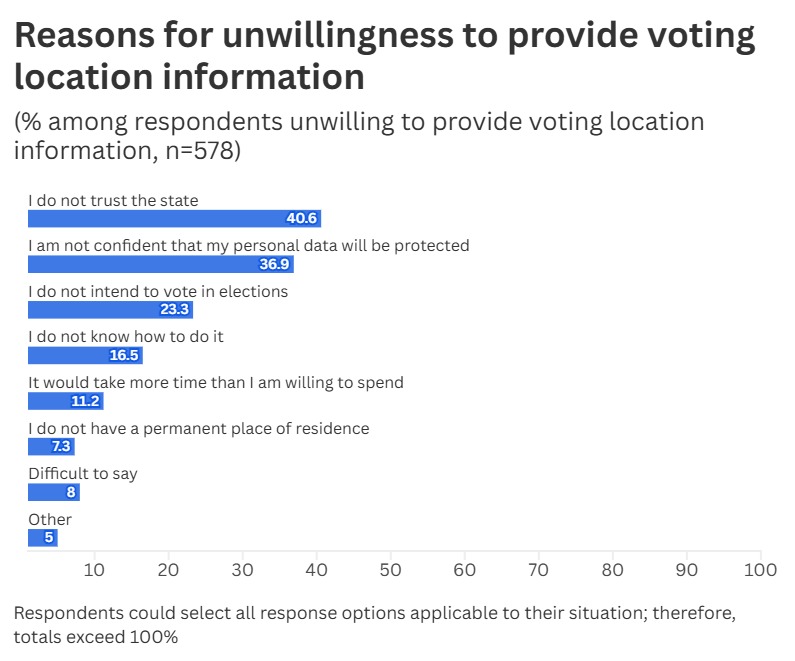
Notably, trust-related barriers are directly linked to the actual use of government digital services. Among respondents who have the Diia application installed, only 12% cite distrust of the state as a reason for refusing to update their information, compared with 38% among those who do not use the application. A similar pattern can be observed with regard to concerns about personal data protection: 12% of Diia users express such concerns, compared with 31% of respondents who do not have the application.
Younger respondents (aged 18–35) are more likely to refer to value-based considerations, particularly distrust of the state (48%) and a lack of interest in participating in elections (29%). Older respondents (aged 51 and over), by contrast, are more likely to point to a lack of understanding of the relevant procedures (24%). Men are significantly more likely than women to express distrust of the state (60% compared with 25%), while women are more likely to cite uncertainty about the procedures involved (22% compared with 9% among men).
Overall, citizens’ willingness to update their voting location information depends to a considerable extent on the proactive role of the state. Strong demand for digital tools coexists with a noticeable degree of distrust and with barriers that vary across different groups of the population. These findings suggest that any information campaign targeting Ukrainians abroad should combine the development of convenient digital tools with measures aimed at strengthening trust in electoral procedures and providing clear explanations of how citizens can exercise their electoral rights.
Potential Turnout and Key Constraints
The findings indicate a generally high level of willingness among Ukrainians abroad to participate in post-war elections. The proportion of respondents willing to vote exceeds the proportion willing to independently update their voting location information.
Under a standard voting schedule (Sunday, 8:00 a.m.–8:00 p.m.), 74% of respondents say they would be willing to vote (40% “definitely” and 34% “probably”). By contrast, 17% do not intend to participate in the elections, while a further 9% remain undecided. This suggests that turnout among Ukrainians abroad in post-war elections could be relatively high.
No substantial differences emerge across countries, although respondents in Germany display a slightly higher degree of certainty about their intention to vote (42% “definitely”), compared with 38% in both Poland and the Czech Republic.
From a socio-demographic perspective, respondents aged 36–50 (78%) and 51+ (75%) are more likely to participate in elections than younger respondents aged 18–35 (71%). Women also report a higher willingness to vote (77%) than men (69%).
Willingness to participate in elections is closely associated with political engagement and previous electoral experience. Among respondents who closely follow political developments in Ukraine, 91% say they are willing to vote, compared with just 33% among those who do not follow Ukrainian politics at all.
A similar pattern can be observed in relation to previous voting experience: among those who have voted in Ukraine before, 86% say they would be willing to vote in post-war elections from abroad, compared with 66% among those who have never voted.
Awareness of electoral procedures is also directly linked to willingness to participate. Among respondents who are definitely willing to vote in post-war elections, 23% say they have a good understanding of how voting abroad works. Among those who definitely do not intend to participate, the figure is only 17%. Conversely, the proportion of respondents who do not know how to vote abroad is almost twice as high among those who definitely do not intend to vote (61%) as among those who definitely plan to participate (33%). This suggests that limited awareness is not merely an information gap but may also be a factor contributing to lower electoral participation.
At the same time, an analysis of hypothetical voting arrangements shows that changes to the format of voting have virtually no effect on overall willingness to participate.
In particular, extending polling hours within a single day (from 7:00 a.m. to 10:00 p.m.) has no impact on overall willingness to vote, which remains at 74%. The only effect is a slight redistribution between the “definitely” and “probably” categories, without altering the overall proportion of respondents intending to vote.
A similar pattern emerges when additional voting days (Friday and Saturday) are introduced. In this scenario, willingness to vote increases only marginally, to 75% (+1 percentage point). The main effect is an increase in the share of respondents who express a firm intention to participate (45%), accompanied by a decline in the share selecting “probably willing to participate”.
The scenario-based questions confirm that extending voting hours or adding additional voting days does little to attract new groups of voters. Among those unwilling to vote under the standard schedule, only 8% would reconsider if polling hours were extended from 7:00 a.m. to 10:00 p.m., while 15% would reconsider if voting were also available on Friday and Saturday. These findings indicate that changes to the format and duration of voting affect voters’ confidence in their intention to participate rather than the overall size of the potential electorate.
The factor with the greatest impact on potential electoral participation is geographical accessibility. If voters were required to travel to the nearest major city in order to vote, willingness to participate would fall to 59% (–15 percentage points), while the share of respondents who do not intend to vote would increase to 31%.
.jpg)
Even among those willing to vote under standard conditions (Sunday, 8:00 a.m.–8:00 p.m.), 20% would refrain from participating if they had to travel to the nearest major city in order to vote. Among those unwilling to vote under the baseline scenario, such travel would have little effect on their position: 88% would still choose not to participate. This demonstrates that the physical accessibility of polling stations is a key factor influencing electoral participation among Ukrainians abroad.
This conclusion is reinforced by responses regarding barriers to participation. Among respondents who are considering voting or remain undecided, the main factors that could prevent them from casting a ballot are:
- lack of information about voting procedures — 33%;
- distance to the polling station — 31%;
- complexity of the procedures — 30%.
Secondary barriers include additional costs (19%), queues (16%), and voting taking place on a working day (11%). At the same time, 25% stated that none of the listed factors would prevent them from voting.
Some country-specific differences are also evident: in Germany, respondents more frequently cite the distance to polling stations (37%), reflecting the wider geographical distribution of Ukrainians across the country. In Poland, respondents are more likely to point to a lack of information (37%).
Socio-demographic differences are equally noteworthy. Younger respondents are more likely to identify insufficient information about voting procedures and additional costs as barriers, whereas older respondents are more likely to say that none of the listed obstacles would be critical for them. Respondents with lower incomes mention financial constraints considerably more often, while better-off respondents are more likely to refer to the complexity of procedures.
Certain barriers also vary according to employment status. Among employed respondents, procedural complexity is cited more frequently as a challenge (34% compared with 25% among those not in employment), as is voting taking place on a working day (14% compared with 7%). By contrast, respondents who are not employed are somewhat more likely to mention difficulties in leaving children or other dependants in their care (7% compared with 3%).
Overall, the findings indicate that although the declared willingness to participate in elections is high, actual turnout will depend to a large extent on organisational decisions, particularly those affecting the accessibility of voting.
It is important to note that even if some citizens return to Ukraine (37% of respondents consider their return after the lifting of martial law to be likely), roughly three-quarters of those who remain abroad still expect to vote. This will place significant pressure on overseas electoral infrastructure and underscores the need to increase the capacity of polling stations abroad.
The sharp decline in willingness to vote when additional travel is required demonstrates that geographical accessibility is a critical determinant of participation. In this context, planning the network of polling stations on the basis of the actual distribution of Ukrainian citizens abroad may prove more effective when undertaken in cooperation with host countries.
This section also reinforces the findings of previous chapters: barriers to participation are driven less by resource constraints, such as time or cost, than by limited understanding of procedures and insufficient information. The fact that respondents mention lack of information and procedural complexity far more frequently than costs or queues highlights the potential to increase participation through improved communication.
The greatest potential for increasing turnout among Ukrainians abroad lies not in extending voting hours, but in improving the physical accessibility of voting, optimising electoral infrastructure planning, and simplifying electoral procedures while providing clear explanations of how they work.
Willingness to Serve on Election Commissions: Motivations and Barriers
The unprecedented number of Ukrainians currently residing abroad is likely to place considerable pressure on electoral infrastructure in the event of post-war elections, even if that infrastructure is significantly expanded. One of the key challenges in these circumstances will be the staffing of election commissions.
The survey findings indicate that around 40% of respondents would potentially be willing to serve on an election commission (18% are fully willing and 22% are somewhat willing). At the same time, 39% are unwilling to do so, 15% do not understand what such work entails, and a further 8% are undecided.
.jpg)
No substantial differences are observed across countries. Willingness is slightly higher in the Czech Republic (41%) and Germany (40%) than in Poland (37%), although these differences are not significant. Socio-demographic differences, however, are more pronounced: respondents of middle age (46%) and older age (44%) are more willing to serve on election commissions, whereas younger respondents are considerably less inclined to do so (32%). Women (44%) are more likely than men (32%) to express willingness to serve, while willingness is lower among those in employment (36%) than among respondents who are temporarily unemployed or seeking work (55%).
Willingness to serve on an election commission is also linked to overall motivation to participate in elections. Among those who intend to vote, 49% are also willing to work on an election commission, compared with only 10% among those who do not intend to vote.
A similar relationship is evident with regard to interest in political developments in Ukraine: among respondents who closely follow political events, 47% are willing to serve on an election commission, compared with just 12% among those who rarely or never take an interest in Ukrainian politics.
Among the factors discouraging participation in election commissions (excluding respondents who said they did not know what such work involves), the most common is existing employment or study commitments (34%). Less obvious barriers also play a significant role, including a lack of perceived personal benefit (22%), uncertainty about the duties involved (20%), and the distance to the polling station (21%).
In Germany, respondents are more likely to mention the distance to polling stations (27%), which is likely related to the more dispersed geographical distribution of Ukrainians across the country. Concerns about the potential loss of social benefits are also somewhat more common there (5%). In the Czech Republic, by contrast, respondents are more likely to cite uncertainty about the responsibilities associated with serving on an election commission (24%).
Barriers vary depending on respondents’ level of willingness. Among those who are somewhat willing to serve, practical constraints are mentioned more frequently, including the distance to the polling station (32%), additional expenses (16%), and caring responsibilities (11%). Among those who are completely unwilling, however, the main barriers are less organisational and more motivational or security-related: 42% do not see any personal benefit in the role, while 17% are concerned about their personal safety. The distance to the polling station is particularly important for respondents who are generally inclined to participate but have not yet formed a firm commitment. This factor is cited by 32% of those who are somewhat willing to serve, compared with 26% of those who are fully willing and only 11% of those who are completely unwilling.
These findings suggest that some individuals who are potentially willing to serve on election commissions could be encouraged through expense reimbursement, conveniently located polling stations, and clearer explanations of the role and working conditions. However, such measures are likely to have only a limited effect on groups that are fundamentally unmotivated to participate.
An analysis of the factors that motivate citizens to serve on election commissions reinforces this conclusion. The most frequently cited factor (among all respondents except those who said they did not know what service on an election commission entails) is a clear explanation of the role and responsibilities involved (33%). Other important incentives include reimbursement of expenses (23%), the ability to combine commission work with one’s primary employment (22%), and guarantees of personal safety while serving on the commission (22%). Factors related to travel time and social protection are less influential but still of some significance.
At the same time, a substantial proportion of respondents (34%) state that none of the proposed incentives would motivate them to serve on an election commission, indicating the existence of a stable group with very low motivation to participate.
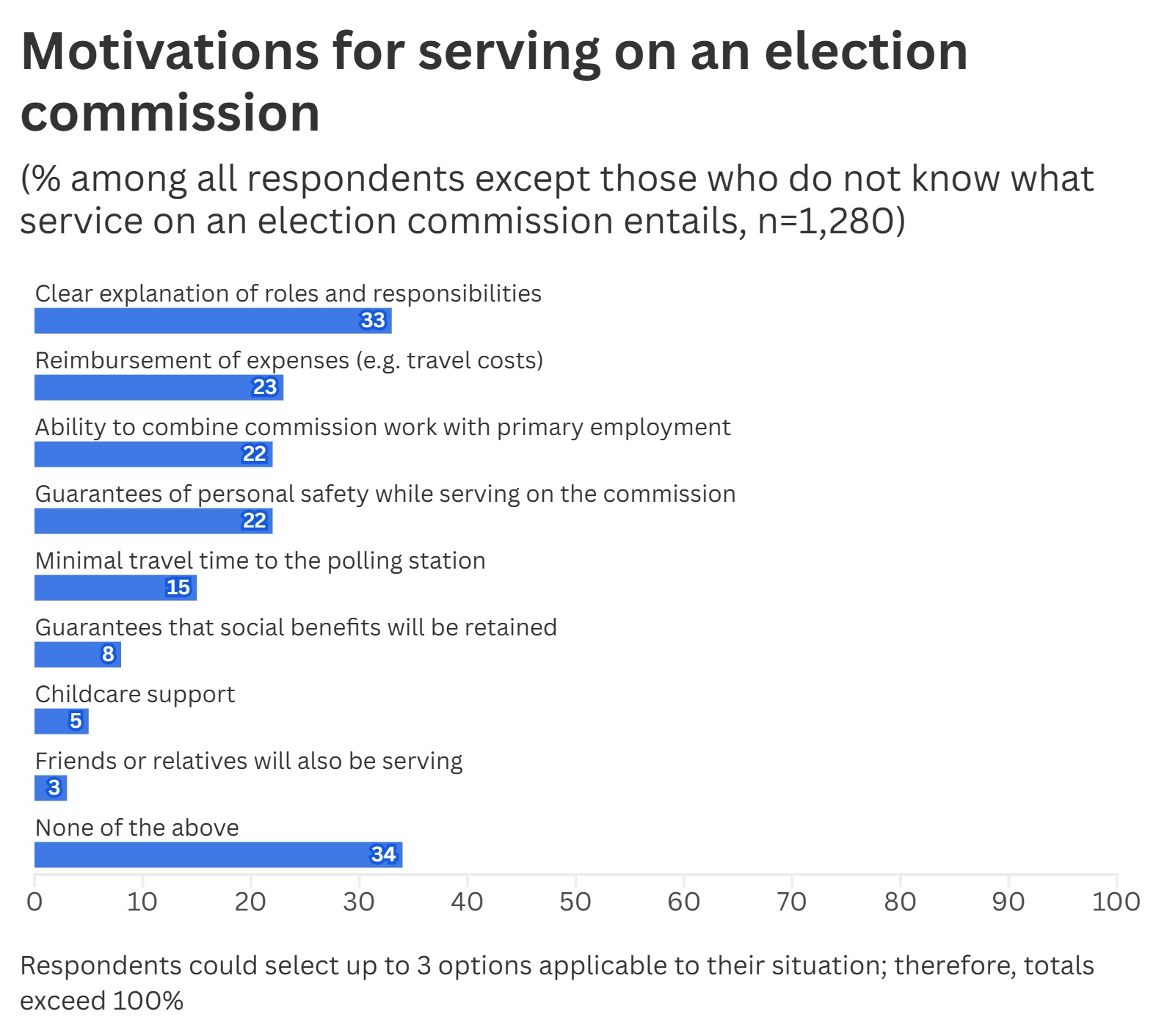
It is also important to emphasise that the distance to polling stations affects both willingness to vote and willingness to serve on election commissions. This once again highlights the importance of the geographical location of electoral infrastructure abroad in shaping citizens’ political participation.
As the findings demonstrate, staffing election commissions abroad will require a proactive recruitment strategy. The key constraint is not merely a lack of time or resources, but also a limited understanding of the role, the nature of the work, and the personal motivation to take part. Effective solutions should therefore combine clear and accessible explanations of responsibilities with opportunities for flexible participation, as well as basic guarantees relating to safety and expense reimbursement.
Residence Requirement: The Limits of Acceptable Exceptions
The residence requirement is one of the key eligibility criteria for exercising passive voting rights. To stand as a candidate for President, a citizen must have resided in Ukraine for the previous 10 years; to run for Parliament, the requirement is 5 years of residence. The full-scale war has called into question the application of this provision in its current form, as millions of Ukrainian citizens have been forced to leave the country.
Three main approaches to addressing this issue have emerged within the expert community. The first proposes that lawful residence abroad during the period of martial law should not be considered a breach of the residence requirement. The second argues against any exceptions on the grounds that altering the substance of the residence requirement through ordinary legislation could conflict with the Constitution. The third approach—a compromise model supported by OPORA—advocates taking into account the circumstances of departure, particularly whether it was forced and lawful, and allowing exceptions under specified conditions.
The survey of Ukrainians abroad shows that respondents’ views on this issue are mixed, but do not favour the strict preservation of the current legal requirements. 40% of respondents oppose any exceptions to the residence requirement, while 31% support exceptions for certain categories of citizens and a further 29% remain undecided. Taken together, this means that 60% of respondents either support revisiting the current approach or have not yet formed a clear position on the issue.
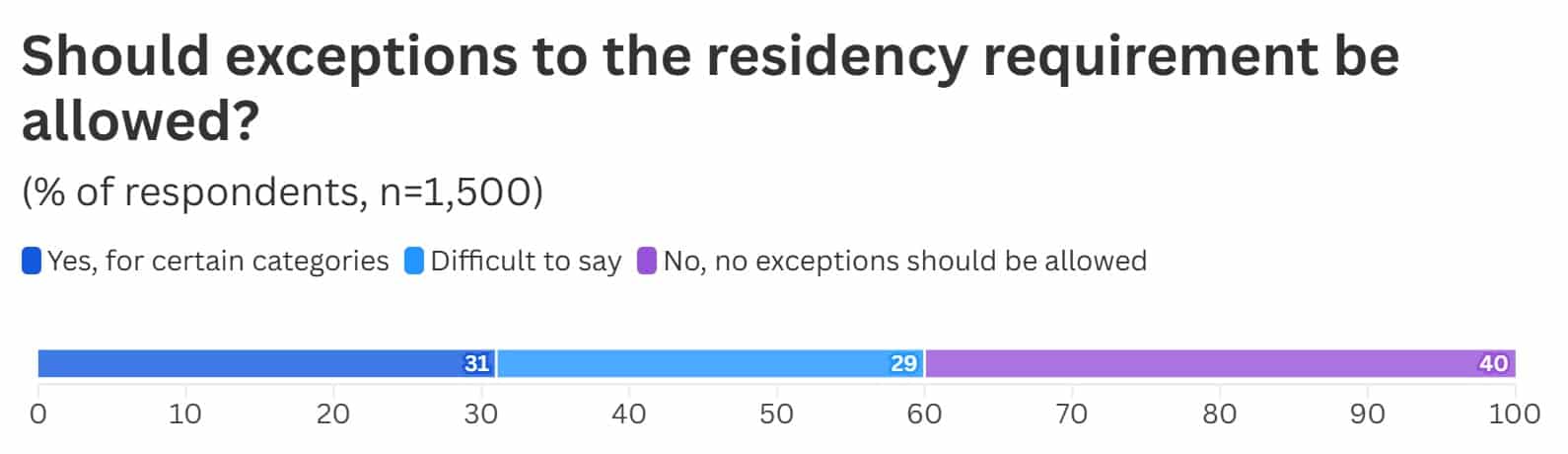
To explore the boundaries of acceptable exceptions to the residence requirement in greater detail, respondents were asked to assess whether waiving the requirement would be acceptable for five distinct categories of citizens, each reflecting different circumstances of residence abroad:
- citizens who return to Ukraine before the elections (testing the effect of the actual restoration of residence);
- citizens who left areas affected by hostilities or occupation (testing whether departure was forced);
- citizens who left areas not affected by hostilities (testing voluntary departure);
- citizens who were not subject to military service obligations (testing the lawfulness of departure);
- citizens who were subject to military service obligations but did not return to Ukraine (testing perceptions of non-compliance with departure restrictions).
Importantly, this question was asked only of respondents who either supported the possibility of exceptions or were undecided on the issue (together accounting for approximately 60% of the sample)—that is, the segment of respondents that could be considered open to potential changes.
The results reveal a clear hierarchy in public perceptions. The two categories receiving the strongest support are citizens who returned to live in Ukraine before the elections (66% consider waiving the residence requirement for this group acceptable) and those who left areas affected by hostilities or occupation (68%).
The lawfulness of departure is the next most important consideration: 61% support allowing individuals who were not subject to military service obligations to stand for election. By contrast, for those who left areas not affected by hostilities, the level of acceptance falls to 53%, while the level of opposition almost doubles.
The least favourable attitudes are directed towards individuals who were subject to military service obligations but did not return to Ukraine. Only 40% consider their participation in elections acceptable, while 31% regard it as unacceptable. This category differs statistically significantly from all others and represents the boundary of public acceptability.
This finding is reinforced by a direct question: individuals who were subject to military service obligations but did not return to Ukraine were the group most frequently identified (31%) as those who should not be permitted to stand for election.
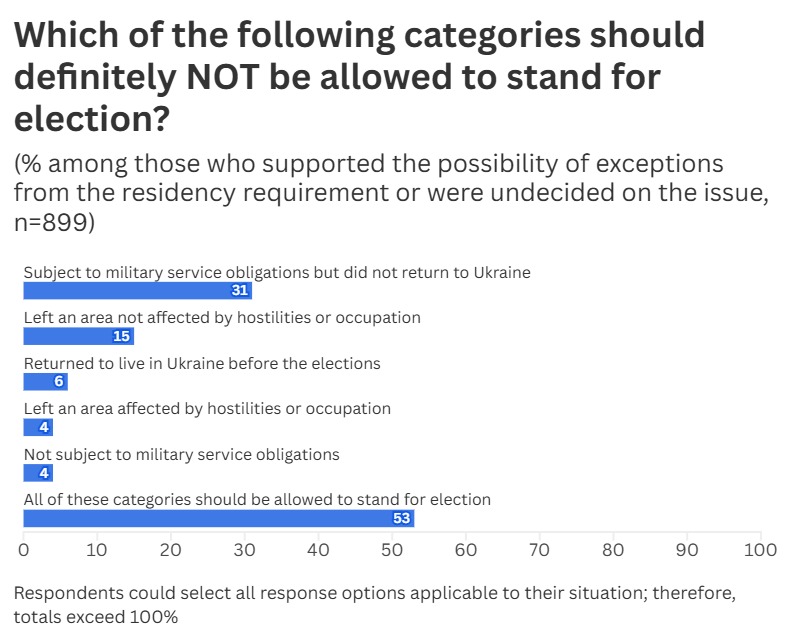
At the same time, 53% of respondents believe that all categories of citizens who resided abroad after 24 February 2022 should be allowed to stand for election.
Overall, attitudes towards the residence requirement are shaped less by the formal requirement of residence itself and more by perceptions of the circumstances surrounding a person’s departure from Ukraine. This creates grounds for a more inclusive regulatory approach, in which the key criteria are whether residence abroad was forced and lawful, as well as whether the individual returned to Ukraine before the elections.
Media Consumption Among Ukrainians Abroad
Interest in Political Developments in Ukraine
The survey indicates that Ukrainians in Poland, Germany and the Czech Republic maintain a high level of interest in political developments in Ukraine: 54.4% follow them regularly, 24.2% often, 12.4% occasionally, 4.8% rarely, and 4.2% not at all. Overall, 78.6% of respondents follow Ukrainian politics either regularly or often, meaning that roughly 4 in 5 respondents remain actively connected to Ukraine’s information space.
This connection is particularly strong among older respondents (aged 51 and over), 75% of whom follow political developments in Ukraine regularly. The figure is substantially lower among younger respondents (aged 18–35), at just 40%. There are virtually no differences by gender. By country, the highest level of sustained interest in political developments in Ukraine is observed in Germany (62% follow them regularly), compared with 49% in the Czech Republic.
Sources of Information
(Data calculated for all respondents except those who reported no interest in political developments)
Among the sources respondents used over the previous two months, social media platforms and messaging applications are by far the most prominent, cited by 76.4% of respondents (excluding those who are not interested in political developments): 77% in Poland, 76% in Germany and 77% in the Czech Republic. Online media (excluding social media) rank second at 36.4%, followed by relatives, friends and acquaintances (32.7%). Other sources include Ukrainian television (11.4%), television in the country of residence (8.1%), the United News telethon (5.6%), radio in the country of residence (3.9%), Ukrainian radio (2.1%) and printed media in the country of residence (2.1%).
.jpg)
Notably, less politically engaged respondents are more likely to obtain information through personal contacts rather than media sources. Among those who follow political developments in Ukraine regularly, 43% use online media, whereas only 13% of those who follow developments rarely do so. By contrast, interpersonal communication plays a greater role among respondents who are less engaged with Ukrainian political life: 42% of those who follow political developments only occasionally or rarely receive information from relatives, friends or acquaintances, compared with 27% among those who follow developments regularly.
Among social media platforms and messaging applications, Telegram is the clear leader, used by 72.8% of respondents (75% in Poland, 75% in Germany and 69% in the Czech Republic). It is followed by YouTube (52.9%), Instagram (46.8%), Facebook (42.3%), TikTok (17.4%), Threads (13%), Viber (11%), WhatsApp (5%), X/Twitter (3.5%), LinkedIn (1%) and Signal (0.9%).
.jpg)
Although Telegram remains the undisputed leader and the most universally used source of news, patterns of information consumption vary somewhat across age groups. Respondents aged 18–35 are the primary users of Instagram and make considerably greater use of TikTok and Threads. The 36–50 age group represents something of a transitional segment: while they still rely heavily on Telegram, they are twice as likely to use Facebook and considerably less likely to use Instagram. Among the oldest respondents (aged 51 and over), Facebook and YouTube are the main sources of news and, within this age group, even surpass Telegram. The use of Viber is also noticeably more common among older respondents.
Telegram is particularly widespread among those who left Ukraine after the start of the full-scale war: 77% of respondents in this group use the platform, compared with 61% of those who began living abroad earlier.
Trust in Information Sources
(Data calculated for all respondents except those who reported no interest in political developments)
When it comes to trust in information sources, social media platforms and messaging applications rank first, trusted by 43.8% of respondents (44% in Poland, 41% in Germany and 46% in the Czech Republic). Relatives, friends and acquaintances rank second at 27.6%, followed closely by online media at 26.4%. Ukrainian television is trusted by 8.1% of respondents, television in the country of residence by 6.4%, the United News telethon by 4.5%, and radio sources by approximately 2–3%. Particularly noteworthy is the proportion of respondents who do not trust any of the listed sources, which stands at 22.2% (23% in Poland, 18% in Germany and 25% in the Czech Republic).
Trust in television sources—whether Ukrainian broadcasters, broadcasters in the country of residence, or the United News telethon—shows clear variation by age and income. The highest levels of trust are found among respondents aged 51 and over and among those with the lowest incomes (ranging from 8% to 14%). By contrast, younger respondents (aged 18–35) have largely excluded television from their list of trusted sources, with trust levels in this group ranging from only 2% to 4%.
Information from Ukrainian Public Authorities
When asked whether they had come across information from official Ukrainian public authorities during the previous day, 38% of all respondents answered “yes”, while 62% answered “no”.
Among the public authorities whose information respondents had encountered, the Office of the President was the most frequently mentioned source (55.4%), followed by the General Staff of the Armed Forces of Ukraine (40.4%), ministries and government agencies (20.1%), the Verkhovna Rada (11.8%), and the Cabinet of Ministers (10%).
Respondents most commonly received information from public authorities through social media platforms and messaging applications (69.6%), followed by online media (32%), official government websites (14.7%), television (10.6%), and relatives or acquaintances (7.1%).
Among respondents who follow political developments in Ukraine regularly, 51% reported having encountered information from official public authorities during the previous day. This figure falls to 31% among those who follow such developments often, and to just 7% among those who do so rarely. Official communication, therefore, reaches primarily those who are already engaged, while having considerably less reach among individuals who are less connected to Ukraine’s information space.
Information About Elections: Information Needs and Communication Channels
When asked what information about Ukrainian elections abroad they considered important, 60% of all respondents selected “where and when to vote”, 55.6% chose “information about candidates or political parties”, 46.5% selected “how to check whether I am included on the voter list”, 40.6% chose “how voting takes place on election day”, 34.7% selected “how to change my voting location”, and 29.0% chose “changes to electoral legislation”. Only 15.5% stated that none of the listed information was important to them, while 7.6% found it difficult to answer.
.jpg)
Among those who definitely intend to vote, the demand for such information is even more pronounced: some 76% want to know where and when to vote, 64% are interested in information about candidates and political parties, 59% want information on how to check whether they are included on the voter list, 49% want to understand how voting will take place, and 44% are interested in how to change their voting location.
By contrast, among respondents who definitely do not intend to vote, only 6% are interested in information about where and how to vote, while 5% are interested in information about candidates.
Attitudes towards political campaigning are predominantly negative. Nearly two-thirds of respondents (65.3%) do not wish to receive campaign materials, with 43% expressing a categorical refusal. Only around 30% of respondents are willing to receive campaign communications, while a further 4.5% were unable to clearly define their position.
Even among those who definitely intend to vote, demand for campaign-related information remains limited: 42% answered either “yes” or “probably yes”, while 55% indicated that they would probably or definitely not like to receive campaign materials. Among those who are only somewhat likely to vote, openness to campaign communications is even lower, at 33%.
Those voters who are willing to consume campaign content overwhelmingly prefer digital channels of communication. More than half of this audience considers messaging applications and social media platforms to be the most convenient channels (53% each), far ahead of email newsletters (13%) and online advertising (12%). Traditional formats, by contrast, are rapidly losing relevance: only 10% of respondents selected face-to-face meetings with politicians and Ukrainian television, respectively, while traditional postal mailings and SMS messages were the least popular formats, each chosen by 8%.
When asked about the most convenient channels for receiving official election-related information (procedural rather than campaign information), Diia is the clear leader, selected by 44% of respondents. It is followed by official social media pages of public authorities (27%), official government websites (23%), Ukrainian online media outlets (19%), websites or social media pages of Ukrainian embassies and consulates (17%), email newsletters (12%), SMS messages (11%), Ukrainian television (7%), and printed materials or outdoor advertising (3%).
.jpg)
Among those who left Ukraine after 24 February 2022, demand for digital channels of official communication is noticeably higher: 47% identified the Diia application as a convenient channel, compared with 36% among respondents who have been living abroad for a longer period.
These findings suggest that official election-related communication could be built around Diia as the primary official channel, supplemented by the social media accounts of public authorities (including the Central Election Commission, the Ministry of Foreign Affairs, and Ukrainian embassies) as well as online media outlets. Ukrainian television appears to have limited reach among Ukrainians abroad, particularly among younger audiences. Its role is more significant among older respondents (aged 51 and over), 14% of whom identified it as a convenient channel for receiving official information, compared with only 3% among younger respondents.
Trust in Sources of Election Information
Election observation organisations emerged as the most trusted source of information on Ukrainian elections, selected by 40% of respondents. They were followed by Ukrainian embassies and consulates (32.4%), civil society organisations (31.1%), and the Central Election Commission (27.7%). Other public authorities were trusted by 8% of respondents, candidates by 5%, and political parties by only 3%. Notably, 26% of respondents stated that they do not trust any of the listed institutions.
At the same time, the survey findings indicate a high level of trust among Ukrainians abroad in the governments of their countries of residence with regard to the organisation of Ukrainian elections on their territory. Overall, 86.1% of respondents expressed at least some degree of trust in the government of the country where they live: 45.2% trust it completely, while 40.9% rather trust it. By contrast, 13.5% expressed distrust in the governments of their host countries (9.4% rather distrust and 4.1% completely distrust them).
The highest levels of complete trust in the government of the country of residence were recorded among Ukrainians in Germany (54%) and the Czech Republic (50%). In Poland, the figure was lower at 31%, although the overall level of trust remained high at 79%.
.jpg)
Levels of trust also vary across socio-demographic groups. The proportion of respondents who completely trust the government of their country of residence increases with age: among respondents aged 51 and over, it stands at 51%, compared with approximately 43–44% among younger age groups. Men are somewhat more likely than women to express complete trust (53% versus 41%).
Respondents were somewhat more cautious in their assessment of whether the governments of their host countries are interested in facilitating the organisation of Ukrainian elections. Nearly three-quarters of respondents (73.4%) believe that the government of the country where they live is interested in supporting the organisation of such elections (19.1% consider it very interested and 54.3% rather interested). A further 27.6% hold the opposite view.
As with levels of trust, the least positive assessments were recorded among Ukrainians living in Poland. Only 10% of respondents there believe that the Polish government is very interested in facilitating the organisation of Ukrainian elections, compared with 23% of respondents in both the Czech Republic and Germany.
Experiment on a Hypothetical Restriction of Voting Rights
To assess whether discussions about the potential restriction of voting rights for Ukrainians abroad could influence citizens’ intentions to return to Ukraine, an online experiment was conducted as part of the study. The experiment involved comparing the responses of two randomly assigned groups of respondents.
Respondents in the reference group were asked about the likelihood of returning to Ukraine without any prior information being provided. By contrast, respondents in the experimental group were first shown a specially prepared news item describing a possible legislative restriction of the voting rights of Ukrainian citizens residing abroad. After reading the text, both groups were asked the same question about the likelihood of returning to Ukraine.
Comparing the responses of the reference and experimental groups makes it possible to assess whether merely mentioning a potential restriction of voting rights can influence the intentions of Ukrainians abroad regarding a return to Ukraine.
Over the course of the survey, 19% of respondents changed their answer to this question. Of these, 13% lowered their assessment of the likelihood of returning to Ukraine, while 6% increased it. Although the observed effect is small, it is statistically significant. The most plausible explanation is a contextual priming effect within the survey itself: the first question was asked at the very beginning of the questionnaire, before respondents had reflected on their everyday lives abroad, whereas by the time they answered the second question at the end of the survey, they had already considered dozens of aspects of their integration, employment and social ties in their country of residence. This may have made the prospect of returning to Ukraine appear subjectively less realistic.
According to the results of the follow-up question, around half of Ukrainians living abroad (52%) consider returning to Ukraine after the lifting of martial law unlikely. Of these, 20% described their return as rather unlikely and 32% as very unlikely. Almost the same proportion of respondents (48%) remain optimistic about returning once martial law is lifted. Among them, 28.5% consider their return very likely, while the remaining 19.5% view it as rather likely. A further 11% of respondents were unable to provide an answer and were therefore excluded from the subsequent analysis.
For half of the respondents, this question was asked after they had read the news item about a potential legislative restriction of the voting rights of Ukrainians abroad. This framing had no effect on respondents’ intentions to return. The proportion of those who considered returning likely was virtually identical in the control group (without the news item) and the experimental group (with the news item): 49% and 47%, respectively. The difference of 2 percentage points is not statistically significant. The results of the statistical test confirm this conclusion.
Among the factors associated with reassessing intentions to return to Ukraine after the lifting of martial law are gender, age, financial situation, employment status, migration wave, the type of settlement from which the respondent emigrated, current country of residence, legal status in that country, and engagement with Ukrainian political life.
Women are more likely than men to plan a return to Ukraine: 53% compared with 40% of men. Age is one of the strongest predictors of return intentions: the older the respondent, the greater the likelihood of returning. Among respondents aged 18–35, only 37.5% consider returning to Ukraine, whereas among those aged 60 and above, 77% view a return as realistic.
Financial well-being shows an inverse relationship with return intentions: the better a household’s financial situation, the lower the likelihood of returning. Among less affluent respondents, 65% consider returning to Ukraine likely, compared with 39% among those who are financially better off. A similar pattern can be observed in relation to employment status. Respondents who were employed at the time of the survey assessed the likelihood of returning to Ukraine less positively than those who were unemployed: 43.5% compared with 55%.
Although parts of eastern and southern Ukraine remain under occupation, the macro-region in which respondents lived before moving abroad does not affect their assessment of the likelihood of returning, including among those who left after the start of the full-scale invasion. However, return intentions are influenced by the type of settlement from which respondents emigrated. Those who had lived in villages or small settlements were more likely to consider returning to Ukraine (58%) than those who had lived in cities (46.5%).
A longer period of residence abroad is associated with lower intentions to return to Ukraine. Respondents who left before 2022 assess the likelihood of returning less positively than those who left after the start of the full-scale invasion: 38% and 52%, respectively. Another predictor is the respondent’s current country of residence. The highest proportion of respondents who consider returning to Ukraine likely is found among those living in Poland (52%), while the lowest is among those living in Germany (43%). The Czech Republic holds an intermediate position at 48%.
Indicators of legal and political integration also appear to be linked to return intentions. Holders of temporary protection are more likely (53%) to say they would return to Ukraine if martial law were lifted than respondents who hold a residence permit (40%).
Respondents who continue to follow political developments in Ukraine are also more likely to report a high probability of returning. As interest in Ukrainian political life declines, so too does the perceived likelihood of return.
Moreover, assessments of the likelihood of returning to Ukraine vary significantly depending on the conditions respondents consider necessary for such a return. Those who regard security as a prerequisite are more likely to retain an intention to return. Among respondents who identified the official end of the war as a condition for returning, 58% consider a return likely, compared with 35% among those who did not identify this condition. A similar, though somewhat weaker, pattern can be observed with regard to the cessation of hostilities and shelling: 60% versus 41%.
A separate set of factors relates to changes in individuals’ legal status while living abroad. Respondents who identified the expiry of temporary protection as a condition for returning were substantially more likely to consider a return to Ukraine likely than those who did not cite this condition: 72% and 45%, respectively. An even stronger pattern emerges in relation to the termination of social benefits in the host country: 82% versus 47%. These respondents appear willing to return but require an external trigger to do so; their return is therefore more likely to be driven by circumstance than by choice.
Employment opportunities in Ukraine have a weaker, though still statistically significant, effect. Among respondents for whom access to employment in Ukraine is an important consideration, 57% assess the likelihood of returning as high, compared with 45% among those for whom this factor is not important.
Respondents who identified the lifting of travel restrictions for persons liable for military service as an important condition for returning to Ukraine were less likely to consider their return probable (41%) than those for whom this condition was not important (51%). A similar pattern is observed among respondents who view a higher standard of living in Ukraine as an important condition for return: 42% of them consider returning likely, compared with 53% among those for whom this factor is not important.
Six factors show no statistically significant relationship with return intentions: the de-occupation of the respondent’s locality, infrastructure reconstruction, the availability of housing in Ukraine, overall economic improvement, the relocation of family members to Ukraine, and enrolment in a Ukrainian educational institution. These conditions, therefore, appear to be either equally important or equally unimportant to both groups—those who plan to return and those who do not.
The strongest association across the entire analytical framework is observed for the response, “No condition would affect my decision to return”. Among respondents who selected this option, 96% consider their return to Ukraine unlikely. This group accounts for around 10% of the overall sample and represents a stable core of individuals who have made a definitive decision to remain abroad, regardless of future developments in Ukraine.
METHODOLOGY
A sociological survey was conducted to examine media consumption patterns and civic and political engagement among Ukrainians living abroad. The research design and analytical processing of the findings were carried out by Civil Network OPORA, which also prepared this report. The fieldwork was conducted by Rating Group LLC (Rating Online) using an online survey (CAWI) based on a questionnaire developed by OPORA’s experts.
The target population comprised adult Ukrainian citizens permanently residing in Poland, Germany and the Czech Republic. Individuals staying abroad temporarily, including for tourism, business travel or short-term visits, were not included in the sample.
The survey was conducted between 17 April and 2 May 2026. The total sample consisted of 1,500 respondents, with 500 respondents in each of the three countries of residence. This sample structure enables both overall analysis and cross-country comparisons, particularly for findings that demonstrate statistically significant relationships.
Data were collected using the CAWI (Computer-Assisted Web Interviewing) method, whereby respondents completed the questionnaire independently online. Participants were recruited using a combined sampling approach: a random sample of mobile telephone numbers, drawing on mobile operator data to identify Ukrainians residing in the relevant countries, supplemented by targeted invitations distributed through selected messaging platforms and social media channels.
The survey results were weighted by age and gender using the latest data from the Office of the United Nations High Commissioner for Refugees (UNHCR), allowing the sample to more closely reflect the actual demographic structure of Ukrainians living abroad. Data quality assurance included checks for response consistency, survey completion time, respondent uniqueness, and measures to prevent duplicate participation.
The study covers several interconnected thematic areas, enabling a comprehensive assessment of the experiences and behaviour of Ukrainians abroad. In particular, it analyses respondents’ socio-demographic and migration profiles, as well as their intentions regarding a return to Ukraine. Particular attention is given to interactions with the state, including the use of consular services and digital public services, awareness of voting procedures abroad, and willingness to update one’s electoral address.
The study also examines political participation, including motivations and barriers to voting, willingness to serve on election commissions, and attitudes towards possible exemptions from the residency requirement. In addition, it explores the information environment of Ukrainians abroad, including media consumption habits, communication channels, expectations regarding campaign communication, and levels of trust in host-country governments in the context of organising Ukrainian elections.
SOCIO-DEMOGRAPHIC PROFILE OF RESPONDENTS
The study surveyed 1,500 Ukrainian citizens residing abroad at the time of the research, with 500 respondents in each of the three countries: Poland, Germany and the Czech Republic. Women account for the majority of the sample (63%), while men represent 37%. This distribution broadly reflects the nature of Ukrainian migration since the start of the full-scale invasion, as women constitute a significant proportion of those who have left the country, partly due to restrictions on international travel for men of military age.
The largest age group consists of respondents aged 18–35, who account for 45% of the sample. A further 30% are aged 36–50, while 25% are aged 51 and over. Most respondents lived in urban areas before leaving Ukraine. 55% resided in regional centres, while a further 28% lived in other towns and cities within their region. Respondents who had lived in villages or smaller settlements account for 16% of the sample. As a result, the sample has a predominantly urban profile, with more than 8 in 10 respondents having lived in urban settlements prior to emigrating.
In regional terms, respondents originally from southern and eastern Ukraine are the most strongly represented. Before moving abroad, 26% lived in the South, 22% in the East, 19% in the West, 19% in the Centre, and 14% in Kyiv. At the level of individual regions, the largest groups come from Kharkiv Oblast and the city of Kyiv (14% each), followed by Dnipropetrovsk Oblast (9%), Donetsk and Zaporizhzhia oblasts (6% each), and Odesa Oblast (5%).
63% of respondents hold a higher education qualification, while a further 22% have completed professional pre-higher education. 11% have completed full secondary education, and 2% have basic secondary education. Consequently, more than 8 in 10 respondents have either higher or professional pre-higher education, which is important to bear in mind when interpreting responses relating to legal procedures, information provision and interaction with public institutions.
In terms of financial circumstances, 53% belong to relatively well-off groups, reporting that they have sufficient resources to cover basic needs and household purchases, or everything they require. A further 30% can be classified as having a moderate level of financial security: they can afford food and clothing, but purchasing more expensive household items presents difficulties. 14% are in a more vulnerable position, reporting that they either cannot afford food or can only afford food.
45% of respondents’ households have financial savings, while 55% do not. Among those with savings, 44% stated that these resources would cover their expenses for between one and six months if they lost their main source of income, while 29% said their savings would last for more than six months.
Most respondents are economically active: 60% are employed, self-employed, sole proprietors or engaged in a family business. A further 3% are temporarily not working but have a job to return to. 9% are unemployed and actively seeking work, 7% are studying, 9% are retired, and 4% are engaged in household or caregiving responsibilities.