 This material was produced as part of the project “Promoting Democratic Integrity and Governance in Ukraine”, implemented by the Civil Network OPORA with the support of the EU. Its content is the sole responsibility of the Civil Network OPORA and does not necessarily reflect the position of the European Union.
On 24 February 2022, regional and district military administrations were established in Ukraine. Under the law, they may be established in territories where martial law has been imposed to ensure the enforcement of the Constitution and laws of Ukraine, defence, civil protection, public safety, the protection of critical infrastructure, and the safeguarding of the rights, freedoms and legitimate interests of citizens.
Subsequently, military administrations (MAs) began to be established in communities as well. The law additionally assigns to their powers the approval of the local budget, which provides them with significant leverage over decision-making. At the same time, the concentration of power within the MAs may restrict the activities of local councils, particularly in the communities where there are functional local government bodies.
The civil society network OPORA has investigated how many military administrations have been established in communities and when they were set up.
What exactly is a military administration in a community?
The grounds for establishing military administrations in local communities are the failure of local government bodies to exercise the powers assigned to them by the Constitution and the laws of Ukraine, as well as certain other cases provided for in the Law “On the Legal Regime of Martial Law” (Article 3( 4)).
In the event of the establishment of military administrations in communities, part of the powers of local self-government bodies are transferred to them. Furthermore, the head of the military administration may assume all the powers of the community head, the local council and its executive committee, provided that the Verkhovna Rada adopts a corresponding decision upon the President’s proposal.
As there are no clear criteria for establishing military administrations in communities, there are sometimes questions about why a military administration has been established in a particular community. It is entirely logical that military administrations are needed in occupied communities or those near the line of contact, especially if local self-government is not functioning: there are no local council sessions, and it is impossible to adopt a budget.
At the same time, there are cases where military administrations have been established in communities where local self-government is functioning. For example, in Odesa in October 2025, a military administration was established following the termination of Ukrainian citizenship of the mayor, Hennadii Trukhanov. Serhii Lysak, the former head of the Dnipropetrovsk Regional Military Administration, became the head of the city’s military administration. Meanwhile, the city council and its members continue to work, and the council secretary, Ihor Koval, has become the acting mayor.
The lack of transparent criteria for establishing military administrations gives the President the power to deploy them in any community. This situation raises concerns about the possibility of a politically motivated approach being adopted, which would lead to a strengthening of the presidential hierarchy and a weakening of local self-government. In wartime, the role of regional councils has diminished significantly, and the establishment of a military administration in a community far from the combat zone could provoke conflict between the local council and the administration.
For example, in Chernihiv, a conflict arose between the city military administration and the city council over appeals against decisions taken by local councillors. In Sumy, there were delays in budget payments due to an unclear division of powers between the city council and the city military administration. In Varash, the city council took legal action against the city military administration regarding the revocation of the latter’s orders.
Of course, conflicts are not everywhere. In some cases, heads of communities are appointed as heads of military administrations. However, this practice is more common for communities located in combat zones or in occupied territories. For example, the mayor of Kramatorsk, Oleksandr Honcharenko, has been appointed head of the Kramatorsk City Military Administration, and the mayor of Mariupol, Vadym Boichenko, has been appointed head of the Mariupol Military Administration.
Where do military administrations operate?
As of December 2025, there are 214 military administrations at the local authority level. Some of these are located in temporarily occupied territories or in areas near the front line. At the same time, some have been established in communities further inland. As of the time of writing, five military administrations were established in December 2025 in the Dnipropetrovsk Oblast.
67 military administrations have been established in cities, 71 in settlements, and 76 in rural communities.
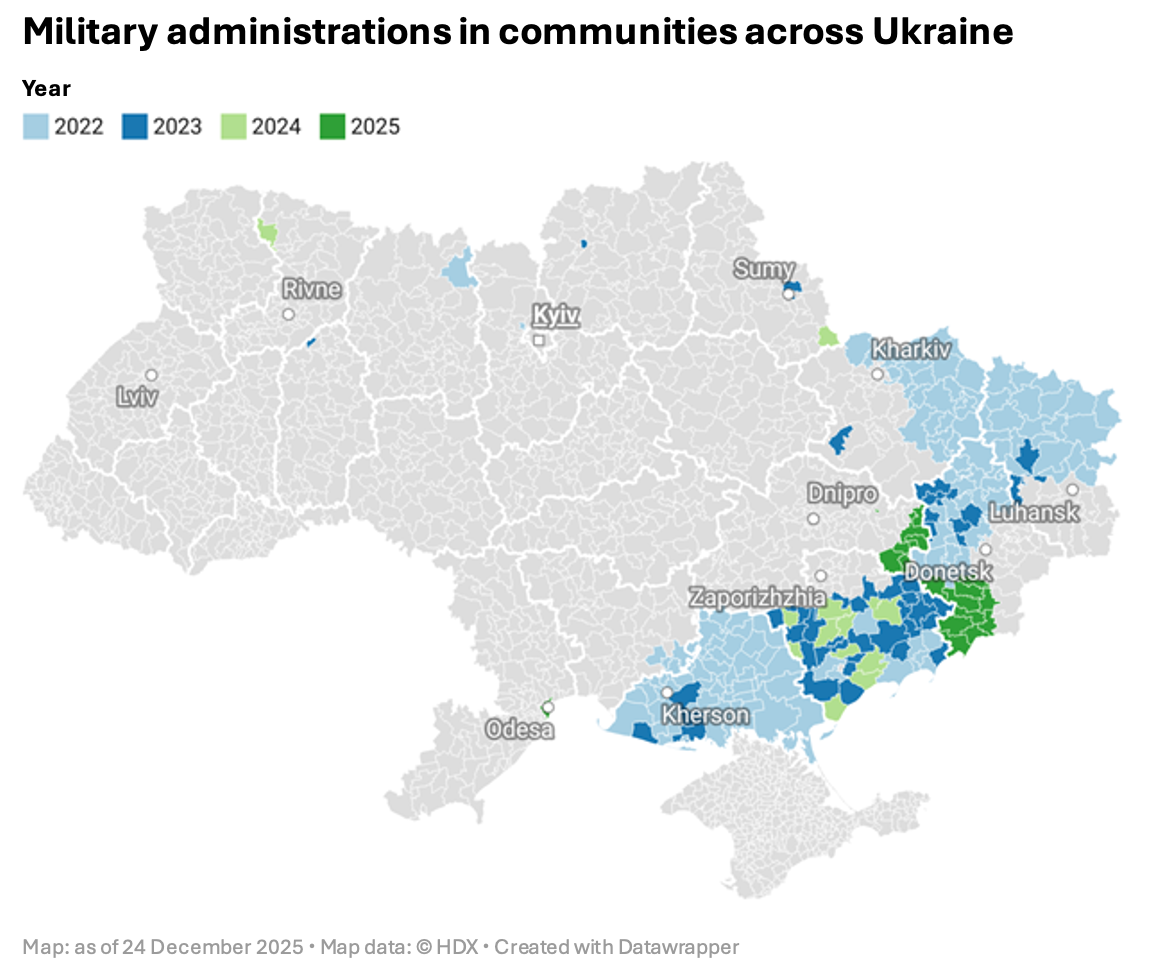
Military administrations at the community level exist in 14 oblasts of Ukraine. Two-thirds of these are located in three oblasts: Kherson (49), Zaporizhzhia (48) and Donetsk (46). Together with the military administrations in the communities of the Kharkiv and Luhansk oblasts, they account for over 90% of all military administrations in communities.
Military administrations have been established in all communities in the Kherson region, as well as in all communities in the Donetsk and Luhansk regions that were under Ukrainian control as of 2020. Military administrations have been established in 48 of the 67 communities in the Zaporizhzhia Oblast and in 27 of the 56 communities in the Kharkiv Oblast.
On the map of Zaporizhzhia Oblast, one can see a grey dot — an occupied community without a military administration. This is the Melitopol City Community, whose head, Ivan Fedorov, has also headed the Zaporizhzhia Oblast Military Administration since February 2024. The Melitopol City Council continues to operate; its last session took place in December 2025.
The remaining 9 oblasts have 18 military administrations, with 6 regions each having a single administration.
When were the military administrations established?
More than half of all military administrations were established in 2022. The figures were as follows: 2022 — 134, 2023 — 49, 2024 — 13, 2025 — 18.
The first military administration at the community level in Ukraine was established on 21 March 2022 in the Hostomel settlement community. The day before, the Russians had killed Yurii Prylypko, the head of the Hostomel settlement.
To this day, it remains the only community military administration in the Kyiv region. Combat continued here in February and March; the world’s largest aircraft, the An-225 “Mriya”, was destroyed in a hangar at Hostomel Airport. In April 2023, the Verkhovna Rada transferred the powers of the Hostomel settlement council, its executive committee and the settlement head to the head of the military administration.
Of the 45 military administrations established in the first year of the full-scale invasion, the largest number were in the Kherson Oblast, which was almost entirely occupied by Russian troops. 27 military administrations were established in the Donetsk Oblast, 26 in the Kharkiv Oblast, and 23 in the Luhansk Oblast.
On 30 March 2022, eight military administrations were established in the Donetsk Oblast, and on 31 March, a further two in the Luhansk Oblast. On 18 April 2022, the Narodychi Settlement Military Administration in the Zhytomyr Oblast was established. Several villages in this community were occupied by the Russians at the start of the full-scale invasion.
An interesting situation arose with the establishment of military administrations in Zaporizhzhia Oblast. On 7 May 2022, the first one was established — the Tokmak City Military Administration. In 2022, there were only 8 military administrations in the oblast, but in the following year, 2023, a further 29 administrations were established, and in 2024, 11 more.
In 2023, military administrations were established in regional centres (Chernihiv and Sumy), as well as in Netishyn in the Khmelnytskyi Oblast. In 2024, the Varash City Military Administration in Rivne Oblast and the Velyka Pysarivka Settlement Military Administration in Sumy Oblast were also established.
During 2025, 18 military administrations were established. These included the Odesa City Military Administration, established in one of the largest and richest cities in Ukraine. Ten administrations were established in the Donetsk Oblast, specifically in the occupied Mariupol Raion and the Volnovakha Raion, which is almost entirely under Russian control.
All military administrations in the Dnipropetrovsk Oblast were established in 2025. The first to appear in March was the Novopavlivka Rural Military Administration, followed in July by the Ternivka City Military Administration. Novopavlivka is located near the front line, while Ternivka is near Pavlohrad. The other five military administrations were established on 17 December 2025 in communities within the Synelnykove Raion.
Currently, military administrations operate in three regional centres, as well as in Kramatorsk and the occupied city of Siverskodonetsk, which, following the occupation of Donetsk and Luhansk in 2014, became the administrative centres of the Donetsk and Luhansk Oblasts.
Military administrations have also been established in communities near nuclear power stations — in Netishyn in the Khmelnytskyi Oblast and Varash in the Rivne Oblast. Their establishment can be justified by the need to ensure security near strategic facilities, and in the case of Varash, also by its proximity to the Belarusian border.
At the same time, a third operational nuclear power plant is located in Ukrainian-controlled territory — near Pivdennoukrainsk in Mykolaiv Oblast. In 2022, the Russians attempted to seize this nuclear power plant, but were stopped. Since no military administration has been established in the Pivdennoukrainsk community, this means that the presence of a strategic facility does not necessarily entail the creation of a military administration in the community.
Do military and political events influence the creation of military administrations?
In total, there are 46 presidential decrees on the establishment of military administrations. Sometimes, a single decree established several military administrations — such “peaks” were most frequent in 2022. For example, 28 administrations were established on 27 October 2022. 20 administrations appeared on 23 September 2022, and 19 administrations appeared on 7 April 2023.
The mass establishment of community-level military administrations is often linked to an intensification of hostilities and the need to govern territories.
For example, in March and July 2022, the establishment of military administrations in the Donetsk Oblast coincided with an intensification of hostilities in the east. In June and July, Siverskodonetsk and Lysychansk were seized, and almost the entire territory of the Luhansk Oblast was occupied.
The need to maintain the functioning of the administrative authorities in the Luhansk Oblast led to the establishment of 20 military administrations on 23 September 2022. A similar step was taken in the Kherson Oblast, where 15 military administrations were established on 19 September.
October 2022, when 43 military administrations were established, coincided with the de-occupation of the Kharkiv and Kherson Oblasts.
In the Zaporizhzhia Oblast, the mass emergence of military administrations coincided with the counter-offensive of 2023. On 7 April 2023, 19 military administrations were established, with a further 10 administrations created on 5 July 2023.
On 14 April 2023, nine military administrations appeared in the Donetsk Oblast, complementing the administrative structure in the east amidst ongoing hostilities.
On 23 April 2024, 8 military administrations were established in the Zaporizhzhia Oblast in occupied or frontline communities that had not had administrations in 2023.
The final peaks in the establishment of military administrations occurred in 2025: On 16 April, 10 military administrations were established in the Donetsk Oblast, including those for the cities of Mariupol and Volnovakha. On 17 December, five military administrations were formed in the Dnipropetrovsk Oblast. These developments are linked to the gradual advance of Russian forces and the expansion of the theatre of hostilities.
Why it is important to preserve local self-government under martial law
Preserving and supporting democratic institutions, even during a full-scale war, is a vital element of Ukrainian resilience and a prerequisite for the realisation of its European aspirations. The introduction of a legal regime of martial law has led to temporary restrictions on the activities of local councils and an expansion of the powers of military administrations as a means of ensuring defence, security and administrative continuity at the local level.
Military administrations can be viewed in different ways: as a wartime necessity or as an attempt to centralise power during wartime. Following the establishment of military administrations at the community level, a dual system of governance emerges. This increases the risk of conflict, including due to the lack of a clear demarcation of powers.
At the same time, the preservation of local self-government is essential for ensuring democratic governance, and any restrictions on it must have clear and well-founded grounds. The Roadmap on the Functioning of Democratic Institutions also highlights the need to define the specific features of local self-government in territories under Ukrainian control, within the legal framework of martial law, taking into account security conditions and other challenges.
However, upon the termination of martial law, Ukraine must ensure a controlled and legitimate transition to civilian governance, in particular by restoring the full functioning of democratic institutions. In this context, research into the activities of military administrations — specifically the geography of their establishment, their powers and operational practices — is important for assessing the justification and proportionality of temporary restrictions on the work of local self-government bodies, as well as for developing approaches to restoring the local governance system in the post-war period.
***
This material was produced as part of the project “Promoting Democratic Integrity and Governance in Ukraine”, implemented by the Civil Network OPORA with the support of the EU. Its content is the sole responsibility of the Civil Network OPORA and does not necessarily reflect the position of the European Union.
First published: Eastern edition