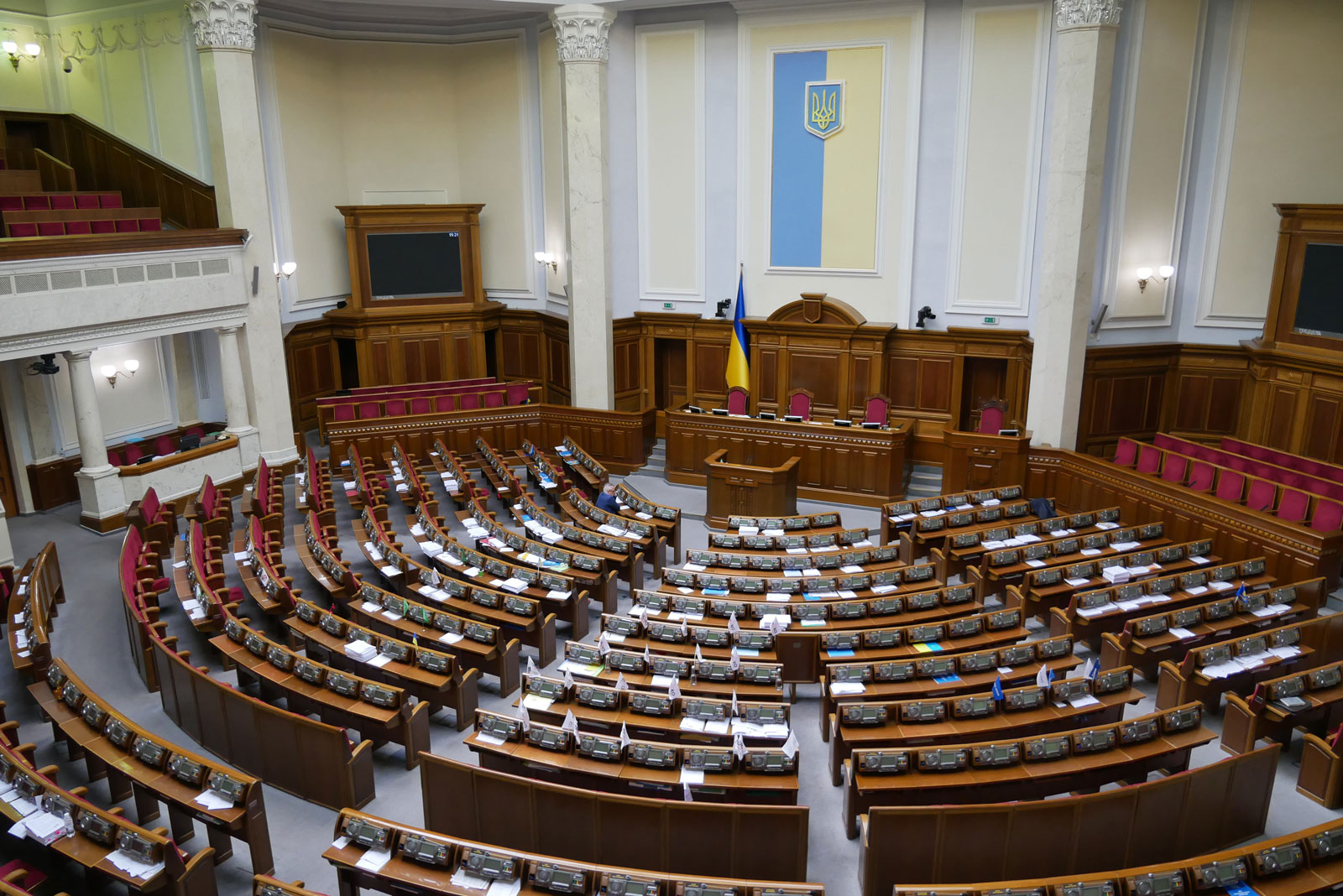
For the first time since the start of Russia's full-scale invasion in February 2022, the Ukrainian Parliament resumed live broadcasts of its sessions at the public's request. For most of their terms, the deputies worked in a semi-closed regime, but using open data from the Parliament's website, OPORA compiled statistics on the work of the Verkhovna Rada over 6 years.
During this time, the Parliament has endured a lot: the formation and gradual decline of the majority, Russia's full-scale invasion, and the flight and resignation of individual MPs. Despite this, the country's legislative body continues to function and remains a center of political discussion. OPORA processed the public information as of August 31, 2025, and prepared an analysis.

How many deputies?
The current convocation of Parliament began its work with 424 deputies out of the 450 provided for by the Constitution (with 225 deputies to be elected via party lists and 225 in majoritarian districts). The deputy composition was effectively reduced because it was impossible to hold elections in the occupied territories in parts of the Donetsk and Luhansk regions and Crimea.
The full-scale invasion has also contributed to the decreasing number of elected representatives. Firstly, due to the legal regime of martial law across the entire country, it is impossible to hold elections, including by-elections, to replace vacated seats for majoritarian deputies. Secondly, deputies elected from the lists of the banned pro-Russian party "Oppositional Platform — For Life" (“OPFL”) cannot be replaced by those next in line.
As a result, every single deputy is valuable for the Parliament's legitimacy.
Currently, the Verkhovna Rada has 396 deputies. However, the actual number of those voting is even lower, as some deputies do not attend sessions or do not participate in votes.
Despite all these circumstances, the quorum requirements for the Parliament remain unchanged. A minimum of 300 People's Deputies is required for the Verkhovna Rada to function. Should the number fall below this threshold, its work will cease. OPORA has previously written about the issue of the number of MPs.
How were the deputies' mandates terminated?
During the 6 years of the current Parliament's work, 60 deputies have left. Specifically, mandates were terminated for 12 deputies in 2022 and 18 in 2023.
The most frequent reason for deputies leaving was a personal written application to resign their mandate (44 cases). On the very first day of the Parliament's work, 5 MPs submitted such applications as they transitioned to work in the government.
Nine cases of mandate termination were due to the death of a deputy. In 2025 alone, Yaroslav Rushchyshyn ("Holos"), Serhii Shvets ("Servant of the People"), and Volodymyr Moroz (parliamentary group "Restoration of Ukraine") passed away. On August 30 of this year, Andriy Parubiy — a deputy from "European Solidarity" and Chairman of the Verkhovna Rada during 2016–2019 — was tragically killed in Lviv.
Other mandate terminations were based on constitutional provisions. Specifically, under Point 4 of Article 81 of the Basic Law, a deputy’ is stripped of their powers upon the cessation of their citizenship or permanent residence outside of Ukraine. For these reasons, mandates were terminated for deputies elected from "OPFL" (Vadym Rabinovych, Viktor Medvedchuk, Renat Kuzmin, and Taras Kozak), as well as non-factional deputy Andriy Derkach and "Servant of the People" Ihor Vasylkovskyi.
Sviatoslav Vakarchuk ("Holos") is the only deputy who ceased to be an MP due to leaving the faction of the party from which he was elected (Point 6 of Article 81 of the Constitution). At one point, Vakarchuk wanted to resign his mandate voluntarily, but the Parliament did not support his application. Therefore, the deputy used a "loophole" in the legislation and withdrew from the "Holos" faction.
How did they vote?
An exemplary deputy who had not missed a single session during the Parliament's 6-year term could have participated in 20,339 votes.
The overall voting discipline (pressing the "For," "Against," or "Abstained" buttons) has been gradually declining since January 2023. There were periodic instances where fewer than 60% of deputies participated in the voting.
Recently, about 60% of parliamentarians have been consistently voting. Ruslan Stefanchuk, the Speaker of the Parliament, noted in June of this year that approximately 340–350 MPs are actually present and voting in the session hall. In our opinion, this trend may be a consequence of the atomization of parties and the decreasing influence of the Parliament on the political process in the country, which is reflected in the motivation of individual deputies to vote.
Deputies voted the most in January 2020 (an average of 81.8% of MPs pressed the buttons), April 2020 (80.7%), and November 2019 (80.2%). However, in October 2023, an average of only 29.7% of MPs pressed the buttons.
Let's look at the participation of specufiv MPs in voting. Civil Network OPORA reminds that, according to the regulations, a deputy is obligated to participate in voting — to press one of the buttons: "For," "Against," or "Abstained." If a deputy did not vote or was absent, it indicates a lack of participation in the consideration of the issue.
The most disciplined are the representatives of "Servant of the People," Oleksandr Bakumov (participated in 99% of votes) and Heorhiy Mazurashu (participated in 98.4% of votes). Other "Servants" who voted regularly include Vladlen Nekliudov, Andriy Klochko, Dmytro Pryputen, Volodymyr Zakharchenko, Maksym Pavliuk, Oleh Koliev, Maksym Dyrdin, and "Batkivshchyna" representative Mykhailo Tsymbaliuk.
In contrast, among the least disciplined are Stepan Ivakhiv and Ihor Palytsia (parliamentary group "Party 'For the Future'"), Vadym Stolar (parliamentary group "Restoration of Ukraine"), Oleksandr Dubinskyi (non-factional), as well as former parliamentarians Vadym Rabinovych, Ihor Abramovych, Taras Kozak (elected from "OPFL"), and Andriy Derkach (self-nominated).
During the IX convocation, deputies pressed the buttons of the "Rada" voting system 5.6 million times. They most frequently voted "For" (in 42.9% of cases), and abstained in 21.6% of votes. Voting "Against" was not a very popular stance: that button was pressed in only 2.2% of instances.
If we consider the "veterans" of the Verkhovna Rada who have been working since the first day of the 9th convocation, the button "For" was pressed the most times by Heorhiy Mazurashu ("Servant of the People") — 14,039 times (69% of all the parliamentarian's votes), Mykhailo Tsymbaliuk ("Batkivshchyna") — 13,541 times (66.5%), Taras Batenko (parliamentary group "Party 'For the Future'") — 13,471 times (66.2%), and Volodymyr Areshonkov (parliamentary group "Dovira") — 13,346 times (65.6%).
If we evaluate voting "For" only by the percentage of the deputy's total votes, we will get somewhat different results: the leaders will be the MPs who were not deputies for the entire parliamentary term. For example, Anna Kovalenko ("Servant of the People"), who left in September 2019 and only managed to participate in 196 votes, supported draft laws most often (supporting decisions in 91.3% of cases). Serhiy Melnik ("Servant of the People"), who became an MP in April 2025, voted "For" in 81.5% of cases. Serhiy Kozyr ("Servant of the People," MP since November 2021) — in 73.5%.
Interestingly, the main "oppositionists" (those who voted "Against" the most times) were representatives of "Servant of the People": Roman Kaptielov — 22.2%, Ihor Nehulevskyi — 15.5%, Serhiy Shvets (who died in May 2025) — 14%, and Halyna Tretiakova — 13.4%.
What did they support?
The Parliament of the IX convocation considered 13,965 draft laws and resolutions. The greatest share of these (87.8%) were initiated by people's deputies. The Cabinet of Ministers submitted 9.3% of the drafts, and the President — 2.9%.
A total of 8,513 draft laws were considered, of which 1,646, or 19.3%, became laws (signed by the President). Almost a quarter of all adopted laws concern economic policy (24.4% of the total number). Sectoral development accounts for 21.7% of signed laws, and legal policy for 16.1%. The least "popular" is humanitarian policy (3% of signed draft laws).
255 initiatives of the President, 1,001 from people's deputies, and 390 from the Government became laws. The President most frequently initiated multilateral and bilateral international agreements (56.8% of adopted laws from his initiative) and draft laws in the sphere of security and defence (18%).
The greatest support throughout the entire period (more than 90% "For" votes) was given to three resolutions dated August 29, 2019, on the Parliament's first day of work: regarding the election of the Provisional Presidium of the first session of the Verkhovna Rada of the IX convocation, the Counting Commission of the Verkhovna Rada of the IX convocation, and the Chairman of the Verkhovna Rada of Ukraine (Dmytro Razumkov was elected then).
Among the laws voted on, the greatest support was received for the amendments to the Tax Code regarding the liquidation of the corruption scheme in the sphere of registering information from real estate appraisal reports and the transparency of asset realization (89% "For" votes), for the extension of martial law in April 2025 (89%), for the amendments to the Forest Code regarding the national inventory of forests (88%), and for the lifting of immunity for People's Deputies of Ukraine (88%). Also, 83.4% of the People's Deputies supported the presidential draft law on restoring the powers of the National Anti-Corruption Bureau of Ukraine (NABU) and Specialized Anti-Corruption Prosecutor’s Office (SAPO), which was a reaction to the limitation of the independence of anti-corruption bodies by Law No. 12414.
Conversely, at the beginning of their term, parliamentarians rejected Presidential Draft Law No. 1014 of August 29, 2019, which proposed to assign the powers to create independent regulatory bodies and the NABU, as well as to appoint and dismiss the Director of NABU and the Director of the SBI (State Bureau of Investigation), to the Head of State.
(Non)talkative MPs
Over the 6 years, deputies collectively "spoke" for 887 hours, 55 minutes, and 24 seconds, or about 37 days. However, this figure is unevenly distributed among the MPs.
The longest speakers were Dmytro Razumkov (non-factional, former Chairman of the Verkhovna Rada), Oleksii Honcharenko ("European Solidarity"), Yulia Tymoshenko ("Batkivshchyna"), Nina Yuzhanina ("European Solidarity"), and Iryna Herashchenko ("European Solidarity"). In addition, Mykhailo Tsymbaliuk ("Batkivshchyna"), Ruslan Stefanchuk (non-factional, Chairman of the Verkhovna Rada), and Nestor Shufrych (Parliamentary Group "Platform for Life and Peace") spoke somewhat less.
The significant number of speeches by Dmytro Razumkov (taking the floor 2,318 times) and Ruslan Stefanchuk (2,136) is explained by their tenure as Chairman of the Verkhovna Rada. If we consider "ordinary" deputies, the leaders here are Oleksii Honcharenko (1,249 speeches), Nina Yuzhanina (1,045), and Nestor Shufrych (995).
However, there are also 27 MPs who have not spoken at all. Among them are those who did not have the opportunity because they immediately resigned their mandates and moved to government positions. These include Mykhailo Fedorov (Minister of Digital Transformation), Denys Maliuska (former Minister of Justice), Hanna Novosad (former Minister of Education and Science), Oleksiy Orzhel (former Minister of Energy and Environmental Protection), and Vladyslav Kryklii (former Minister of Infrastructure). Of these, only Fedorov retained his position and even received a promotion, becoming First Vice Prime Minister — Minister of Digital Transformation.
Among the current deputies who have not spoken, we can highlight Vasyl Virastiuk ("Servant of the People"), Serhiy Lyovochkin (Parliamentary Group "Platform for Life and Peace," formerly Head of the Administration of President of Ukraine Viktor Yanukovych), Vadym Stolar (Parliamentary Group "Restoration of Ukraine"), and Stepan Ivakhiv (Parliamentary Group "Party 'For the Future'").
If we consider the shortest speeches over 6 years, they are a 4-second speech by Mykola Kyrychenko ("Servant of the People") in February 2020 and a 6-second speech by non-factional Viktor Baloha.
Ultimately, the statistics of 6 years of work by the Verkhovna Rada of the 9th convocation demonstrate how the Parliament has changed over time and the challenges it faces. These include the reduction in the number of MPs, decreased voting discipline, and so on. In the context of war and new security realities, the Verkhovna Rada's ability to strengthen its institutional capacity and increase effectiveness is one of the key challenges for the resilience of Ukrainian democracy on the path toward European integration.
Source: ESPRESO.TV